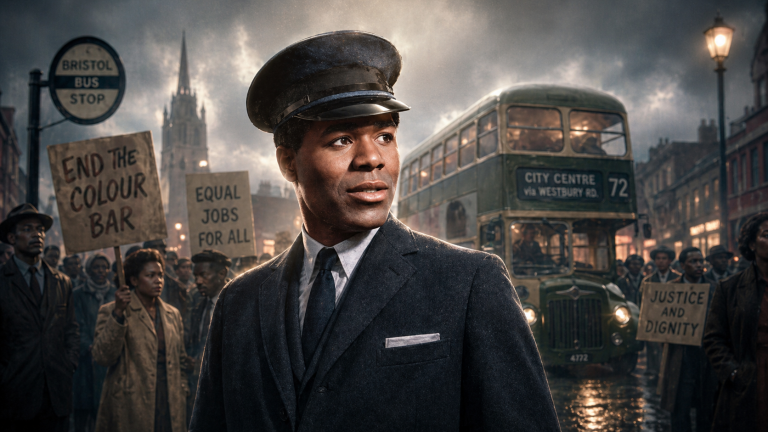

The arrival of the Empire Windrush at Tilbury on 22 June 1948 stands as a defining moment in modern British history. The passengers aboard, alongside the broader wave of post-war migration from the Caribbean, played a crucial role in transforming Britain’s social, cultural, political, and economic landscape. However, Windrush did not mark the beginning of Black history in Britain, nor did it initiate Black settlement, family life, labor, military service, artistic achievement, or political participation.
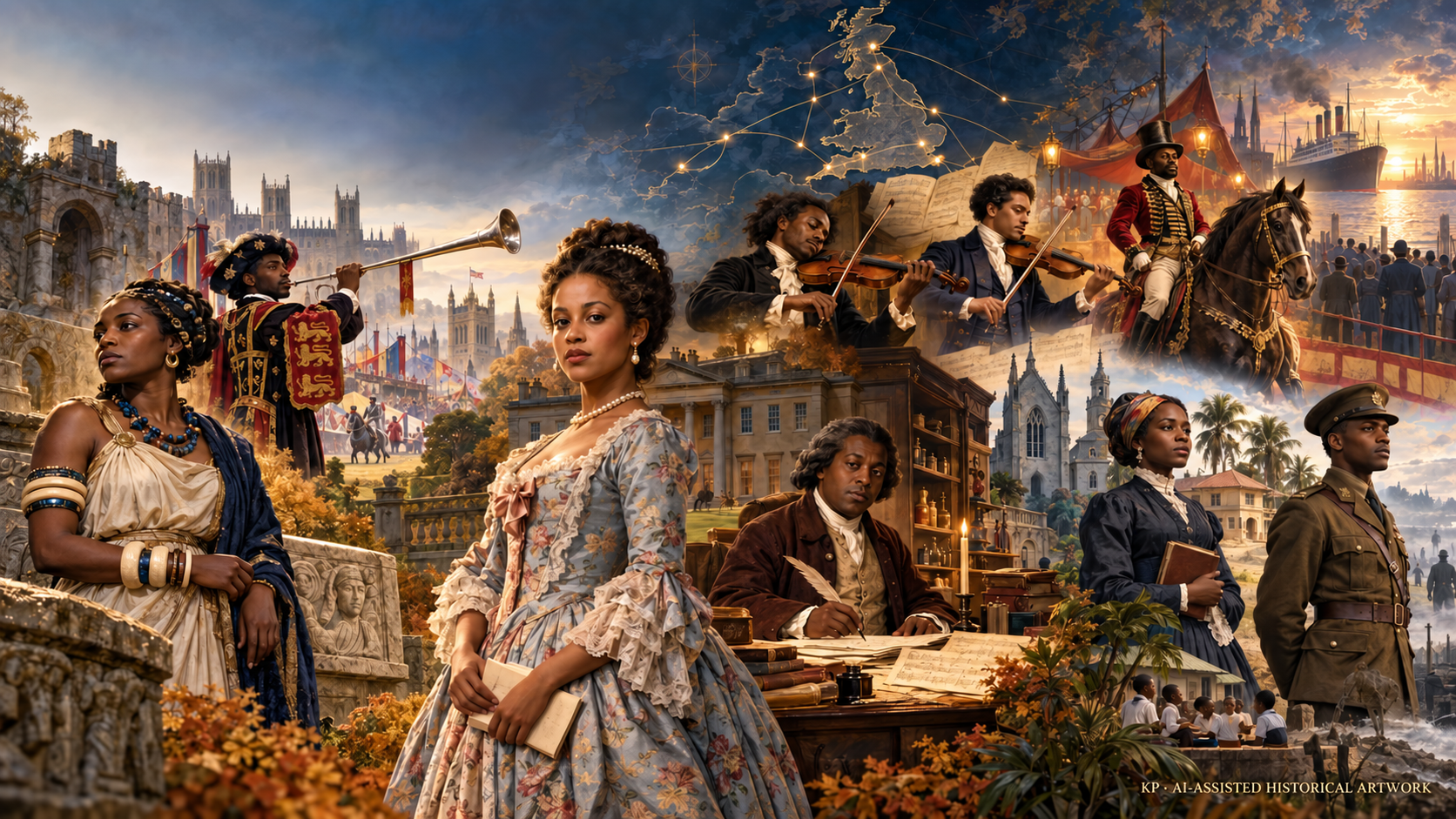
People of African descent have lived in Britain for centuries before 1948. Their presence is documented in Roman archaeological sites, Tudor court records, Georgian London, Victorian popular culture, and the armed forces during both World Wars. Some arrived through military, maritime, or commercial networks; some were brought in bondage; and others were born in Britain. Their experiences defy a single narrative of exclusion or acceptance, reflecting diverse social roles—including servants, sailors, shopkeepers, musicians, soldiers, writers, entrepreneurs, courtiers, and members of established British families.
It should be noted that the term “Black” is a modern political and cultural identity and should not be uncritically applied to people from earlier centuries. In this article, the term refers to people of African descent, African heritage, or African-associated identity in Britain, while recognizing that contemporary language was often racialized, inconsistent, and dehumanizing.
Before 1948: a longer history
Long before the twentieth century, Black people lived in Britain and played active roles in both world wars. During the First World War, individuals from across the British Empire served in the armed forces and supported war industries. Caribbean, African, and other colonial troops and laborers made vital contributions both on land and at sea, frequently serving in segregated units and facing unequal conditions. The British West Indies Regiment, the King’s African Rifles, and other military forces were integral to this broader wartime story.
In the Second World War, thousands of Caribbean people traveled to Britain to serve in the armed forces or to perform crucial civilian work. They joined the Royal Air Force, the Army, and the Royal Navy, and contributed in factories, hospitals, transportation, civil defense, and air-raid precautions. Notably, Jamaican-born RAF volunteer Billy Strachan flew operational missions over Europe and later emerged as a significant communist and anti-colonial activist in Britain.
Black British communities did not begin with the post-war generation. The Windrush era is part of a much longer narrative of migration, settlement, and resilience.
In eighteenth-century Britain, contemporary estimates suggested as many as 20,000 Black people lived in London in 1764, though this figure was not based on a formal census. Modern historians estimate that at least 10,000 Black people may have lived in London during the later eighteenth century, with several thousand more in other parts of Britain. While the precise numbers remain uncertain, Black communities and individuals were clearly visible in London, port cities, and towns across the country.
Roman Britain and early evidence
The Ivory Bangle Lady
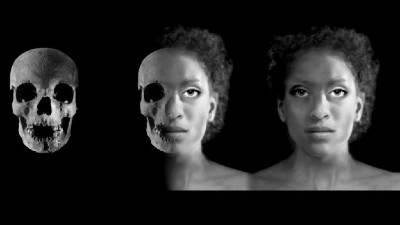
The “Ivory Bangle Lady” was a young woman buried in a stone coffin at Sycamore Terrace, York, in the late fourth century CE. Her grave, excavated in 1901, contained striking objects including ivory bangles, jet jewelry, glass beads, pendants, earrings, a glass flask, and a mirror. These possessions indicate substantial status and access to long-distance trade networks in Roman Britain.
Scientific research indicates she was between eighteen and twenty-three years old at the time of her death. Analysis of her skeletal features suggests mixed ancestry, potentially including North African heritage. Isotope evidence shows she spent her childhood in western Britain or in western Europe and the Mediterranean, rather than in Africa. The evidence points to a high-status woman in Roman York with possible North African and mixed ancestry, highlighting the diversity present in Britain during this period.
A bone plaque from the burial bears the inscription Soror ave vivas in Deo—“Hail, sister; may you live in God.” It is often understood as evidence of Christian belief or Christian association in late Roman York.
However, even before Roman times, Black people seem to have been the first people to live in Britain; before the Celts!
Cheddar Man
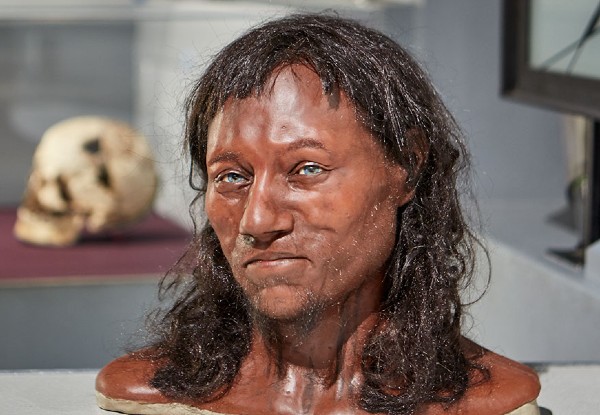
Cheddar Man, discovered in Gough’s Cave, Somerset, in 1903, lived approximately 10,000 years ago during Mesolithic Britain. Ancient DNA analysis reveals that he likely had dark to black skin, blue or green eyes, and dark hair. He was part of a group now known as western European Mesolithic hunter-gatherers, reflecting the rich genetic diversity of early Britain.
This discovery is significant because it overturns the assumption that Britain’s earliest inhabitants resembled the lighter-skinned populations of later northern Europe. While all modern humans ultimately trace their origins to Africa, Cheddar Man was part of a population that had lived in prehistoric western Europe for thousands of years, highlighting the longstanding diversity present in Britain’s earliest history.
Ten historical figures
1. John Blanke
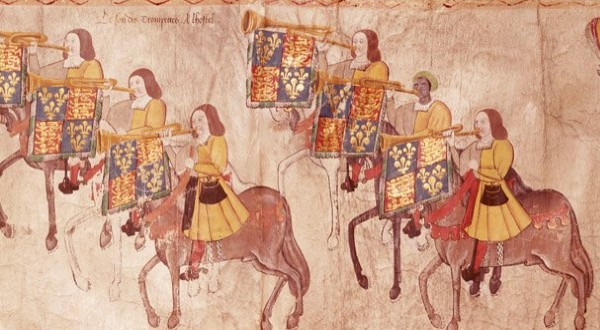
John Blanke served as a royal trumpeter at the courts of Henry VII and Henry VIII, making him one of the earliest recorded Black individuals in Tudor England. Historical records show that “John Blanke the Blacke Trumpet” received wages from the royal household starting in 1507. Notably, he successfully petitioned Henry VIII for a pay increase, doubling his daily wages from 8 pence to 16 pence.
Blanke is widely believed to be the Black trumpeter depicted twice on the Westminster Tournament Roll of 1511, a document created to celebrate the birth of Henry VIII and Catherine of Aragon’s son, Prince Henry. While this identification is compelling, it is not definitive and rests on a correlation between court payment records and visual evidence. Regardless, the Tournament Roll stands as one of the most striking surviving representations of Black presence at the Tudor court.
John Blanke’s story highlights that Black people in Tudor England were more than visitors or curiosities. They could be skilled professionals in royal service, earn wages, petition the monarch, and take visible part in courtly ceremonies.
2. Joseph Antonio Emidy
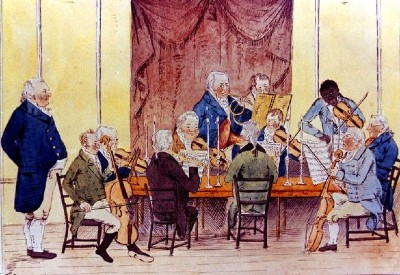
Joseph Antonio Emidy (c. 1775–23 April 1835) was an Afro-Portuguese violinist, composer, teacher and instrument repairer who became one of the most prominent musical figures in early nineteenth-century Cornwall. He is increasingly recognised as one of Britain’s earliest known composers of African descent: a major Black Atlantic musician whose compositions have not survived, but whose remarkable career can be partially reconstructed from newspapers, family memorials, naval records and the recollections of former pupils.
Emidy’s origins remain contested. The traditional account holds that he was born in Guinea, captured as a child, trafficked by Portuguese enslavers to Brazil and later taken to Lisbon, where he became a violinist at the opera. More recent scholarship notes that his headstone describes him as “a native of Portugal” and argues that he may have been born or raised in Lisbon’s large Afro-Portuguese community. In 1795, he was forcibly taken into British naval service after officers from HMS Indefatigable, commanded by Sir Edward Pellew, heard him perform in Lisbon. Though long believed to have been left at Falmouth in 1799, naval records suggest that he may have remained in service until 1802.
By 1802, Emidy had entered Cornwall’s professional musical life. He taught violin, piano, cello, clarinet and flute; worked as an instrument repairer; performed widely; and eventually led the Truro Philharmonic Society. He is credited with symphonies, violin concertos and smaller pieces, none of which is known to survive. In 1802, he married Jenefer Hutchins, and they had eight children. Emidy died in Truro on 23 April 1835 and was buried in Kenwyn Churchyard. His story reminds us that Black cultural history in Britain is not confined to London or to the twentieth century.
3. Pablo Fanque
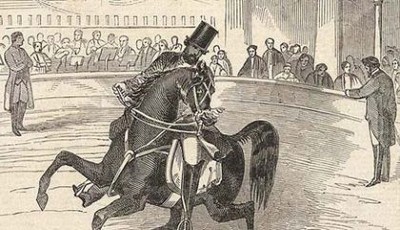
Pablo Fanque (1810–1871), born William Darby in Norwich on 30 March 1810, became Britain’s first Black circus owner. An accomplished acrobat, equestrian performer, and circus proprietor, Fanque is widely recognized as the first recorded Black British circus owner and ranks among the most successful traveling entertainers of the Victorian era.
Darby’s early life began in St Andrew’s Workhouse, Norwich, before he entered the circus world as an apprentice to the renowned proprietor William Batty. First performing as “Young Darby,” he later adopted the stage name Pablo Fanque. His repertoire featured horsemanship, rope-walking, acrobatics, and the corde volante (aerial rope).
In the early 1840s, Fanque established his own traveling company, Circus Royal, which toured extensively across England, Scotland, and Ireland. He quickly became a familiar and celebrated figure among Victorian audiences. However, his career was marked by tragedy: in 1848, his wife, Susannah Darby, was killed when a circus building collapsed in Leeds.
Fanque’s legacy lives on in popular culture, most notably through the Beatles. John Lennon based the lyrics of “Being for the Benefit of Mr. Kite!” from the album Sgt. Pepper’s Lonely Hearts Club Band on an 1843 Pablo Fanque circus poster. The song’s reference to “Pablo Fanque’s Fair” helps keep the name of this nineteenth-century Black British showman known to audiences worldwide.
4. George Bridgetower
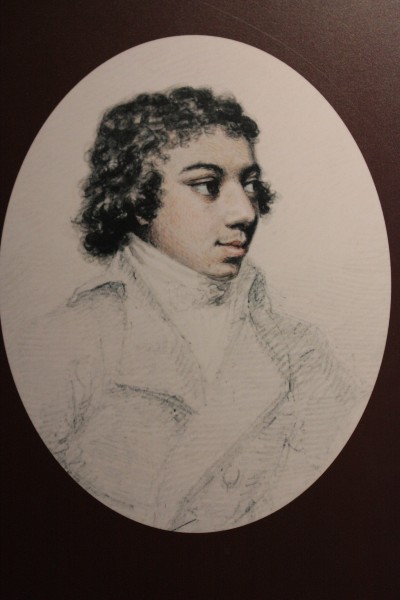
George Augustus Polgreen Bridgetower was a violin virtuoso, composer, and educator of African and European descent. Born in 1778, 1779, or 1780—most likely in present-day Poland—to an African father and a Polish mother, his precise origins remain uncertain.
Displaying remarkable musical talent from an early age, Bridgetower performed in Paris at just nine years old. He later settled in London, where he attracted the patronage of the Prince of Wales, the future George IV. Bridgetower played in London theatres and was appointed first violinist in the Prince’s private orchestra.
In 1803, while on a concert tour in Vienna, Bridgetower met Ludwig van Beethoven. Impressed by his artistry, Beethoven composed a violin sonata for them to perform together. The work was originally dedicated to Bridgetower; however, following a dispute, Beethoven withdrew the dedication in favor of the violinist Rodolphe Kreutzer, who is believed never to have performed the piece. Today, it is known as Beethoven’s Kreutzer Sonata.
Bridgetower later received a Bachelor of Music degree from the University of Cambridge in 1811 and continued performing and teaching for many years. He died in Peckham, London, in 1860. Bridgetower’s legacy deserves recognition in the history of European classical music—not merely as a footnote to Beethoven, but as a gifted Black musician whose artistry helped inspire one of Beethoven’s greatest violin sonatas.
5. Sarah Forbes Bonetta Davies
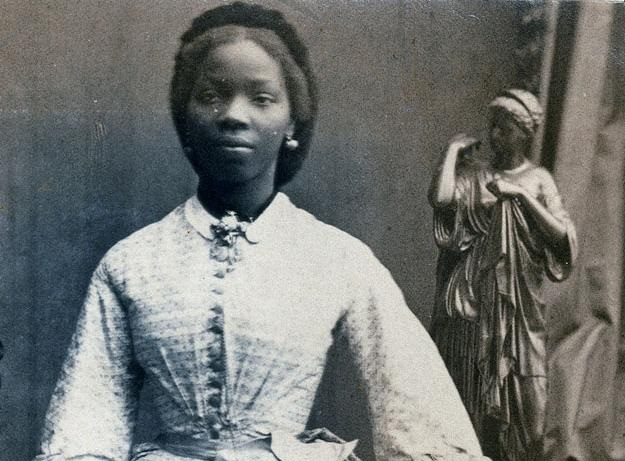
Sarah Forbes Bonetta Davies, born Omoba Aina around 1843, was a Yewa Yoruba woman, born into a royal family from present-day southwestern Nigeria. Captured as a child during a Dahomean attack in 1848, she lost her parents and was held at King Ghezo’s court before being brought to Britain aboard HMS Bonetta. She was baptized and renamed Sarah Forbes Bonetta, yet continued to identify as Ina.
Presented to Queen Victoria in 1850, Sarah impressed the monarch and became her ward, popularly known as her goddaughter. She was educated in Britain and Sierra Leone, where she learned languages and music. Her place in the royal household brought opportunity, but also made her a symbol in Victorian debates about race.
In 1862, Sarah married Captain James Pinson Labulo Davies, a wealthy Yoruba merchant, in Brighton. She signed the marriage register as “Ina Sarah Forbes Bonetta.” The couple lived in Freetown and later Lagos, where Sarah became an educator and eventually Acting Principal at the Annie Walsh Memorial School. They had three children, including Victoria Matilda Davies, whose godmother was Queen Victoria.
Sarah died of tuberculosis in Madeira on 15 August 1880, aged about thirty-seven, and was buried there. Her husband memorialized her with a granite obelisk in Lagos. Her legacy extends beyond a sentimental “African princess” story, to Yoruba survival, African women’s education, Black presence in Victorian Britain and the enduring family networks of nineteenth-century West Africa.
6. Walter Tull
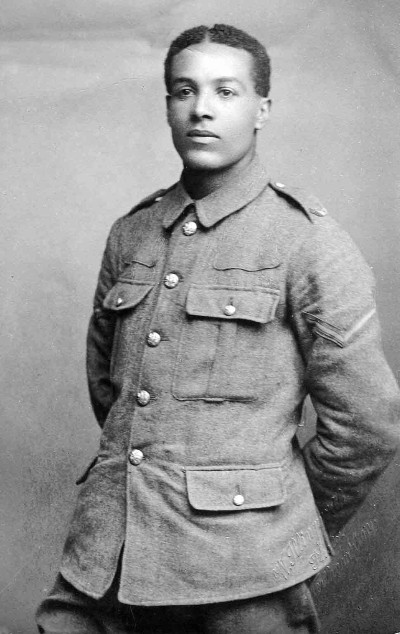
Walter Daniel John Tull was born in Folkestone, Kent, on 28 April 1888. His father, Daniel Tull, hailed from Barbados, while his mother, Alice Palmer, was from Kent. After losing both parents, Walter and his brother Edward spent part of their childhood in a Methodist orphanage in Bethnal Green, London.
Tull rose to prominence as a professional footballer, playing for Clapton, Tottenham Hotspur, and Northampton Town. As one of the earliest Black professional footballers in Britain, he faced persistent racist abuse from both spectators and journalists.
In December 1914, Tull joined the Middlesex Regiment’s Footballers’ Battalion. He served in France, fought on the Somme, and in May 1917 was commissioned as a second lieutenant—making him one of the first Black officers in the British Army, a remarkable achievement in a military institution shaped by racial prejudice.
Tull later served on the Italian Front before returning to France in 1918. He was killed by machine-gun fire near Favreuil on 25 March 1918, at the age of twenty-nine. His body was never recovered, but he is commemorated on the Arras Memorial.
7. Cesar Picton
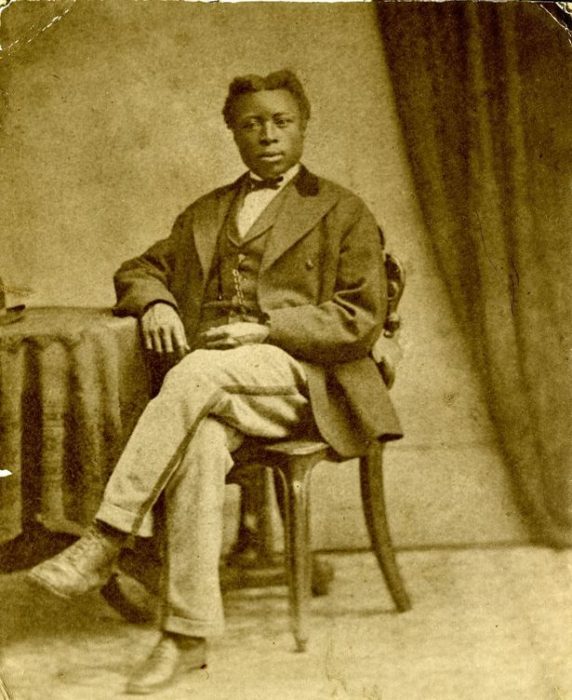
Cesar Picton was a successful coal merchant and property owner linked to Kingston upon Thames and Thames Ditton. Likely born in West Africa around 1755, he arrived in Britain as a child in 1761, his journey shaped by the realities of the transatlantic trafficking and British imperialism.
Picton was brought to the household of John Philipps and Elizabeth Philipps at Picton Castle in Pembrokeshire. He was baptized, educated, and raised within the family. After Elizabeth Philipps’s death, Picton inherited funds that enabled him to establish himself in business. He became a coal merchant in Kingston and gradually amassed significant property. By the time of his death in 1836, he left behind a house, land, a wharf, shops, and other assets. A contemporary will described him as “Caesar Picton of Tullworth, gentleman.”
Picton’s life challenges the misconception that all Black people in Georgian Britain shared the same economic or social status. While his prosperity was exceptional, it demonstrates the range of Black experiences in eighteenth- and early nineteenth-century Britain.
8. Ignatius Sancho
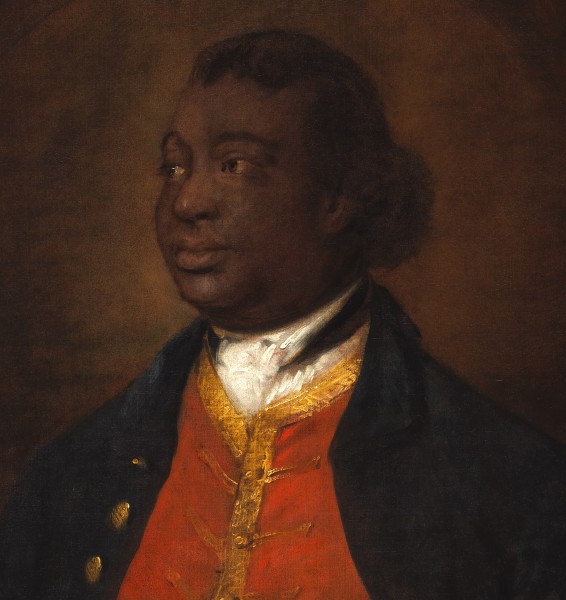
Ignatius Sancho (c. 1729–1780) was a writer, composer, shopkeeper, and prominent critic of the Maafa. Born on a transatlantic ship and spending his early years in Grenada, he was brought to England as a child. Settling in Greenwich and later Westminster, Sancho became one of the most renowned Black intellectuals in eighteenth-century Britain.
With the encouragement of John, the second Duke of Montagu, Sancho educated himself and later served the Montagu family. He composed music, wrote influential letters, actively engaged in literary and political circles, and gained wide respect in London society.
In 1774, Sancho and his wife, Anne Osborne, opened a grocery shop on Charles Street, Westminster. Meeting the property qualification, Sancho voted in the parliamentary elections of 1774 and 1780—making him the first known person of African descent to vote in a British parliamentary election.
His letters were published posthumously in 1782 as The Letters of the Late Ignatius Sancho, an African. The collection was widely read and significantly shaped debates about slavery, African humanity, and British morality. Sancho’s legacy lies not only in his “firsts” but also in the breadth and quality of his intellectual, musical, and political contributions.
9. Francis Barber
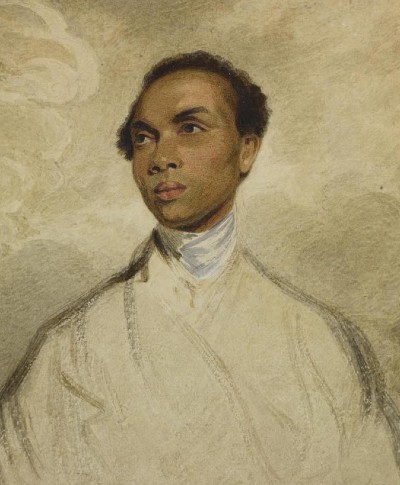
Francis Barber, born around 1735 and dying in 1801, is best known as the friend, servant, secretary, and principal heir of the writer Samuel Johnson. He was born in captivity in Jamaica, and Richard Bathurst brought him to England. After Bathurst’s death, Barber was left £12 and his freedom.
Barber entered Samuel Johnson’s household and remained closely connected to him for much of his life. His relationship with Johnson was not simply one of servitude: he was a trusted companion, household manager, assistant, and confidant. Johnson supported Barber’s education and, when Barber joined the Royal Navy, used his influence to help secure his discharge.
When Johnson died in 1784, Barber inherited a substantial share of his estate, including an annual income, books and personal possessions. He and his wife, Elizabeth Ball, moved to Lichfield, Staffordshire, where they had children and lived with a degree of security unusual for a Black family in eighteenth-century England.
Some claim that Barber became Britain’s first Black schoolmaster. He is known to have attempted to run a school at Burntwood, near Lichfield. More securely, he should be remembered as an educated Black man whose life was deeply interwoven with one of Britain’s eighteenth-century literary figures.
10. Dido Elizabeth Belle
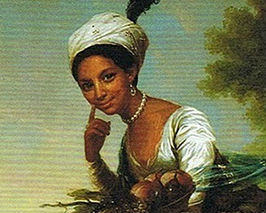
Dido Elizabeth Belle (1761–July 1804) was raised in an aristocratic household in Georgian Britain at the height of the Maafa—the Atlantic system of trafficking, captivity, and racial capitalism. The daughter of Maria Bell, an African woman enslaved in the Caribbean, and Captain John Lindsay, a British naval officer, Dido was brought to England by her father in or before 1766. Lindsay entrusted her care to his uncle, William Murray, first Earl of Mansfield, and Lady Elizabeth Murray, at Kenwood House, Hampstead. There, Dido grew up alongside her cousin Elizabeth Murray, spending about thirty years within the Mansfield household.
Although the surviving record is limited, it shows that Dido was well educated, received an annual allowance, and was treated in many ways as a member of the Mansfield family. Contemporary visitors noted her close relationship with Lord Mansfield, who often sought her company and praised her handwriting. Dido is also believed to have assisted with household correspondence.
As Lord Chief Justice, Mansfield presided over the landmark 1772 case of Somerset v Stewart, ruling that James Somerset could not be forcibly seized in England and transported overseas for sale. He declared that captivity was “so odious” it could only be supported by “positive law.” This decision was widely seen as a major setback for the legal foundations of the slave tradein England. While some have speculated that Mansfield’s bond with Dido may have influenced his legal outlook, no evidence confirms a direct connection.
In his will, written in 1782 and proved after his death in 1793, Lord Mansfield confirmed Dido’s freedom and left her £500 and a £100 annuity. In December 1793, she married John Davinier, a French steward, and they had three sons: Charles, John, and William. Dido died in July 1804, aged forty-three. Her life provides a compelling lens on race, law, kinship, inheritance, and status in eighteenth-century Britain: she was raised in aristocratic privilege, yet her story remained deeply entwined with the Atlantic system of captivity that underpinned Britain’s wealth.
Why this history matters
The history of Black Britain before Windrush is not a footnote to the nation’s past—it is an integral part of British history itself.
These stories reveal that Black people were present in Britain across centuries and regions—from York and Sussex to London, Greenwich, Norwich, Cornwall, Brighton, Folkestone, Kingston upon Thames, Lichfield, and beyond. Their lives intersected with the Roman Empire, the Maafa, colonial warfare, court life, music, literature, sport, commerce, migration, and anti-slavery activism.
Sources:
Black and British: A Forgotten History by David Olusoga
Blackamoores: Africans in Tudor England by Onyeka Black; Tudors: The Untold Story by Miranda Kaufmann Staying Power: The History of Black People in Britain by Peter Fryer Black and British: A Forgotten History by David Olusoga
https://www.npg.org.uk/schools-hub/history-explainer-who-was-john-blanke
https://research.gold.ac.uk/id/eprint/35395
https://www.cornwallheritagetrust.org/commemorative_plaque/joseph-emidy/
https://archives.shef.ac.uk/agents/people/299
https://www.english-heritage.org.uk/visit/places/osborne/history-and-stories/sarah-forbes-bonetta
https://brightonmuseums.org.uk/discovery/history-stories/african-princess-and-queen-victorias-goddaughter-sarah-forbes-bonetta-1843-1880/
https://www.nam.ac.uk/schools/learning-resources/walter-tull-soldiers-story
https://www.cwgc.org/stories/stories/second-lieutenant-walter-daniel-john-tull
https://www.english-heritage.org.uk/visit/places/portchester-castle/history-and-stories/black-people-in-late-18th-century-britain
https://www.english-heritage.org.uk/learn/histories/women-in-history/dido-belle
https://www.english-heritage.org.uk/visit/places/kenwood/history-stories-kenwood/somerset-case
https://www.nhm.ac.uk/our-science/research/projects/human-adaptation-diet-disease/cheddar-man-faq.html
https://www.nhm.ac.uk/discover/cheddar-man-mesolithic-britain-blue-eyed-boy.html
https://www.nhm.ac.uk/discover/news/2025/december/the-changing-story-beachy-head-woman.html
https://www.yorkmuseumstrust.org.uk/blog/ivory-bangle-lady-looking-back-and-to-the-future/
https://www.ourmigrationstory.org.uk/oms/roman-britain-the-ivory-bangle-lady