
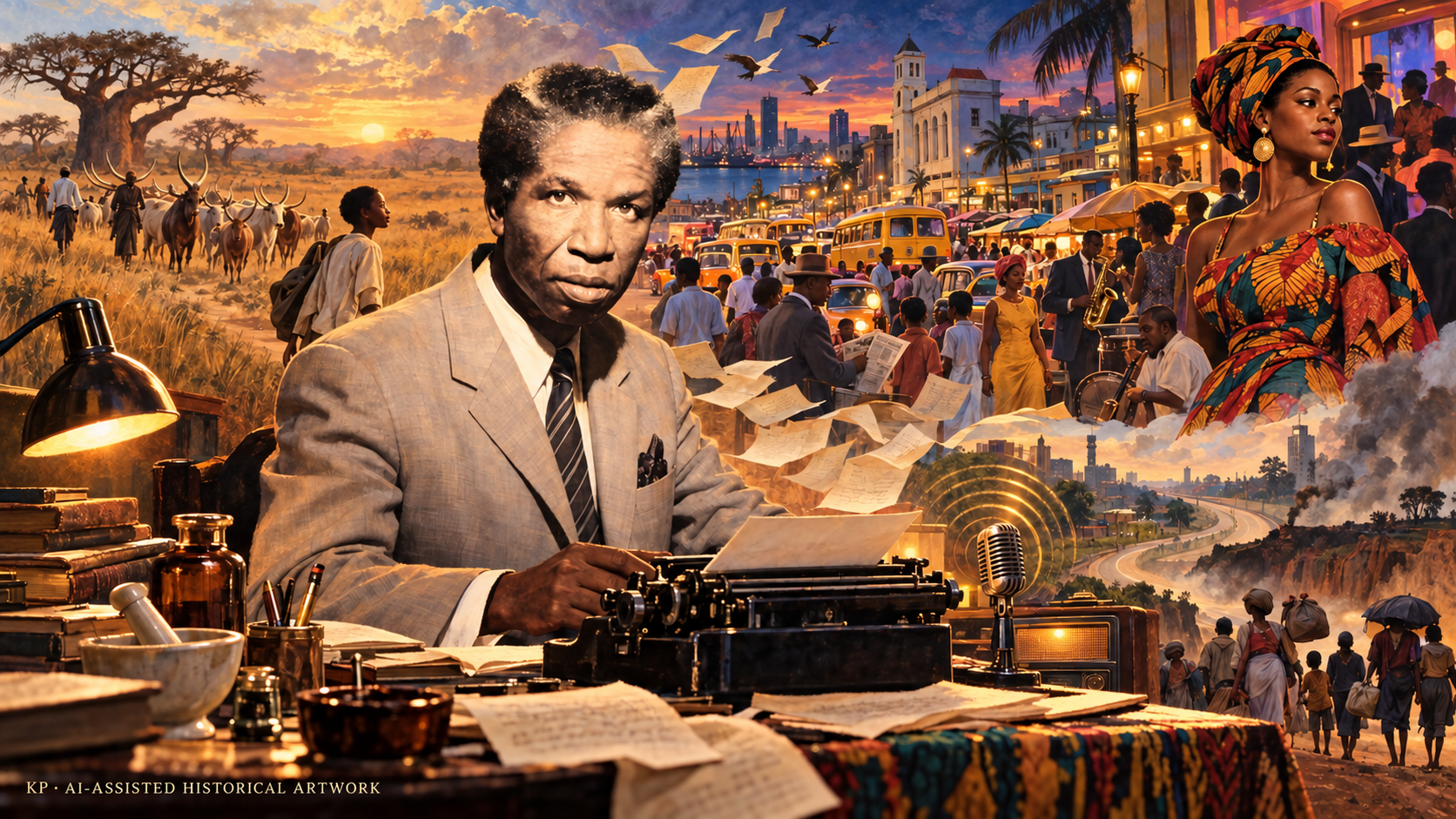
Cyprian Ekwensi was a pioneering Nigerian author, pharmacist, broadcaster, and public servant. Widely regarded as a chronicler of Nigerian city life and a foundational figure in modern African literature, he published over 40 books, along with numerous short stories, radio plays, and screenplays throughout his long career, including celebrated works like Jagua Nana and The Drummer Boy.
Chief Cyprian Odiatu Duaka Ekwensi was born on 26 September 1921 in Minna, in present-day Niger State, northern Nigeria, into an Igbo family whose ancestral home was Nkwelle Ezunaka in Anambra State. His life, like his fiction, moved across regional and cultural boundaries. Though Igbo by heritage, he was born in the north, educated in the west and east of Nigeria, studied in Ghana and Britain, and later made Lagos one of the central imaginative landscapes of African literature. This breadth of experience gave his writing a distinctly national—and often Pan-African—range.
Ekwensi’s earliest literary influence came from his father, David Anadumaka, a carpenter, elephant hunter, and gifted storyteller. The elder Ekwensi’s tales helped foster in his son a lasting interest in narrative, adventure, and the oral traditions through which communities preserved memory and meaning. For Cyprian Ekwensi, storytelling was never merely an ornament of culture; it was a living way to observe society, entertain ordinary readers, and reveal the pressures shaping human lives.
His education was equally varied. He attended Government College, Ibadan, and Government College, Umuahia, as well as Achimota College in Ghana. At Ibadan, he immersed himself in Yoruba culture and developed the broad social curiosity that later distinguished his work. He subsequently studied forestry at Ibadan, trained in pharmacy at Yaba Technical Institute and the Lagos School of Pharmacy, and won a scholarship to the Chelsea School of Pharmacy at the University of London. These movements through Nigeria, West Africa, and Britain exposed him to contrasting languages, customs, landscapes, and social worlds—materials he would later transform into fiction.
From Forest Officer to Writer
Before he became widely known as a novelist, Ekwensi worked as a forestry officer in northern Nigeria between 1945 and 1947. His duties took him into the savannah and riverine areas where tsetse flies were being controlled, and the isolation of this work gave him time to write. In those forests, he began composing adventure tales that drew on Igbo storytelling traditions and his own observational gifts. The resulting collection, Ikolo the Wrestler and Other Ibo Tales, appeared in 1947. Lutterworth Press also published five of his short works in England that year as part of its African new-writing series.
His contact with Fulani cattle herders during these forestry years also proved enduringly important. It later informed Burning Grass (1961/62), one of his best-loved books, which portrays the movement, hardship, and emotional world of nomadic Fulani life. In this respect, Ekwensi was never solely a writer of Lagos. His work also carried the marks of northern Nigerian landscapes, village ethics, migration, and the country’s interwoven cultural worlds.
By the late 1940s, he had begun publishing popular novellas for a broad reading public. When Love Whispers, issued in 1947 or 1948, became a significant early work in the development of Onitsha Market literature, inexpensive, accessible booklets circulated through Nigeria’s bustling commercial networks. Its romantic and sexually candid subject matter made it especially popular with younger readers and controversial among religious authorities; copies were reportedly banned in some convent schools. Ekwensi also produced works such as An African Night’s Entertainment (1948), The Boa Suitor (1949), The Leopard’s Claw (1950), and The Passport of Mallam Ilia, displaying an early commitment to pace, drama, and popular accessibility.
Lagos Life in the Raw
Ekwensi’s decisive contribution was his fictional rendering of the modern African city. In 1949, he began reading short stories weekly on Radio Nigeria while also writing for Lagos newspapers and magazines. Living in Ebute Metta on the Lagos mainland, he absorbed the metropolis at street level: its musicians, traders, journalists, performers, hustlers, lovers, politicians, and people struggling to make a livelihood amid the city’s promise and disorder.
Those radio stories became the foundation of People of the City (1954), one of the earliest Nigerian novels to achieve international recognition and to be published in Britain. The novel follows a crime reporter and bandleader, using music, journalism, romance, corruption, and urban spectacle to create a vivid portrait of Lagos. Ekwensi reportedly compiled and expanded the manuscript during a thirteen-day sea voyage from Apapa to Liverpool, when he traveled to Britain to continue his pharmacy studies. Originally titled Lajide of Lagos, the work announced him as a writer able to capture the restless movement of a new urban Africa.
His greatest popular and critical success came with Jagua Nana (1961), the story of Jagua, an ambitious Lagos woman and sex worker navigating love, class aspiration, political influence, fashion, and the city’s shifting moral codes. The novel provoked controversy, including criticism from churches and exclusion from some schools, yet it also secured Ekwensi’s standing as an original voice in African literature. It won him the Dag Hammarskjöld International Prize in Literature in 1968. Jagua’s forcefulness and contradictions made her a memorable literary figure: she is neither reduced to a moral warning nor idealized, but presented as a person struggling for agency within a society structured by money, gendered vulnerability, and ambition.
Ekwensi’s city fiction was often judged against the more formally experimental work of writers such as Chinua Achebe and Wole Soyinka. Some critics dismissed his fast-moving plots as sensational or insufficiently literary. Yet this criticism overlooks the deliberate character of his project. Ekwensi described himself as a “writer for the masses,” interested less in stylistic display than in reaching “the heart of the truth which the man in the street can recognize.” He believed that a creative writer should show people themselves, enabling a society to confront its own truths and adjust its values.
That conviction explains both his accessibility and his enduring importance. Ekwensi wrote not from a detached distance but from the crowded streets and everyday moral dramas of modern life. His protagonists included market women, musicians, children, sex workers, refugees, officials, students, and people whose lives were often overlooked in more elevated narratives of nationhood. His stories explored the contrast between village values—respect for elders, care for children, and communal obligations—and the material pressures of urban life, where money could seem to displace every other ethical measure.
Broad Public Service and War
Ekwensi’s working life was as varied as his literary output. He served as a science teacher, teaching English, chemistry, biology, and pharmacology; he worked in pharmacy, including at Oldchurch Hospital in Romford, Essex; and, after returning to Nigeria in 1956, he lectured briefly in pharmacology. His growing career in broadcasting eventually led to his role as Head of Features at the Nigerian Broadcasting Corporation and later to his appointment as Director of Information in Nigeria’s Ministry of Information during the First Republic.
The political crisis of 1966 transformed his life. In the atmosphere of ethnic violence following the military coups and the assassination of Major General Johnson Aguiyi-Ironsi, Ekwensi saw Igbo neighbors disappear in night-time abductions and killings. He resigned as Director of Information and fled Lagos with his family to Enugu. During the Nigerian Civil War, from 1967 to 1970, he advised Chukwuemeka Odumegwu Ojukwu and chaired Biafra’s Bureau for External Publicity. In this role, he addressed international journalists and sought to publicize the suffering created by war, blockade, displacement, and famine.
The end of the war brought another period of hardship. After losing his official position, Ekwensi remained in Enugu and rebuilt his livelihood through practical means—selling goods, opening a pharmacy, and doing business. He later became managing director of the Star Newspaper. His remark during this difficult period, “I have proved that I can do anything,” expressed a resilience that shaped both his public life and his fiction.
The war’s human cost also entered his writing. Novels such as Survive the Peace and Divided We Stand: A Novel of the Nigerian Civil War (1980) examined the chaos left in the wake of conflict: displacement, moral uncertainty, shattered families, and the difficult effort to reconstruct ordinary life after catastrophe. In both his political work and his fiction, Ekwensi’s outlook was fundamentally humanist. He was concerned with the sanctity of human life and with the harm done when political conflict reduced people to abstractions.
Legacy
Ekwensi produced more than forty books, as well as hundreds of short stories, radio plays, television scripts, and screenplays. His works included children’s classics such as The Drummer Boy (1960), inspired by the blind street musician Kokoro; the northern-set The Passport of Mallam Ilia; urban novels including Beautiful Feathers (1963) and Iska (1966); the short-story collection Lokotown and Other Stories (1966); Restless City and Christmas Gold (1975); Motherless Baby (1980); For a Roll of Parchment (1986); Jagua Nana’s Daughter (1986/87); and Cash on Delivery (2007).
He also contributed to Nigeria’s literary institutions. In 1981, he helped found the Association of Nigerian Authors. In recognition of his cultural achievements, he was appointed a Member of the Order of the Federal Republic in 2001 and elected a fellow of the Nigerian Academy of Letters in 2006. The Cyprian Ekwensi Center for Arts and Culture in Abuja bears his name.
Ekwensi died in Enugu on 4 November 2007, aged eighty-six, after surgery for an undisclosed illness. He had been working on an autobiography at the time of his death. The Association of Nigerian Authors, which had planned to honor his body of work later that month, conferred its special award posthumously.
Cyprian Ekwensi’s enduring achievement lies in the worlds he made visible. He gave narrative form to African modernity as lived by ordinary people: its mobility, glamour, corruption, vulnerability, and irrepressible appetite for story. Long before the contemporary global prominence of Lagos-centred fiction, he established the city as a powerful literary presence—an arena in which rural memory, colonial legacies, migration, desire, popular culture, and political change converged. His work remains essential not only because it helped found the modern African urban novel, but because it insisted that the lives of people in the street were worthy of serious, energetic, and compassionate literature.
Sources:
https://en.wikipedia.org/wiki/Cyprian_Ekwensi
https://www.theguardian.com/books/2008/jan/24/culture.obituaries
https://engelsbergideas.com/portraits/cyprian-ekwensi-lagos-life-in-the-raw/
https://www.youtube.com/watch?v=-gYRxoQziI8&t=60s
https://www.youtube.com/watch?v=ghENDmP_b5Q
https://www.researchgate.net/publication/310733143_Cyprian_Ekwensi_as_a_National_Urban_or_Pan-African_Writer
https://www.the-criterion.com/V10/n2/AF02.pdf