
bell hooks, born Gloria Jean Watkins, was one of the most influential Black feminist thinkers, cultural critics, educators, and public intellectuals of the late twentieth and early twenty-first centuries. Over a career spanning more than four decades, she produced a remarkable body of work that challenged the intertwined structures of racism, sexism, class inequality, and capitalism, while also emphasizing the political necessity of education, healing, community, and love. Writing with extraordinary clarity across theory, memoir, poetry, criticism, and children’s literature, hooks made radical ideas accessible far beyond the university classroom.
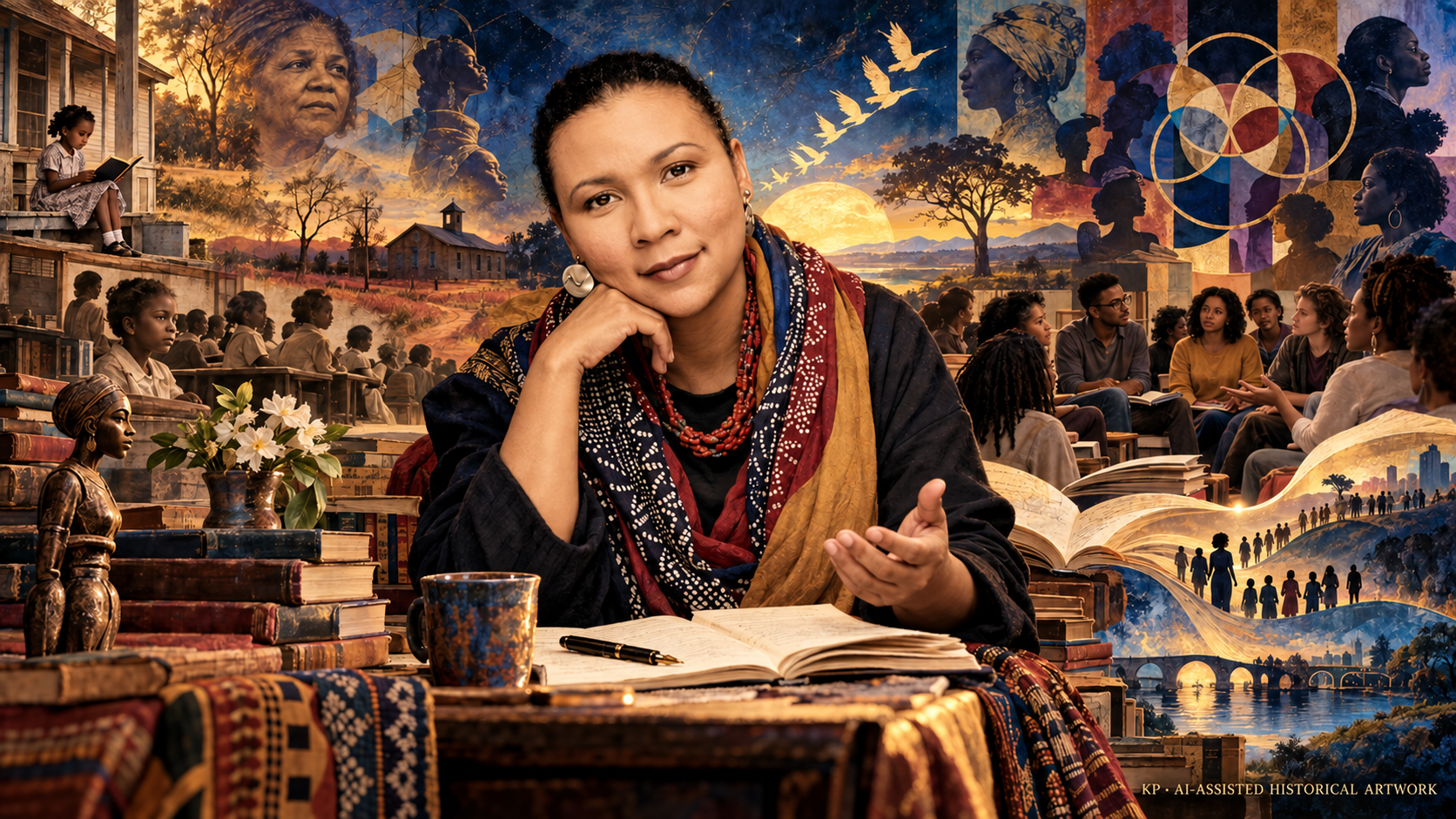
bell hooks was born on September 25, 1952, in Hopkinsville, Kentucky, into a poor, working-class Black family as one of seven children. Her father, Veodis Watkins, worked as a post office janitor, while her mother, Rosa Bell Watkins, was both a homemaker and a maid in white households. The contradictions of this environment—racial segregation, economic hardship, Black family life, Christian faith, storytelling, and a deep respect for learning—shaped the foundation of her intellectual journey. At her grandparents’ home, Baba and Daddy Gus, she experienced the sustaining power of oral storytelling; among the books in her family’s home, she discovered a private world of imagination and companionship. Later in life, hooks recalled that books made her feel less alone and provided an entryway into other worlds.
From an early age, hooks displayed the spirited independence that would later animate her writing. She was often reprimanded for “talking back,” for addressing adults as though she were their equal and refusing to stay silent in the face of authority. Rather than suppressing this impulse, she transformed it into an intellectual and political method. Her later book Talking Back: Thinking Feminist, Thinking Black made this practice central: to talk back was to resist oppression, claim one’s voice, and insist that marginalized people possessed the authority to name their own experience. Her pen name, bell hooks, honored her maternal great-grandmother, Bell Blair Hooks, remembered as an outspoken woman with sharp opinions and a bold tongue. The lowercase form was deliberate. It represented hooks’s wish to decentre the individual author and emphasize the substance of her thought.
hooks’s earliest education took place in segregated Kentucky schools, where Black teachers nurtured their pupils’ intellectual promise and linked academic achievement to collective responsibility. She later contrasted this experience with the alienation she felt after entering an integrated school system in the late 1960s. In her view, desegregation did not automatically produce educational liberation; it could also mean the loss of affirming Black educational spaces and the authority of Black teachers who believed in their students. These experiences became foundational to her later reflections on pedagogy, especially in Teaching to Transgress: Education as the Practice of Freedom (1994), where she argued that education should be an active, participatory practice that helps people imagine and build freer lives.
She attended Stanford University, earning a bachelor’s degree in English in 1973, followed by a master’s degree in English from the University of Wisconsin–Madison in 1976. In 1983, she completed a doctorate in literature at the University of California, Santa Cruz, where her dissertation focused on the fiction of Toni Morrison. While still an undergraduate at Stanford, at only nineteen, she began writing Ain’t I a Woman?: Black Women and Feminism, the book that would establish her as a formidable feminist theorist. Published in 1981, it drew inspiration from Sojourner Truth’s famous question and offered a historical analysis of the combined effects of the Maafa, racism, and sexism upon Black women’s lives. hooks demonstrated that Black women had been marginalized not only within Anglo-American society, but also within many strands of feminist and Black political thought.
With Ain’t I a Woman?, hooks challenged the dominant assumptions of second-wave feminism. She argued that a feminism centered primarily on the concerns of Anglo-American, middle-class women could not adequately explain or confront the oppression experienced by Black women and other poor and working-class women. In her 1984 work, Feminist Theory: From Margin to Center, she developed this argument further. It called for a feminism rooted in solidarity across racial and class differences, rather than one that treated European womanhood as universal. Hooks offered a definition of feminism that became one of her most enduring formulations: feminism, she wrote, was “a movement to end sexism, sexist exploitation, and oppression.” By defining feminism in this way, she rejected the notion that it was simply anti-male. Patriarchy, she argued, damaged men and boys as well as women and girls, and liberation required collective change.
Her work consistently insisted that systems of oppression operate together. Race, gender, class, and capitalism were not separate topics to be considered one at a time; they were interlocking forces shaping material life, cultural representation, education, family relationships, and personal self-understanding. Although the term “intersectionality” became widely used in later public discourse, hooks had long examined these connected structures in language that was accessible to general readers. She was especially committed to moving theory out of academic spaces and into everyday life. For hooks, intellectual work mattered most when it helped ordinary people interpret their circumstances, confront injustice, and cultivate practices of freedom.
This commitment shaped both her style and the extraordinary range of her published work. hooks wrote more than thirty books, and perhaps nearer to forty, across multiple genres. Her cultural criticism included Black Looks: Race and Representation (1992), Outlaw Culture: Resisting Representations (1994), and Reel to Real: Race, Sex, and Class at the Movies (1996), texts that examined how film, television, and mass media reproduce ideas about race, gender, desire, and power. In Yearning: Race, Gender, and Cultural Politics (1990), which received the American Book Award, and Where We Stand: Class Matters (2000), she challenged readers to recognize class hierarchy as central to American social life and political struggle.
Education remained one of hooks’s most sustained concerns. Deeply influenced by the Brazilian educator Paulo Freire, whose work framed teaching as a practice of liberation, she developed what she called “engaged pedagogy.” This approach rejected the idea of students as passive recipients of knowledge. Instead, it treated the classroom as a space where teachers and students could participate in mutual learning, critical reflection, and personal and intellectual transformation. She continued to explore these ideas in Teaching Community: A Pedagogy of Hope (2003) and Teaching Critical Thinking: Practical Wisdom (2010). Her teaching career included positions at the University of Southern California, Yale University, Oberlin College, the City College of New York, and other institutions, before she returned to Kentucky in 2004 as Distinguished Professor in Residence at Berea College.
At Berea, hooks’s intellectual and community commitments acquired an institutional home. In 2014, Berea established the bell hooks Institute, preserving her work, writings, and personal materials. The institute’s existence reflected the breadth of her legacy: she was not merely a theorist to be studied, but a teacher whose ideas were intended to sustain new forms of critical thought, activism, and community. Her work was also associated with spaces for students from historically marginalized backgrounds, including Black, brown, femme, queer, and Appalachian communities, for whom education could become a site of affirmation and radical possibility.
In the later decades of her life, hooks increasingly wrote about love as an ethical and political force. In All About Love: New Visions (2000), she argued that love was neither sentimental nor private; it was a practice requiring care, responsibility, respect, knowledge, commitment, and trust. She linked the inability to love with the injuries caused by domination, violence, patriarchy, and emotional neglect. Love, in her work, therefore became a necessary foundation for justice and healing. Her books Salvation: Black People and Love (2001), Communion: The Female Search for Love (2002), and The Will to Change: Men, Masculinity, and Love (2004) continued this exploration. In the latter, she examined the psychological wounds patriarchy inflicts upon men and boys and called for a compassionate transformation of masculinity.
Her writing on recovery and emotional survival was equally attentive to Black women’s lives. Sisters of the Yam: Black Women and Self-Recovery (1993), named for a support group she founded, addressed the pressures of racism, sexism, exhaustion, and self-neglect. Hooks refused the expectation that Black women should endlessly endure without care. Instead, she made room for rest, self-reflection, mutual support, and healing as politically meaningful practices. Her children’s books, including Happy to Be Nappy, Homemade Love, Be Boy Buzz, and Skin Again, similarly affirmed Black identity, family love, dignity, and self-esteem for young readers.
hooks was also a poet and memoirist. Her works Bone Black: Memories of Girlhood (1996), Wounds of Passion: A Writing Life (1997), and Remembered Rapture: The Writer at Work (1999) explored her inner life, creative development, childhood, faith, and writing practice. Poetry remained a constant thread from her earliest years, when her mother encouraged her to recite poems by Gwendolyn Brooks, Langston Hughes, Elizabeth Barrett Browning, and William Wordsworth before her church community. Her own poetry collections included And There We Wept (1978), When Angels Speak of Love (2005), and Appalachian Elegy: Poetry and Place (2012).
Her intellectual formation drew from a wide range of traditions. She engaged the work of Toni Morrison, James Baldwin, Lorraine Hansberry, Frantz Fanon, Gustavo Gutiérrez, Erich Fromm, and Paulo Freire. She also combined her Christian upbringing with Buddhist thought, which she encountered through Beat poetry and Gary Snyder’s work during college. Thích Nhất Hạnh’s teachings were especially influential in her later thought on mindfulness, compassion, healing, and love. This synthesis enabled hooks to articulate a politics that took both structural injustice and interior life seriously. Liberation, in her work, demanded resistance to oppressive institutions, but it also required cultivating self-awareness, ethical relationships, and spiritual renewal.
Her influence grew across generations and disciplines. She became a prominent public speaker, appeared in documentaries, and offered wide-ranging commentary on education, popular culture, race, feminist politics, sexuality, and representation. Her recognition includes the American Book Award for Yearning, the Bank Street College Children’s Book of the Year award for Homemade Love, induction into the Kentucky Writers Hall of Fame in 2018, and inclusion in TIME magazine’s 100 Women of the Year in 2020. In the same period, All About Love experienced a renewed popular readership, particularly during the racial justice movements of 2020, demonstrating the continuing vitality of her work for readers seeking a language of solidarity, repair, and transformation.
bell hooks died of kidney failure on 15 December 2021, aged sixty-nine. Her death marked the loss of a major intellectual figure, but her work continues to speak urgently to questions of power, inequality, cultural representation, education, and human connection. She left behind an immense archive of books and ideas, yet perhaps her deepest legacy lies in the ethical challenge she posed to readers: recognize domination wherever it appears, refuse silence, make knowledge accessible, and treat love as a disciplined practice of freedom. Through the force of her scholarship and the accessibility of her prose, bell hooks taught generations of readers to “talk back”—not merely in defiance, but in the service of collective liberation.
Sources:
https://en.wikipedia.org/wiki/Bell_hooks
https://www.plutobooks.com/blog/feminism-is-for-everybody-bell-hooks/
https://www.britannica.com/biography/bell-hooks