
John Sayers Orr—known in the streets and newspapers of his day as “the Angel Gabriel”—deserves to be remembered as a political transatlantic figure of the nineteenth-century Black Atlantic. His career joined evangelical performance, anti-Catholic militancy, anti-Maafa language, and a fierce defense of popular speech. In Guyana in 1856, his arrest helped ignite one of the country’s largest post-emancipation uprisings.
A figure obscured by history
John Sayers Orr’s name has survived chiefly as an epithet: the Angel Gabriel, a horn-blowing street preacher blamed for the disturbances that shook Guyana in February 1856. That shorthand is inadequate. It turns both a man and an uprising into a colonial fable of fanaticism and disorder. It also reproduces the work of colonials, hostile newspapers, and later commentators who found it convenient to portray African Guyanese people as a credulous mass led astray by a supposedly deranged agitator.
Orr was, rather, an unusually transnational figure in Caribbean history. Born in Demerara, probably around 1800, he moved through Scotland, England, Canada, and the northeastern United States before returning to British Guiana late in 1855. At each stage, he used open-air preaching, theatrical symbolism, and a gift for crowd-making to intervene in conflicts over religion, labor, nationality, race, and political authority. He was provocative, often dangerously so. Yet reducing him to a mere inciter overlooks the social conditions that made his words matter and denies the conscious grievances and political agency of the people who rallied to the cause he articulated.
Orr’s story is not simply the story of “riots.” It is a story of post-emancipation struggle: of Black people contesting the terms of freedom in a country where captivity had formally ended, but economic dependency, racial hierarchy, punitive policing, and unequal law remained firmly in place.
Origins, identity, and formation
The surviving evidence regarding Orr’s beginnings is incomplete and sometimes contradictory, which itself helps explain why his biography has been left in fragments. He was born in Guyana and was of mixed African and Scottish descent. His father, John Orr, was a Scottish planter associated with the firm Orr, Macrae & Co. and with Plantation La Penitence; he died in 1804. Orr’s mother, Mary Ann Orr, was described in the colonial record as a “respectable coloured woman.”
According to accounts attributed to Orr himself, he was taken from Demerara to Greenock, Scotland, around age three, along with a brother and sister. Greenock was an important port: a town shaped by Atlantic commerce, emigration, industrial change, and the social tensions produced by Irish Catholic migration. The city’s Protestant political culture, its connections to colonial wealth, and its popular religious life all formed part of the milieu through which Orr moved. It is not difficult to see why a man born in a plantation colony but raised, at least partly, within Scotland’s imperial orbit would develop a volatile and contradictory political imagination.
His mother’s later public defense of him is especially important. After Orr’s death, Mary Ann wrote to The Creole, the Black-owned newspaper that supported his cause. She stressed the respectability and standing of his family connections and indicated that he may not have welcomed the nickname “Angel Gabriel.” Her letter complicates the familiar caricature of Orr as a rootless fanatic. He had kin, social standing, memory, and a mother who insisted that his death should not be dismissed in silence.
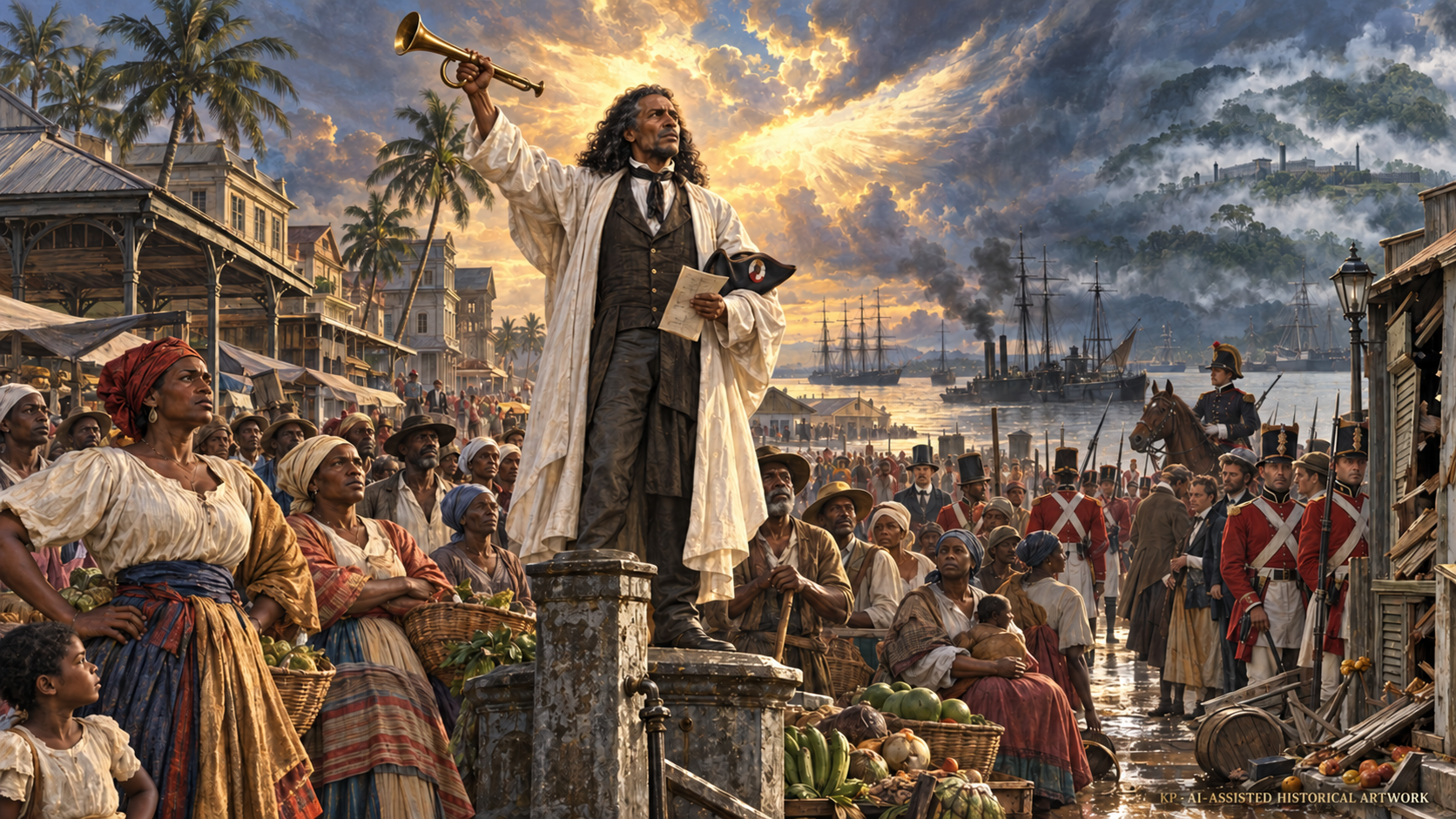
The moniker “Angel Gabriel” originated from Orr’s distinctive public presence. He would blow a brass horn or trumpet to gather crowds, reminiscent of the biblical angel known for heralding divine messages with a trumpet blast. Contemporary accounts also highlight his striking appearance: he wore his hair long, kept a beard, sometimes donned a flowing white robe, and at other times sported a three-cornered hat adorned with a cockade. These were not mere eccentricities. In the bustling public spaces of nineteenth-century towns—markets, commons, street corners, churchyards, and courthouse steps—attire, sound, movement, and spectacle became tools of political expression. Before the advent of microphones, radio, mass political rallies, or broad access to formal representative institutions, Orr’s trumpet ensured he could not be ignored by those typically excluded from traditional political power.
A transatlantic street preacher
Before his final return to Guyana, Orr had established an extraordinary record of movement and confrontation. Reports place him in London in 1832, where he was arrested for open-air preaching, and again in the political ferment of 1848. He was also reported in Montreal and, during the early 1850s, in Scotland and northern England. His most heavily documented travels occurred in the United States in 1854, when he appeared in Boston, New York, Brooklyn, Bath in Maine, Rochester, Palmyra, and Manchester, New Hampshire.
Across the Atlantic world, Orr displayed an uncommon ability to arrive in an unfamiliar town and gather a substantial audience. His appearances in the United States, Britain, and Guyana repeatedly brought people together around already politically charged disputes. Accounts of his American tour claimed he drew as many as 10,000 people to City Hall in Manhattan, and that approximately 2,000 then followed him in procession toward Brooklyn. There, at Fulton Street, they encountered Irish Catholic opponents and fighting followed. Contemporary accounts treated the encounter as among the most serious street conflicts then remembered in Brooklyn. These events leave little doubt about Orr’s exceptional capacity to stir large public gatherings.
He could call out Protestant crowds in Scotland with a similar force. In Greenock, his preaching drew a mass audience, and his arrest for breach of the peace was followed by attacks on St Mary’s Catholic Church, requiring the intervention of military and naval forces to restore order. The violence that surrounded his appearances was real, and Orr’s anti-Catholic rhetoric was often inflammatory. It should not be minimized. Yet it is equally important not to reproduce the explanation favored by hostile commentators that crowds were passive instruments of one aberrant man. His words took effect because they entered communities already divided by religious antagonism, class insecurity, national rivalry, and mistrust of official power.
His career as a transatlantic preacher was consequently marked by a recurring pattern. He brought together crowds through forceful preaching, biblical symbolism, and the public sound of his horn; religious and political opponents mobilized in response; police and military authority entered the scene; and, in several places, violence, arrests, and attacks on Catholic property followed. Orr was arrested on numerous occasions and repeatedly emerged physically unharmed from hostile encounters.
Orr understood his own public role in expansive terms. Whatever the contradictions of his politics, he did not see himself as a mere religious figure. He saw himself as a spokesman for people excluded from economic security, official respect, and political influence. That self-conception helps explain why his return to Georgetown proved so consequential: his trumpet sounded within a post-emancipation society already burdened by inequality, commercial conflict, colonial coercion, and unfinished freedom.
He also claimed the language of liberty—one refrain associated with him declared, “Freedom to man be he black or white”—and he opposed forms of domination and captivity. At the same time, he cultivated an intense anti-Papal and anti-Catholic rhetoric. His speeches were associated with disturbances and attacks on Catholic institutions. In Boston, a huge crowd assembled to hear him in April 1854, and police took him into custody to protect him during a near-riot. In New York, his preaching prompted such concern that police deployed extra officers. In Bath, Maine, a mob attacked and burned a Catholic church after one of his appearances. In Palmyra, New York, a Catholic church was entered and damaged.
Orr’s agitation against the Catholic Irish in the United States was closely connected to the sentiments of anti-Maafa campaigners, who blamed the Southern-based Democratic Party for the 1854 Kansas-Nebraska Act. They viewed the Act as a gateway for expanding captivity into the new territories of Kansas and Nebraska. The Irish Catholic community, predominantly pro-Maafa and strongly anti-African American, aligned itself with the pro-Maafa Democrats. When the Kansas-Nebraska Act became law on May 30, 1854, Orr launched a sweep through the Eastern United States between May and July, leaving in his wake violent clashes, loss of life, serious injuries, and the destruction of Catholic churches. The violence that followed Orr was part of a broader upheaval across the United States surrounding the Kansas-Nebraska controversy. In 1856, John Brown—the Anglo-American martyr of the anti-Maafa movement—led Kansas anti-Maafa forces in a brief but consequential “war” that resulted in the deaths of several pro-Maafa militants.
The same pattern appeared in Scotland. In Greenock in 1855, Orr preached from the Customs House steps and was convicted of breach of the peace, receiving a sixty-day sentence in Paisley Prison. His supporters subsequently attacked St Mary’s Catholic Church, breaking dozens of windows; Royal Navy personnel and militia troops were called in to restore order. Orr later successfully pursued a claim for wrongful imprisonment and received compensation, an outcome that likely deepened his conviction that public authority had wronged him.
Orr, a man of African descent from Guyana, traveled, spoke, organized crowds, entered international political disputes, and left a record across the Atlantic world.
Return to British Guiana
Orr returned to Georgetown in December 1855. He came back to a society transformed by emancipation but not liberated from colonial control. African Guianese people had created villages, acquired land in some areas, built churches and mutual-aid institutions, and sought independence from the plantation economy. Yet they faced high taxation, limited employment, state coercion, disease, drought, and official policies designed to secure a cheap labor force for sugar estates.
One major colonial response to post-emancipation African independence had been indentured immigration. Portuguese migrants, many from Madeira, had become especially prominent in urban and rural retail trade. Their commercial mobility, access to credit, and increasing position in shopkeeping produced strong resentment among many African Guyanese people, especially small traders, hucksters, peddlers, laborers, and customers who believed that Portuguese shopkeepers monopolized trade, manipulated prices, or cheated buyers. Competition was not simply “racial animosity”; it was embedded in an unequal colonial economy in which Black enterprise and livelihood were constrained while state policy could appear to favor immigrant commercial interests.
Orr understood how to speak into this atmosphere. On 1 January 1856, he wrote to Governor Philip Wodehouse, declaring his wish to reach “the masses of the Poor, the ignorant and despised” while insisting on his right to speak freely so long as he violated no law. The letter is crucial: before authorities portrayed him as a criminal, Orr framed himself as an advocate for the socially excluded and as a claimant of public political rights.
At Georgetown’s Stabroek Market, he began holding meetings in which anti-Catholic preaching fused with criticism of Portuguese business power. He carried his flag, wore badges, sounded his horn, and gathered listeners at street corners. In the governor’s contemptuous language, the followers were “rabble”—a term that thinly disguised official disdain for poor and working-class Black people. They responded because Orr named conditions they recognized: commercial displacement, police and court inequality, social humiliation, and the fragility of freedom in a post-slavery colony.
A later summary by A. R. F. Webber captured the substance of Orr’s claims: Portuguese traders had “taken the bread out of the mouths of the creoles,” pushed colored hucksters and peddlers out of business, and used ready cash to monopolize produce at the markets. Whether every detail of such charges was true is less important than the fact that they expressed a widely felt political economy of exclusion. Orr’s return also coincided with efforts by Black shopkeepers to organize mutual aid and recover a fairer share of the retail trade.
The crisis of February 1856
The immediate confrontation developed rapidly. Portuguese men reportedly assembled with sticks and whips near one of Orr’s accustomed meeting places, apparently prepared to confront either him or his followers. Orr was absent, but his supporters interpreted the gathering as evidence of an intended assault. Tensions sharpened further when authorities moved to suppress his meetings, reportedly after intervention from the Portuguese consul. Police clashes with his supporters followed, and Orr himself was arrested even though he was not present at several of the altercations that intensified the crisis.
On 10 February 1856, according to the pro-government Royal Gazette, Orr mounted the town pump in front of Stabroek Market, armed with a dagger and a life-preserver, and addressed a crowd estimated by a policeman at more than one thousand people. He denounced the Portuguese and accused them of coming to the colony to drive poor Creoles out of business. Authorities charged him with seditious language and unlawful assembly, later adding libel and inciting a riot. His bail was set at the extraordinary sum of £500, effectively ensuring his detention.
The response demonstrates the depth of popular attachment to him and, more importantly, to the issues he represented. Supporters raised money to secure legal representation for Orr. The Black-owned Creole newspaper defended the broader cause. Protestant ministers supported him against the Portuguese Catholic establishment and assisted with his legal defense. His imprisonment became the immediate spark for collective action, but it did not create the combustible material from nothing.
The disturbances that followed lasted about six days and spread across Demerara, Essequibo, and Berbice. They targeted Portuguese-owned shops, houses, and property. Windows and doors were broken; premises were ransacked; goods were looted, consumed, or destroyed; in some places, houses were burned. Violence appeared in Georgetown, especially Charlestown, and in a wide range of villages and districts, including Mocha, Buxton, Mahaica, Ann’s Grove, Hopetown, Canal No. 1, Diamond, Belladrum, Friendship, and others.
The uprising was neither uniform nor reducible to a single motive. It included attacks on Portuguese people and property. Yet the riot also drew its force from accumulated grievances: taxation; the unequal treatment of African Guyanese people in the courts; drought; cholera, measles, and dysentery; anger over state expenditure on Indian immigration; restrictions on movement between villages; and the harsh punishment of Black women in prisons, including stocks and foot punishments that recalled the coercive practices of captivity.
Women were central actors in the disturbances. Colonials repeatedly singled them out for special vilification. Wodehouse condemned arrested women as belonging to “the most vicious and savage class of the community,” a statement revealing the racist and misogynistic logic through which colonials interpreted Black female political action. Contemporary reports recorded women and children as especially visible in raids on Portuguese property. Their presence should not be treated as a marginal curiosity: it demonstrates that the 1856 uprising involved households, market networks, and community life, not simply male street politics.
Colonial repression and Orr’s death
Wodehouse responded as a colonial defender of property and hierarchy. The authorities mobilized police, militia, volunteer special constables, and the West India Regiment. Wodehouse did not trust Black policemen, whom he considered “unreliable,” and he sought assistance from Barbados. By the time the uprising was contained, the colony had brought in 200 Barbadian troops. Dutch and French warships also helped repress the uprising, including the Dutch vessel Curaçao.
The violence was met with violence. At least one policeman was killed in Charlestown. Colonial forces shot Black people, and hundreds of individuals were arrested. Some prisoners were deported, while overcrowding forced others into penal settlements. In Essequibo, twelve people were reportedly condemned to ten years’ deportation from the colony. The legal response was starkly unequal. Three Portuguese men accused of preparing to assault Orr or his followers with sticks and horsewhips received comparatively light sentences, while Orr—detained despite not being present at several key confrontations—was tried before the Supreme Criminal Court and treated as the central author of the crisis.
After his conviction for unlawful assembly, libel, and exciting a riot, Orr was sentenced to three years’ hard labor. His sentence became, in effect, a death sentence. He was sent to the Mazaruni penal settlement, where he died of dysentery on 27 November 1856, listed as Convict No. 323. A later account by a former prisoner reported a marker identifying him as having died “while undergoing Penal servitude for originating the riot of 1856.” The phrase reflects the colonial verdict on his life; it should not be accepted as the final historical judgment.
The repression did not end with imprisonment. Wodehouse introduced extraordinary ordinances authorizing fines, imprisonment, and flogging—up to thirty-nine lashes—for actions defined broadly enough to discipline public dissent. He also imposed a punitive poll tax intended to raise reparations for Portuguese claimants, whose losses were calculated at approximately $250,000. The burden fell, in effect, on the African Guianese population as collective punishment for an uprising whose causes included the colony’s own racial and economic order. Protest from anti-Maafa advocates and others eventually contributed to the tax’s withdrawal in 1858.
Popular anger toward Wodehouse remained intense. When he attempted to leave Guyana in 1857, a crowd reportedly gathered at the wharf and pelted his party with stones, plantain stalks, and offal. The episode was not an isolated insult to a colonial; it was evidence that the events of 1856 had widened rather than extinguished public resentment.
How Orr should be remembered
John Sayers Orr should not remain entombed beneath the colonial label of lunatic, demagogue, or riot-maker. Orr was a mixed-race Guyanese man whose life unfolded across the Atlantic world; an itinerant public speaker who refused silence; a claimant of free speech; a figure who used the language of universal freedom; and a catalyst for an uprising rooted in the unfinished emancipation of Guyana. The people who responded to him did so amid material hardship, racial discrimination, commercial exclusion, and the daily evidence that formal emancipation had not delivered equal citizenship.
The Angel Gabriel Riots were therefore not simply an eruption caused by a horn, a costume, or a charismatic preacher. They expressed post-emancipation discontent in a society where Black Guyanese people were free in name, while colonial policy constrained their work, movement, commerce, dignity, and political voice. Orr’s arrest gave that discontent a focal point. The colonial’s response—military occupation, flogging, mass arrests, deportation, penal labor, and collective taxation—revealed the limits of the freedom it claimed to govern.
His death in Mazaruni prison in November 1856 should be remembered as more than the end of an eccentric career. It marked the silencing of a powerful public voice and the punishment of a community’s demand to be heard. To restore John Sayers Orr to popular memory is to recognize him as a neglected, contradictory, and significant Guyanese actor whose life illuminates the racial, religious, economic, and imperial conflicts of the nineteenth-century Caribbean.
Sources:
Tony Martin, Caribbean History: From Pre-colonial Origins to the Present.
https://www.spanglefish.com/slavesandhighlanders/index.asp?pageid=716566
https://jeffreygreen.co.uk/104-john-sayers-orr-preaching-against-popery-1854-1855/
https://sonofskye.wordpress.com/2014/06/02/john-sayers-orr-greenocks-anti-catholic-riots/
https://guyaneseonline.wordpress.com/2022/03/21/guyana-history
https://rochistory.wordpress.com/2025/02/13/demagoguery-in-the-streets-the-angel-gabriel-comes-to-rochester/-summarising-the-1856-angel-gabriel-guyana-riots-by-nigel-westmaas/#more-106364
https://www.stabroeknews.com/2022/03/20/sunday/summarising-the-1856-angel-gabriel-guyana-riots/
https://www.jstor.org/stable/40653132
https://www.euppublishing.com/doi/10.3366/swc.2022.0404euppublishing