
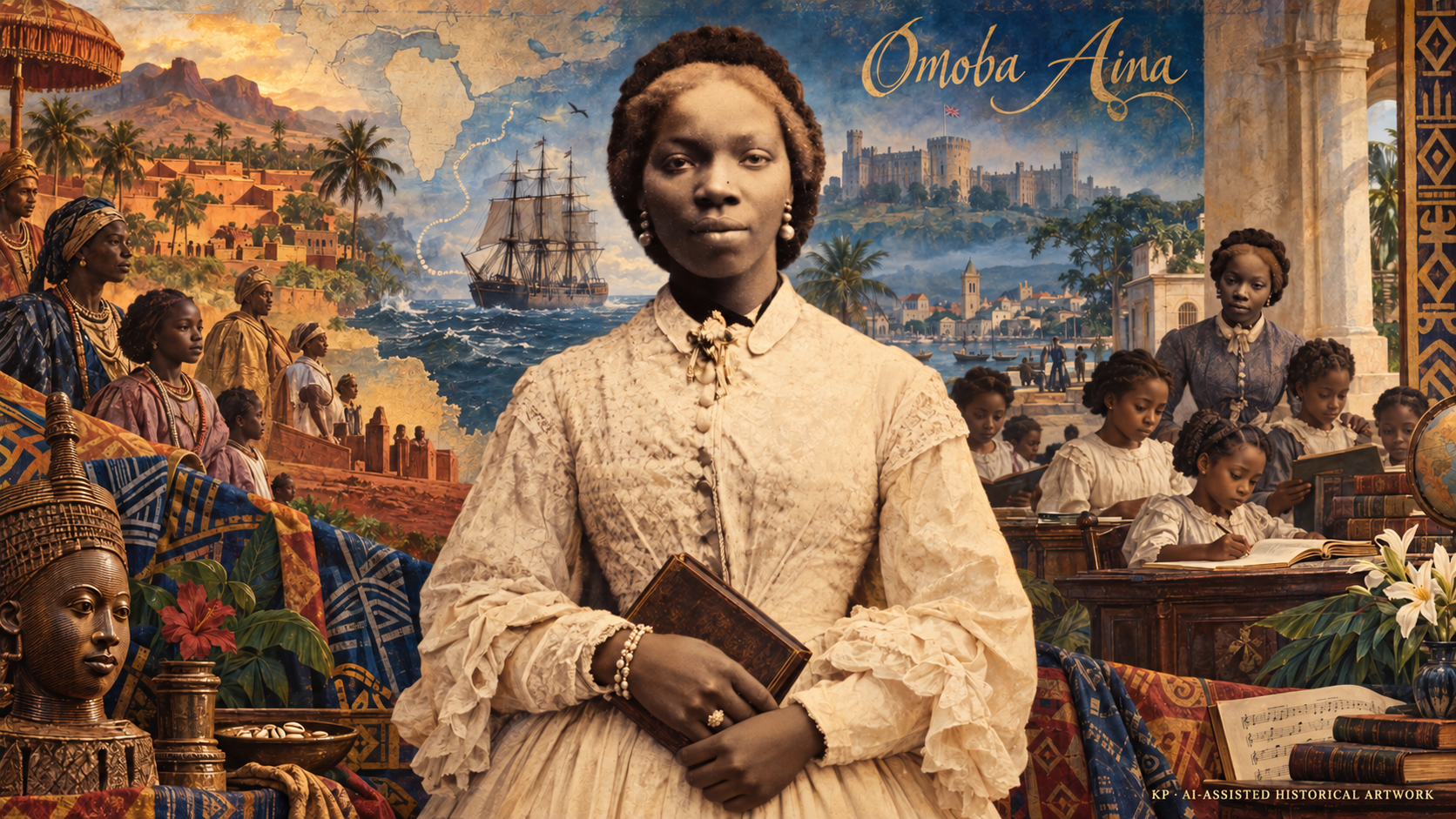
Sarah Forbes Bonetta—born Omoba Aina, or Ina, around 1843—lived a life shaped by extraordinary rupture, displacement, intellect, and self-possession. Remembered for many years chiefly as the African child presented to Queen Victoria and popularly styled her “goddaughter,” she was, more accurately, the Queen’s sponsored ward and protégée. Yet this royal association, though central to the public record of her life, should not eclipse the identity she retained as a Yewa Yoruba woman, an educator, a wife and mother, and a survivor whose life crossed the violent frontiers of nineteenth-century West Africa and Victorian Britain.
Aina was born in Oke-Odan, in what is now south-western Nigeria, into an Egbado—or Yewa—Yoruba royal family. Her childhood was catastrophically interrupted in 1848, when the forces of King Ghezo of Dahomey invaded and captured her village. Her parents were killed, the settlement was destroyed, and the young child was taken captive to the Dahomean court. The political instability of Yorubaland in this period, following the weakening and fragmentation of the Oyo Empire, had made communities such as Oke-Odan vulnerable to raids and expansionist warfare. Aina’s royal lineage, reportedly recognized through her facial markings, meant that she was retained as a high-status prisoner rather than trafficked into the transatlantic system. This distinction did not bring security: she was reportedly held for about two years and designated for ritual execution during the Annual Customs of Dahomey.
In July 1850, her fate changed when Captain Frederick E. Forbes of the British Royal Navy arrived in Dahomey on a diplomatic mission. Forbes witnessed the rituals associated with the Dahomean court and intervened on behalf of the approximately seven-year-old girl. He persuaded King Ghezo to spare her life, arguing that Queen Victoria could not respect a monarch who allowed the killing of a child. Ghezo ultimately handed Aina over as a diplomatic gift, using the deeply racialised language of the period: a present “from the King of the Blacks to the Queen of the Whites.” Forbes later maintained that refusing her would have meant leaving her to an immediate death. Her rescue was therefore inseparable from the coercive political world of nineteenth-century diplomacy, captivity, abolition, and empire.
During the voyage to Britain, Aina impressed Forbes and the crew of HMS Bonetta with her quick command of English, her aptitude for music, and her evident intelligence. She was baptized and renamed Sarah Forbes Bonetta: “Forbes” acknowledged the naval officer who had removed her from Dahomey, while “Bonetta” derived from his ship. She became known affectionately as “Sally,” a name used by the ship’s crew and later within royal circles. These new names marked her incorporation into a British social and imperial world, but they did not erase the identity into which she had been born. Years later, she would publicly affirm that earlier self by signing her marriage certificate “Ina Sarah Forbes Bonetta.”
On 9 November 1850, Captain Forbes presented Sarah to Queen Victoria at Windsor Castle. The Queen was struck by the child’s intelligence and assumed responsibility for her education, maintenance, and welfare. Sarah initially lived with the Forbes family and became a familiar visitor to royal residences, including Windsor Castle and Osborne House. Her abilities were repeatedly noted: she was described as gifted in music, literature, art, and languages, and she established friendships with members of the royal household, particularly Princess Alice. She also attended significant royal occasions, including the marriage of Victoria, Princess Royal, in 1858 and that of Princess Alice in 1862.
Sarah’s relationship with Queen Victoria was both exceptional and complicated. On the one hand, it provided material support, educational opportunity, and unusual access to the social world of the British monarchy. On the other, it placed her under continual observation as an African child in Victorian society. Abolitionists and sympathetic commentators pointed to her intellectual accomplishments as evidence against racist assumptions about African people’s capacities. At the same time, her presence could be used by the British as a symbol of Britain’s supposed benevolence and “civilizing mission.” Others thus repeatedly interpreted her life as proof of their political or moral ideas.
In 1851, concerns arose about Sarah’s health. She had developed a persistent cough and was considered physically fragile; Victorian assumptions held that the damp British climate was unsuitable for African children. Queen Victoria therefore arranged for her to travel to Freetown, Sierra Leone, where she attended the Female Institution, later known as the Annie Walsh Memorial School. The school had missionary connections, and it was initially imagined that Sarah might eventually be trained for missionary work. While in Freetown, Queen Victoria continued to finance her upkeep and education, sending books, toys, games, and personal gifts. Yet Sarah was unhappy there and wished to return to England. In 1855, at about twelve years old, they brought her back to Britain.
After returning, Sarah lived in Gillingham, Kent, with the Reverend James Frederick Schön, a former missionary, and his wife Elizabeth. At Palm Cottage, she found an affectionate domestic environment and called Mrs Schön “Mama.” She continued her studies in English, French, and music, developing the accomplishments expected of a young woman being prepared for educated society. Later, she was moved to Brighton under the supervision of Miss Sophia Welsh, in part to be introduced to British high society. The transition was not wholly welcome: Sarah was reluctant to leave the Schön family, and she reportedly disliked her new Brighton household. These moments show that, despite powerful people arranging her life, she had her own preferences, attachments, and judgments.
Her personal independence was particularly evident in her response to the proposal of Captain James Pinson Labulo Davies. Davies was a wealthy Yoruba merchant, businessman, philanthropist, and former naval officer, thirteen years Sarah’s senior. The two had first met during her school years in Sierra Leone. When he later proposed marriage, Sarah initially resisted. Writing to Mrs Schön, she rejected the idea that financial security should determine such an intimate decision, asking whether she was expected to “barter” her peace of mind for money. Her words suggest a woman conscious of the pressures surrounding her and unwilling to reduce marriage to wealth or convenience. Nonetheless, Queen Victoria approved the match, and amid considerable encouragement and pressure Sarah agreed.
On 14 August 1862, Sarah married Captain Davies at St Nicholas Church in Brighton. The ceremony was a major public event: the wedding party traveled in ten horse-drawn carriages, and sixteen bridesmaids attended Sarah—eight Black and eight white women. Large crowds gathered outside the church, and newspapers across the empire covered the occasion. The spectacle revealed the fascination generated by the marriage of a Yoruba woman associated with Queen Victoria to a wealthy African merchant. Yet Sarah made a quiet but profound assertion of identity within this highly public Victorian setting. When she signed the parish marriage register, she wrote “Ina Sarah Forbes Bonetta,” joining her Yoruba birth name to the names she had acquired through captivity, rescue, baptism, and royal patronage. The signature preserved a line of continuity between the child of Oke-Odan and the adult woman before the altar in Brighton.
After their wedding, Sarah and James Davies had celebrated photographer Camille Silvy take formal portraits of them before they departed for West Africa. They settled first in Freetown, then in Lagos. There, Sarah did not merely become the wife of an affluent merchant; she returned to education, teaching at the Annie Walsh Memorial School she had attended as a child. By 1870, she served as the school’s Acting Principal. This achievement is central to her biography. Her work placed her within the expanding networks of African education, women’s learning, and professional life in nineteenth-century West Africa. After the family moved to Lagos, she continued teaching while raising her children.
Sarah and James Davies had three surviving children: Victoria, born in 1863; Arthur, born in 1871; and Stella, born in 1873. A fourth child, Alice, is said to have died in infancy. Queen Victoria became the godmother of Sarah’s eldest daughter, Victoria Matilda Davies, giving the younger Victoria an inscribed gold christening set. The royal relationship thus extended into the next generation. In December 1867, Sarah brought her daughter to Windsor Castle, where Queen Victoria described the child as “a lively intelligent child, with big melancholy eyes.” When Sarah died, the Queen provided Victoria with an annuity and supported her education at Cheltenham Ladies’ College.
Throughout her life, Sarah remained physically vulnerable. Her recurring ill health eventually developed into tuberculosis. Seeking relief, she traveled to Funchal on the Portuguese island of Madeira, but she died there on 15 August 1880, at the age of thirty-seven. She was buried in the British Cemetery in Funchal, in grave number 206. Her husband commemorated her with an eight-foot granite obelisk on his cocoa farm in Ijon, Western Lagos. The memorial offers a material reminder that her life, though often narrated through Britain and the monarchy, belonged equally to West African family, community, education, and memory.
Her descendants became connected to influential families and public figures in Nigeria and beyond. Her daughter Victoria married Dr John Randle and joined the prominent Randle family of Lagos. Through her younger daughter Stella, Sarah’s descendants included Sarah Abigail Idowu Macaulay Adadevoh and, in a later generation, Dr Ameyo Adadevoh, remembered for her decisive role in helping to contain the 2014 Ebola outbreak in Nigeria. Such continuities make clear that Sarah Forbes Bonetta’s legacy did not end with the Victorian era. It extended through family networks, educational work, public service, and Nigerian social history.
For much of the twentieth century, Sarah’s story remained marginal in mainstream British historical memory. In more recent years, historians, writers, and artists have returned to her life in order to examine race, gender, empire, representation, and historical erasure. Artists including Ayana V. Jackson, Heather Agyepong, Hannah Uzor, and Joy Labinjo have engaged with her image and history, often challenging the Victorian gaze that made her a symbol while obscuring her inner life. Her portrait at Osborne House, public commemorations in Gillingham, and renewed scholarly and artistic attention have helped restore her to a broader history of Black presence in nineteenth-century Britain.
Sarah Forbes Bonetta’s life cannot be reduced to an imperial rescue narrative, nor to the sentimental image of Queen Victoria’s African protégée. She was Omoba Aina: a Yoruba child who survived the destruction of her home and family; a girl transported between Dahomey, Britain, and Sierra Leone; an intellectually gifted student; an educated woman who worked as a teacher and acting principal; a wife and mother; and a figure who preserved her name amid the powerful forces that sought to rename, represent, and define her. Her life remains compelling because it illuminates both the violence of the nineteenth-century Atlantic world and the enduring human capacity to retain identity, cultivate knowledge, and create a legacy across continents.
Sources:
https://en.wikipedia.org/wiki/Sarah_Forbes_Bonetta
https://www.english-heritage.org.uk/visit/places/osborne/history-and-stories/sarah-forbes-bonetta/
https://brightonmuseums.org.uk/discovery/history-stories/african-princess-and-queen-victorias-goddaughter-sarah-forbes-bonetta-1843-1880/
https://helenrappaport.com/queen-victoria/sarah-forbes-bonetta/
https://www.clan-forbes.org/post/sarah-forbes-bonetta
https://scholarsarchive.byu.edu/cgi/viewcontent.cgi?article=1348&context=studentpub