
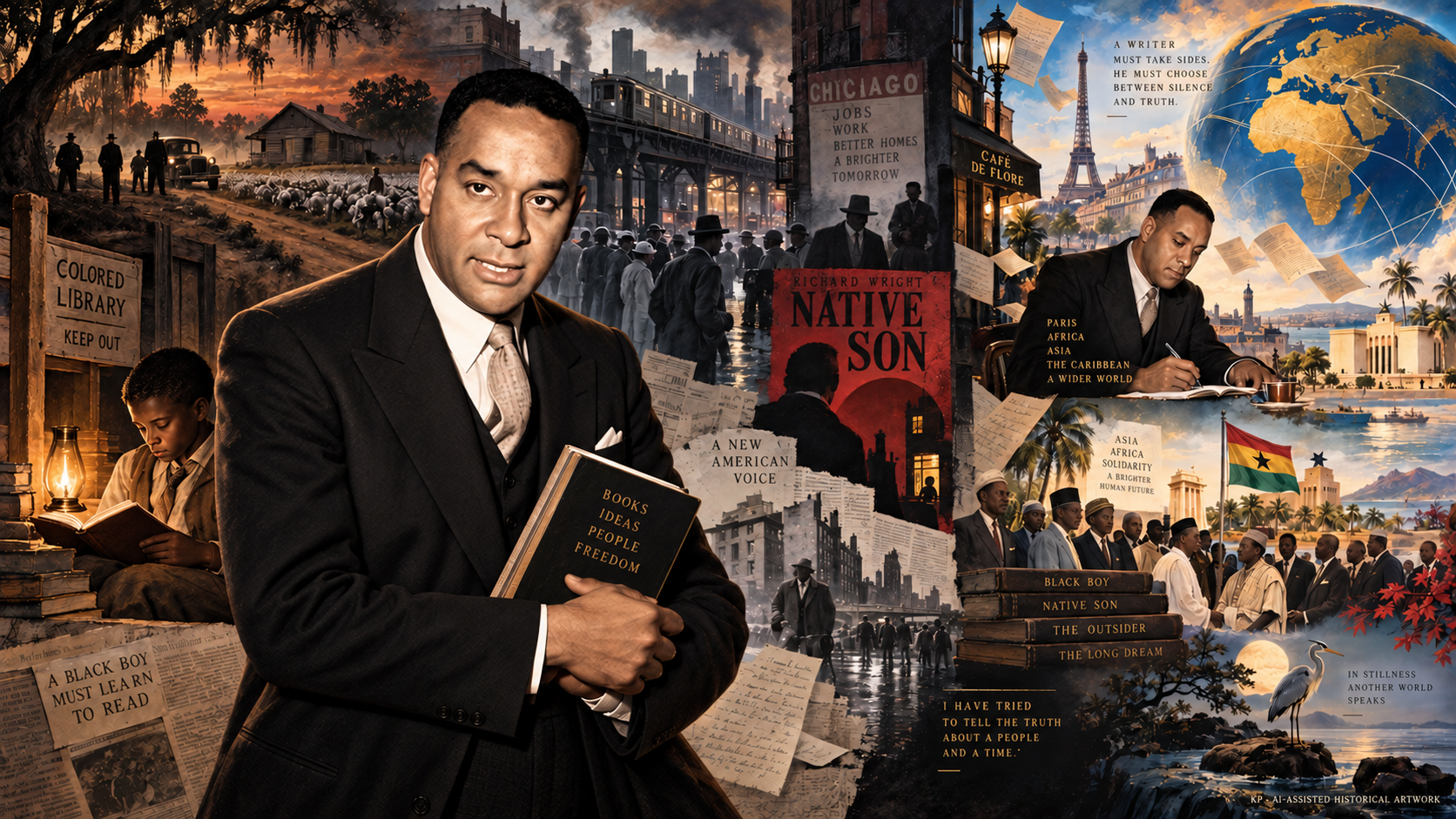
Richard Wright occupies a commanding place in twentieth-century American and African American letters. Novelist, memoirist, essayist, short-story writer, poet, political journalist, and international commentator, he made literature answerable to the lived realities of racial oppression, economic deprivation, fear, exile, and the human need for self-realization. His work did not invite readers to regard racism as a regional prejudice or a private moral failing; it revealed it as an organized social order capable of shaping consciousness, restricting aspiration, and deforming intimate life. In Wright’s fiction and autobiography, hunger is both literal and metaphysical: a hunger for food, education, dignity, freedom, and a life in which Black people might be recognized as fully human.
Born into the post-emancipation South, only a generation removed from the Maafa, Wright experienced Jim Crow as a total environment, shaped by poverty, family separation, religious coercion, racial violence, and exclusion from formal education. These conditions shaped his intellectual life. Yet the very harshness of those conditions sharpened his attachment to books and language. “Whenever my environment had failed to support or nourish me,” he later wrote in Black Boy, “I had clutched at books.” That gesture—turning to reading where society had withheld nourishment—became central to both his life and his art.
Wright’s career carried him from Mississippi and Tennessee to Chicago and Harlem, then to Paris, Africa, Asia, and Europe. Along the way, he moved through radical politics, Communist Party organizing, literary celebrity, government surveillance, expatriation, existentialism, and anti-colonial thought. His achievement lies not only in the landmark success of Native Son and Black Boy, but also in the breadth of his intellectual development: he transformed the particular injuries of Black life in the United States into a searching inquiry into power, alienation, and the international struggle against racial and colonial oppression.
The Southern Forge: Childhood, Terror, and Intellectual Hunger
Richard Nathaniel Wright was born on 4 September 1908 on Rucker’s Plantation near Natchez, Mississippi. His origins were rooted in the immediate aftermath of the Maafa. His father, Nathan Wright, was an illiterate sharecropper; his mother, Ella Wilson Wright, had trained as a schoolteacher. Both sides of his family carried the memory of captivity. His grandfathers had been in bondage and, according to the document, had secured their freedom through service during the Civil War: his paternal grandfather served in the 28th United States Colored Troops, while his maternal grandfather had liberated himself and served in the United States Navy. Wright’s life therefore began within a family history marked by bondage, military service, precarious freedom, and the long aftermath of Reconstruction’s defeat.
His childhood was unstable almost from the beginning. When he was about five or six, his father abandoned the family for another woman. The departure left his mother struggling to support Richard and his brother amid the economic constraints imposed upon Black women in the segregated South. The family moved repeatedly between Mississippi, Tennessee, and Arkansas, following fragile opportunities for shelter and work. Wright’s early years were punctuated by hunger, illness, discipline, and insecurity—experiences that later gave Black Boy its relentless emotional intensity.
Several events shaped his childhood memories. As a small boy in Natchez, he accidentally set fire to his grandparents’ home and was beaten so severely by his mother that he lost consciousness. In 1915, after Ella’s health failed, Wright and his brother spent time in a Methodist orphanage in Memphis. He attended the Howe Institute there from 1915 to 1916. These disruptions were compounded by his mother’s later paralyzing stroke, which fragmented the household and forced him into the care of relatives. By age twelve, the accumulated effects of family crisis and movement meant he had not completed even one uninterrupted school year.
The most enduringly traumatic episode occurred in Elaine, Arkansas, where Wright’s family lived with his aunt Maggie and her husband, Silas Hoskins. Hoskins had established a successful saloon business, but a Euro-American man coveting that success murdered him. The family fled in terror, aware that the killing could expose them to further danger. Wright later recalled the murder as his closest early encounter with what he called the “white-hot face of terror.” His question—why had the family not fought back?—was met not with an answer but with fear and punishment. The incident helped establish a central pattern in Wright’s writing: racial violence was never merely an individual atrocity but a system of social intimidation that compelled Black families to regulate their speech, movement, feeling, and imagination.
In Jackson, Mississippi, Wright lived in the strict household of his maternal grandmother, a Seventh-day Adventist. Religious doctrine became another arena of conflict. He experienced his grandmother’s faith not as comfort but as discipline, repression, and an assault on intellectual independence. He was required to pray, subjected to beatings, and constrained by Sabbath rules that even limited his ability to work and earn money. His aunt Addie, who taught him at a Seventh-day Adventist school, reinforced the atmosphere of authoritarian control. These experiences shaped Wright’s lasting suspicion of organized religion and dogmatic systems more broadly. In later writing, he often treated religious certainty and political orthodoxy as related forms of psychological confinement: both could demand submission at the cost of independent thought.
Yet Jackson also revealed Wright’s gifts as a student and writer. In 1921, after entering Jim Hill public school, he was advanced to the sixth grade within two weeks. He worked to afford clothing, food, and books, but academic accomplishment offered him a brief recognition denied in other areas of life. In 1924, at about fifteen, he published his first short story, “The Voodoo of Hell’s Half-Acre,” in the local Black newspaper Southern Register. The publication mattered as an early declaration of intellectual purpose. Writing, even then, represented a way of refusing the narrow identity assigned to him by poverty and segregation.
When Wright graduated as valedictorian from Smith Robertson Junior High School in 1925, he encountered another test of independence. The school principal handed him a pre-written graduation speech designed to avoid offending Euro-American officials. Wright refused to deliver words that were not his own, despite threats that his graduation might be blocked and suggestions that obedience could bring him a future teaching post. He ultimately read his own speech. The episode prefigured his adult career: he would repeatedly reject the demand that Black writers make their experience palatable to European authority.
Financial necessity prevented him from continuing his education. He enrolled at the newly built, segregated Lanier High School in Jackson in September 1925, but attended only briefly before leaving to work. His formal education ended early, but his self-education was only beginning.
Books, Migration, and Political Awakening
At seventeen, Wright moved to Memphis, where he worked as a dishwasher, delivery boy, and optical helper. In the city, he confronted the everyday machinery of segregation in a particularly revealing form: Black people were excluded from the public library. Determined to read, he persuaded an Irish co-worker to lend him a library card. Wright then forged notes to the librarian identifying himself as the Irish man’s messenger and requesting books. The scheme gave him access to works by H. L. Mencken as well as literary periodicals such as Harper’s, The Atlantic Monthly, and The American Mercury.
The library stratagem was a decisive act in Wright’s intellectual formation. It showed both the absurd cruelty of segregation and the resourcefulness required to resist it. Mencken’s criticism of Southern provincialism and hypocrisy made a profound impression on him. Wright recognized in prose a weapon: language could name realities that a racial order required people to deny. His subsequent career would expand that discovery into a formidable body of fiction and nonfiction.
In 1927, Wright left the South for Chicago, joining the wider Great Migration of African Americans seeking possibility beyond the legal and social suffocation of Jim Crow. Chicago offered a relative release from Southern racial ritual, but not liberation from racism or poverty. Wright worked a succession of exhausting jobs, including postal clerk or sorter, street sweeper, ditch digger, insurance worker, and laboratory animal caretaker at Michael Reese Hospital. During the Great Depression, he lost his postal employment and went on relief. The industrial North exposed him to another form of social constraint: crowded Black neighborhoods, job insecurity, labor exploitation, and residential segregation.
Chicago nevertheless became the city in which Wright found a political and literary community. In the early 1930s, he began attending the John Reed Club, a Marxist cultural organization, and formally joined the Communist Party in 1933. Communism initially gave him a language through which to understand the links between racial oppression and class exploitation. It also connected him with writers, workers, and organizers who took Black intellectual life seriously. He founded the South Side Writers Group with figures including Arna Bontemps and Margaret Walker, edited the literary magazine Left Front, and published revolutionary poetry in journals such as New Masses, Anvil, and Partisan Review.
The New Deal’s Federal Writers’ Project provided another important opening. Through the WPA, Wright gained employment and experience as a professional writer; he later contributed to New York Panorama, including its essay on Harlem. He moved to New York in 1937 and became the Harlem editor of the Communist newspaper Daily Worker. There he wrote more than 200 articles addressing the crises of Depression-era life. For a writer who had been denied the ordinary resources of formal education, this period was an extraordinary apprenticeship in journalism, political analysis, and public argument.
But Wright’s relationship with the Communist Party was never uncomplicated. He admired its declared commitment to working people and racial equality, yet he increasingly encountered ideological rigidity, factional suspicion, and racism within its ranks. He was criticized for valuing literary complexity over Party propaganda, and he became disillusioned with the Party’s shifting priorities during the Second World War, particularly its retreat from militant opposition to segregation to support the American war effort. He gradually broke with the Party between roughly 1942 and 1944, later recounting his disillusionment in The God That Failed in 1949. The rupture did not erase Marxism’s importance to his development; rather, it deepened his hostility to any institution that demanded the surrender of independent consciousness.
Literary Breakthrough and the Making of a National Figure
Wright’s national reputation was established with Uncle Tom’s Children in 1938. The collection of novellas addressed lynching, Southern racial terror, labor conflict, and Black resistance. Its title deliberately engaged the legacy of Harriet Beecher Stowe’s Uncle Tom’s Cabin, but Wright rejected sentimental portrayals of Black suffering. He later judged the collection harshly, believing that it allowed readers the emotional comfort of pity rather than forcing them to confront the social structures responsible for violence. He resolved that his next book would be “so hard and deep” that readers would have to face its reality “without the consolation of tears.”
That next book was Native Son, published in 1940. The novel made Wright a major literary figure and changed the scale of Black authorship in American publishing. It became a bestseller and was the first novel by an African American writer selected as a main choice of the Book-of-the-Month Club. Its protagonist, Bigger Thomas, is a young Black man living in Chicago’s South Side, hemmed in by poverty, segregation, fear, and the constant threat of white power. After accidentally killing Mary Dalton, the daughter of his wealthy white employer, Bigger enters a spiraling sequence of concealment, panic, violence, and capture.
The significance of Native Son lies in Wright’s refusal to make Bigger harmless, exemplary, or reassuring. Bigger is not offered as a universal representative of Black people, nor is he a simple villain. His consciousness has been formed under conditions of acute social restriction. Wright asked readers to recognize how a racist order produces fear, rage, estrangement, and distorted forms of agency. Bigger’s violence is horrifying, but Wright insists that the society surrounding him cannot be treated as morally innocent. The novel’s great provocation was its argument that the most brutal acts of an oppressed individual must be understood in relation to the structures that have denied that person education, opportunity, safety, and meaningful self-determination.
The book’s impact was immediate. Paul Green adapted it for Broadway, and Orson Welles directed it in 1941. In 1951, Wright himself played Bigger Thomas in an Argentinian film adaptation. Although the film was not successful, the decision to embody his own character testifies to Wright’s intense identification with the questions the novel raised: what happens to a human being forced to live within a social world that anticipates his failure, criminality, or death?
Wright followed Native Son with 12 Million Black Voices in 1941, produced with photographer Edwin Rosskam. The book offered a folk history of Black Americans, connecting the rural South, migration, labor, dispossession, and urban life. Its political force was such that the FBI investigated whether it violated sedition laws. The surveillance fit into a broader pattern. Wright’s Communist past, international connections, and uncompromising criticism of American racism brought him under FBI scrutiny from the early 1940s, and this attention continued during his years abroad.
In 1945 Wright published Black Boy, the memoir that remains one of the most powerful works of autobiographical writing in American literature. The book recounts his Southern childhood: hunger, family instability, racial intimidation, religious conflict, work, reading, and the developing conviction that he must become a writer. It is not simply a record of events; it is a narrative of consciousness. Wright describes the formation of an individual determined to find meaning in a world that repeatedly imposes meaningless suffering. The memoir’s famous declaration that “men can starve from a lack of self-realization as much as they can from a lack of bread” expresses the ethical core of his life’s work. He understood that material and spiritual deprivation were intertwined.
The original conception of the autobiography extended beyond the South to include Wright’s Northern years and his disillusionment with Communism. That material, eventually known as American Hunger, was removed from the initial publication at the request of the Book-of-the-Month Club and appeared posthumously in restored form in 1977. The editorial history itself illustrates a recurrent tension in Wright’s career: publishers welcomed the dramatic story of Southern racism but were less ready to embrace his critique of Northern racism, capitalism, and political organizations.
Exile, Internationalism, and Final Years
By the mid-1940s, Wright had become one of the world’s most famous Black writers, yet fame did not protect him from American racism. He remained subject to discriminatory housing practices and government surveillance, while the emerging Cold War intensified suspicion around his political history. In 1946 he left the United States, spending time in Quebec before settling permanently in Paris. He became a naturalized French citizen in 1947.
Paris offered Wright a social and intellectual freedom that he had rarely experienced in America. He entered the orbit of Jean-Paul Sartre, Simone de Beauvoir, and Albert Camus, and participated in the cultural world surrounding Présence Africaine. The move did not mean that he viewed France as free of racism or colonial violence. Instead, it let him live and write with a degree of personal latitude unavailable to him in the United States, while broadening his attention to global questions of empire, liberation, and human freedom.
His fiction shifted during this period. The Outsider (1953), often described as the first American existentialist novel, turns from the social naturalism of Native Son toward questions of metaphysical alienation, freedom, power, and moral responsibility. Its protagonist, Cross Damon, attempts to break free from the constraints of identity and social obligation, only to discover the destructive consequences of seeking absolute autonomy. In Savage Holiday (1954), Wright explored psychological and sexual anxiety. His later novel The Long Dream (1958) returned more directly to Mississippi and to the devastating ways white supremacy shaped the relationship between Black fathers and sons.
Wright’s nonfiction became increasingly international and anti-colonial. He traveled to the Gold Coast, later Ghana, and published Black Power in 1954, an account of the territory’s movement toward independence and of Kwame Nkrumah’s political rise. He attended the Bandung Conference in Indonesia in 1955 and produced The Color Curtain in 1956, a major reflection on the gathering of Asian and African nations seeking to challenge colonial domination and Cold War alignment. In White Man, Listen! (1957), he developed arguments about race, colonialism, and the need for Western societies to confront the historical violence underpinning their global power. These works demonstrate that Wright’s thinking had expanded beyond the United States without abandoning its central questions. Jim Crow, he came to see, belonged to a wider world system of racial hierarchy and imperial control.
Exile, however, was no simple refuge. Wright remained vulnerable because he needed an American passport to travel and reside abroad. The document describes the pressure he faced from U.S. authorities, including confidential reporting after his 1953 Gold Coast trip and meetings with State Department representatives in Paris. His political choices in this period have generated debate, particularly because they reflect the compromised position of a writer trying to remain abroad while watched by the government of the country he had left. Wright’s later years were further marked by conflict in the expatriate literary world, including his painful break with James Baldwin after Baldwin’s critique of Native Son in “Everybody’s Protest Novel.”
Wright’s final creative turn was unexpectedly delicate. During the last eighteen months of his life, while ill and increasingly isolated, he wrote more than 4,000 haiku. He selected 817 for publication, though the collection appeared posthumously as Haiku: This Other World in 1998. The poems reveal another dimension of a writer often associated with urban terror and political confrontation: an attentiveness to weather, animals, seasonal change, solitude, mortality, and nature’s restorative presence.
On 28 November 1960, Wright entered the Eugène Gibez clinic in Paris for medical attention connected to recurring illness, including amoebic dysentery. He died suddenly of heart failure that night at the age of fifty-two. He was cremated with a copy of Black Boy, and his ashes were placed in Père Lachaise Cemetery. His daughter Julia and his friend Ollie Harrington later voiced suspicions about the possibility of government involvement in his death, suspicions shaped by the documented fact of long-term surveillance; the document presents these as allegations rather than established proof.
Legacy: A Writer Who Changed the Ground
Richard Wright’s legacy rests on the force with which he altered what American literature could confront. Before him, Black writers had of course produced major works of fiction, poetry, history, and autobiography. Wright’s distinctive achievement was to bring the psychological violence of racial oppression into the center of mass American literary culture with an intensity that could not be easily domesticated. Native Son made visible the fear, fury, and confinement produced by segregation; Black Boy gave enduring form to the consciousness of a child and young man refusing intellectual surrender.
His influence on later writers was both direct and complicated. He offered practical assistance to writers including James Baldwin, Chester Himes, and Gwendolyn Brooks, and he became a necessary point of reference for writers such as Ralph Ellison, Lorraine Hansberry, Ann Petry, George Lamming, Amiri Baraka, and Toni Morrison. Baldwin’s relationship with Wright demonstrates the complexity of that inheritance. Baldwin criticized Wright’s protest fiction for reducing character to social condition, yet he also acknowledged that Wright’s example had helped him survive: Wright proved that a young Black man from Mississippi and Chicago could become a writer of international consequence.
Wright’s work has also invited sustained criticism, particularly concerning its treatment of women, the gendered meanings of violence, and the limitations of naturalist protest fiction. Such criticism does not diminish his importance; it shows the scale of the questions he placed before readers. His writing continues to provoke debate because it refuses easy moral resolution. It makes demands: that readers consider how social systems enter the psyche, how fear can become a mode of living, and how the desire for freedom can assume tragic forms when ordinary avenues to dignity are blocked.
Posthumous editions and archival discoveries have renewed attention to Wright’s range. Works including Eight Men (1961), Rite of Passage (1994), A Father’s Law (2008), and the restored novel The Man Who Lived Underground (2021) have expanded the public understanding of his unfinished and suppressed work. Restored versions of Native Son and Black Boy have also returned censored material to the texts, enabling readers to encounter more fully the work Wright intended.
Richard Wright remains essential because he treated literature as a site of moral and political reckoning. He gave language to the injuries of a world built on racial hierarchy, but he also wrote from an unyielding belief that self-realization was a human necessity. His life—from a plantation near Natchez to the literary and political centers of Chicago, New York, Paris, Accra, and Bandung—embodies the movement of a Black intellectual who refused confinement, whether imposed by Jim Crow, poverty, dogma, political parties, publishers, or nations. His work endures as testimony, accusation, philosophical inquiry, and a fierce declaration that no society can claim justice while denying people the conditions to become fully themselves.
Sources:
https://en.wikipedia.org/wiki/Richard_Wright_(author)
https://www.poetryfoundation.org/poets/richard-wright
https://www.britannica.com/biography/Richard-Wright-American-writer
https://archive.nytimes.com/www.nytimes.com/learning/general/onthisday/bday/0904.html
https://www.jbhe.com/features/59_richardwright.html
https://www.math.buffalo.edu/~sww/wright/wright_bio.html
https://www.youtube.com/watch?v=uEM933JHXUc
https://www.biography.com/authors-writers/richard-wright
https://www.nypl.org/sites/default/files/archivalcollections/pdf/Sc_Micro_R1234-1235mg309.pdf
https://antilogicalism.com/wp-content/uploads/2020/07/native-son.pdf
https://www.jetir.org/papers/JETIR1902950.pdf
https://fullpdfword.com/look-up/mL3A60/601783/5041042-richard-wright-the-man-who-lived-underground