
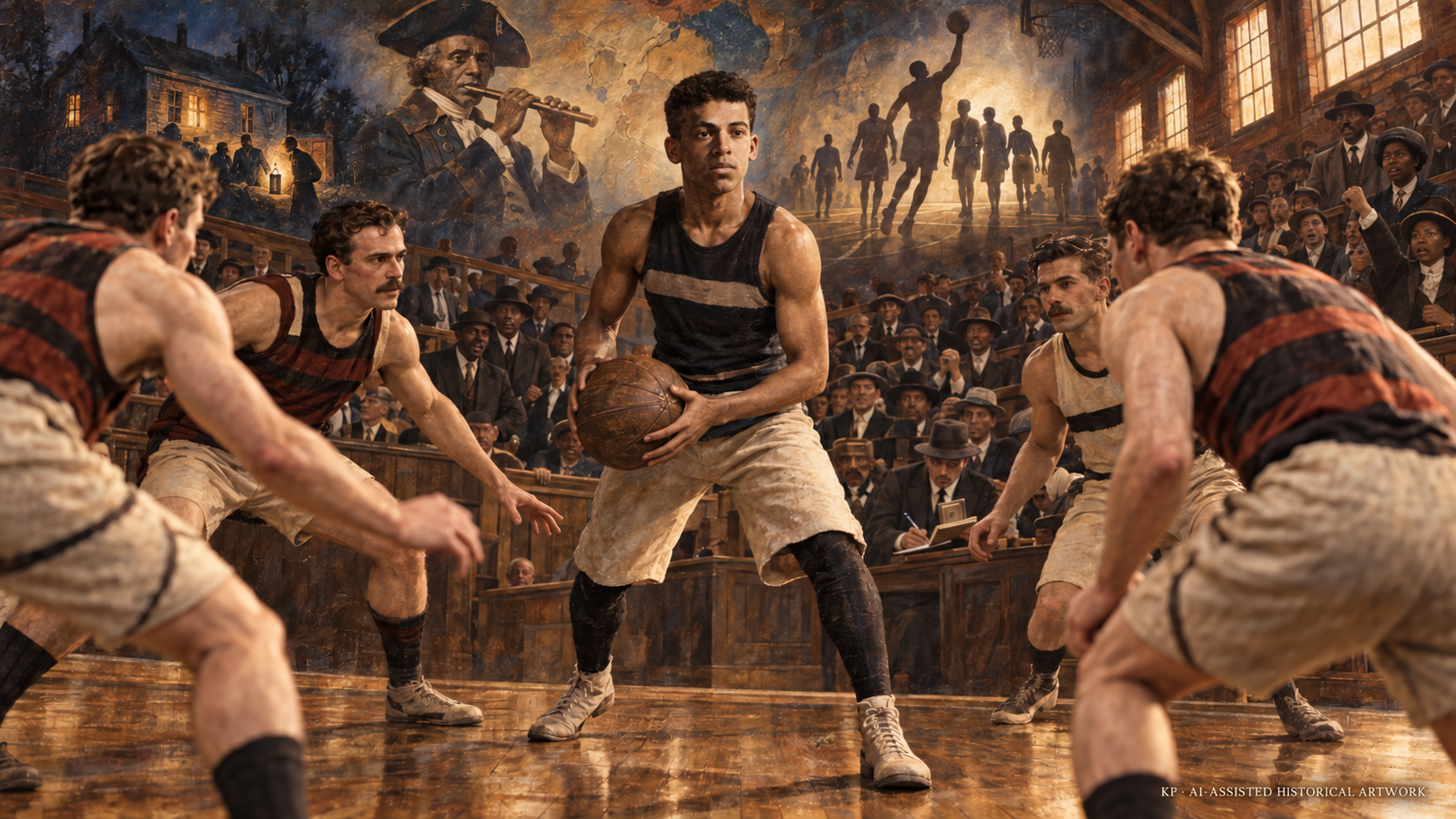
Harry Haskell “Bucky” Lew is best known as the first Black professional basketball player in the United States. In 1902, at age 18, he joined Lowell’s Pawtucketville Athletic Club in the newly formed New England Basketball League. Lew would spend more than two decades in the game as a player, coach, manager, referee, and team owner.
Harry Haskell Lew was born in Pawtucketville, Lowell, Massachusetts, on 4 January 1884, into a prominent Black family with a long and distinguished history in Massachusetts. His relatives had long been active in struggles for freedom, civil rights, education, and community advancement.
Lew’s great-great-grandfather, Barzillai Lew, was a free Black man who purchased the freedom of his future wife, Dinah Bowman, for $400. A gifted musician, he served as a soldier and fifer during the American Revolution, including at the Battle of Bunker Hill and, later, at General John Burgoyne’s surrender following the Battles of Saratoga. The Lowell home of Lew’s grandparents, Adrastus Lew and Elizabeth Freeman, was a stop on the Underground Railroad.
Later generations continued this legacy. Lew’s father, William Adrastus Lew, was a delegate to the 1891 Equal Rights Convention in Boston. His sister, Teresa Lew, was salutatorian of Lowell High School’s class of 1912 and later became one of Massachusetts’s earliest Black women teachers. His brother, Gerard Nelson Lew, helped found Chicago’s DuSable Museum of African American History in 1961 and became its first president.
Known as “Bucky” from childhood, Lew joined the Lowell YMCA’s “young employed boys” basketball team at age fourteen. His YMCA team won state championships during the four years he played with it, from 1898 to 1902.
In 1902, Lew was recruited by Lowell’s Pawtucketville Athletic Club, or P.A.C., of the New England Basketball League. His signing made him the first Black player known to have played professional basketball in the United States. Yet the team manager initially refused to let him play. Even after injuries depleted the team, the manager preferred to play four Pawtucketville men against opposing five-man teams rather than use Lew. As the team began to lose, however, local supporters demanded that he be allowed to play.
Lew finally entered his first professional game on 2 November 1902.
Years later, in a 1958 interview with Springfield Union reporter Gerry Finn, Lew recalled that first game:
“I can almost see the faces of those Marlborough players when I got into that game,” said Lew, who was seventy-four when the article was published. “Our Lowell team had been getting players from New York, New Jersey, Pennsylvania, and some of the local papers put the pressure on by demanding that they give this [Black] from around the corner a chance to play. Well, at first the team just ignored the publicity. But a series of injuries forced the manager to take me on for the Marlborough game. I made the sixth player that night and he said all I had to do was sit on the bench for my five bucks pay. There was no such thing as fouling out in those days so he figured he’d be safe all around.
It just so happens that one of the Lowell players got himself injured and had to leave the game. At first this manager refused to put me in. He let them play us five on four but the fans got real mad and almost started a riot, screaming to let me play. That did it. I went in there and you know… all those things you read about Jackie Robinson, the abuse, the name-calling, extra effort to put him down… they’re all true. I got the same treatment and even worse. Basketball was a rough game then. I took the bumps, the elbows in the gut, knees here and everything else that went with it. But I gave it right back. It was rough but worth it. Once they knew I could take it, I had it made. Some of those same boys who gave the hardest licks turned out to be among my best friends in the years that followed.”
A 5-foot-8 player who played the “left back” position—an early predecessor of the modern guard—Lew became a popular and respected figure in New England basketball. He played in the New England League, which later became the New England Association and disbanded after the 1905 season. In 1907, he joined the Springfield Athletic Club. After that team disbanded, Lew organized a traveling team with four other players; for more than twenty-five years, they barnstormed across New England. He also coached, managed, refereed, and owned teams during his long career in the sport.
Lew’s pioneering achievement came nearly five decades before the NBA’s racial integration. In 1950, the Boston Celtics selected Charles Cooper, the first Black player drafted by an NBA team. The Celtics later became the first NBA team to start five Black players during the 1964–65 season, and in 1966 appointed Bill Russell as the first Black head coach in major U.S. professional sports. Lew’s career did not cause these later breakthroughs, but it stands as an earlier and consequential challenge to racial exclusion in professional basketball.
“Bucky Lew was a man of courage and perseverance. He didn’t talk about basketball,” his daughter Phyllis told a reporter. “But sometimes, if things weren’t going well for one of us or if we were having difficult times, he’d talk about how things were for him back then. He used his athletic experiences to teach us what life was about.”
Lew died in Springfield, Massachusetts, on 22 October 1963, at age 79. Although he was not inducted into the Naismith Memorial Basketball Hall of Fame in Springfield, he was posthumously inducted into the American Basketball Hall of Fame in 2026—long-overdue recognition for a player whose courage expanded the possibilities of professional basketball.
Source:
http://www.biography.com/people/harry-lew-21465453
https://en.wikipedia.org/wiki/Harry_Lew
http://www.massmoments.org/moment.cfm?mid=9
https://libguides.uml.edu/c.php?g=1125577&p=8215152
https://www.wwlp.com/news/local-news/springfield-basketball-pioneer-bucky-lew-receives-hall-of-fame-recognition/