
Walter Theodore “Sonny” Rollins (September 7, 1930–May 25, 2026) was an American tenor saxophonist, composer, and bandleader. Over his remarkable seven-decade career, Rollins became one of the most influential and important figures in jazz history. Revered as the “Saxophone Colossus,” he was celebrated for his masterful improvisations, innovative musical concepts, and the unwavering discipline with which he pursued self-mastery, spiritual growth, and artistic integrity.
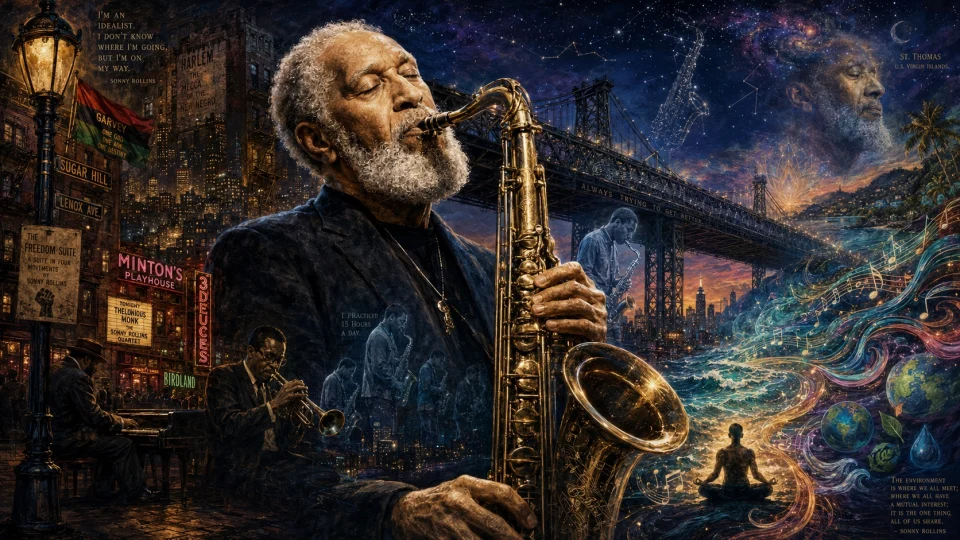
Born in New York City to parents who immigrated from the Virgin Islands, Rollins grew up in Harlem’s Sugar Hill neighborhood—a vibrant center of Black cultural energy and musical innovation. The youngest of three, Rollins was raised in a musically rich household: his brother played violin, his sister played piano, and both received classical training. His grandmother, a devoted follower of Marcus Garvey, was a formative influence, fostering his early political awareness by taking him to rallies for figures like Paul Robeson. Nicknamed “Jester” as a child for his humor, playfulness, and athleticism, Rollins thrived in Harlem’s dynamic street culture, enjoying games like stickball and marbles.
Rollins began his musical journey on piano at around age nine, but was soon captivated by Louis Jordan’s jump blues and R&B, which inspired his move to saxophone. Starting on alto, he switched to tenor at sixteen to emulate his idol Coleman Hawkins, whose commanding sound deeply influenced him. Rollins attended Edward W. Stitt Junior High and later Benjamin Franklin High School in East Harlem, where he was among the first Black students bused into a predominantly Italian area. During this period, he formed a neighborhood band with future jazz luminaries like Jackie McLean, Kenny Drew, and Art Taylor, entering the vibrant world of bebop as it reshaped New York’s music scene.
After high school, Rollins quickly transitioned into professional music. He began performing in 1948 and made his first recordings as a sideman for vocalist Babs Gonzales in 1949. By age twenty, he had already collaborated with jazz greats like J.J. Johnson, Bud Powell, Fats Navarro, and Miles Davis. He earned the nickname “Newk” for his resemblance to Brooklyn Dodgers pitcher Don Newcombe. Around this time, Thelonious Monk became his mentor, offering invaluable guidance and allowing Rollins to rehearse at his apartment. Monk profoundly shaped Rollins’s understanding of musical structure and the art of improvisation.
Rollins’s rise was not without hardship. Deeply admiring Charlie Parker, he emulated not only Parker’s artistry but also his drug use, developing a heroin addiction in his early twenties that led to petty crimes and legal troubles. In 1950, he was arrested for armed robbery and spent ten months on Rikers Island; in 1952, he was arrested again for violating parole. The turning point came in 1955, when he voluntarily entered the Federal Medical Center in Lexington, Kentucky, for experimental methadone therapy. Though he feared sobriety would diminish his artistry, the opposite proved true: Rollins overcame addiction, remained clean for over sixty years, and emerged with renewed discipline and creative power.
That same year, Rollins joined the Clifford Brown–Max Roach Quintet, cementing his status as a leading voice in modern jazz. The years that followed were among his most creative and productive. By 1954, he had already composed “Oleo,” “Airegin,” and “Doxy” during sessions with Miles Davis—pieces that quickly became jazz standards. In 1956, Rollins released Saxophone Colossus, the album most associated with his legacy, featuring “St. Thomas,” a calypso-inspired piece based on a childhood melody from his mother. He also pioneered the pianoless trio—saxophone, bass, and drums—gaining greater harmonic freedom. In 1958, he released The Freedom Suite, a bold political statement protesting the repression of African Americans.
Despite his fame, Rollins remained self-critical, convinced he had not yet reached his true musical or spiritual potential. In 1959, he withdrew from public performance, embarking on the legendary practice sabbatical on the Williamsburg Bridge, where he played up to sixteen hours daily to avoid disturbing neighbors. This period became a modern jazz legend, not for spectacle, but for the extreme discipline and commitment it revealed. When Rollins returned in 1962 with The Bridge, featuring guitarist Jim Hall, the album’s title symbolized his journey through solitude, hard work, and renewal.
Rollins’s personal life was shaped by significant relationships. He married actress and model Dawn Finney in 1957; though brief, their marriage inspired his composition “Sonnymoon for Two.” In 1965, he married Lucille Pearson, who became his life partner, business manager, and producer. Lucille played a crucial role in stabilizing his career and supporting his return to music in the early 1970s. Their marriage lasted thirty-nine years, until her death in 2004, and she remained a sustaining emotional presence throughout his life.
Rollins was a voracious reader who largely educated himself outside formal institutions. His intellectual pursuits deepened alongside a lifelong spiritual search, especially through yoga and meditation—practices he first adopted during his Williamsburg Bridge sabbatical and later expanded during a second hiatus from 1969 to 1971. During this time, he traveled to Japan and India, spending months at an ashram in Powai to study Eastern philosophies, which he credited with bringing “peace to his restless soul.” These disciplines became central to his life, helping him win what he called the “battle with yourself,” foster better habits, and reach the receptive mental state essential for true improvisation. Thanks to yoga, exercise, and disciplined living, he maintained remarkable physical health—reportedly, at age fifty-two, he had the body of an eighteen-year-old.
When Rollins returned to active performance in the early 1970s, his musical vision had expanded. During a prolific period with Milestone Records, he released over two dozen albums, embracing funk, R&B, pop, calypso, and electric influences. While his innovations surprised some listeners, Rollins always stayed true to his artistic instincts—whether delivering uncredited solos on the Rolling Stones’ Tattoo You (1981) or performing extended, unaccompanied saxophone meditations, later captured on The Solo Album. In these years, his music often became a spiritual monologue: free, associative, and deeply rooted in his lifelong study of melody, rhythm, and emotion.
Rollins remained politically engaged and morally serious throughout his life. The influence of his grandmother’s Garveyism and his devotion to Paul Robeson instilled in him the belief that music could be a vehicle for social conscience. This conviction shaped works like The Freedom Suite and later extended to environmental advocacy, with albums such as Global Warming expressing his concern for the planet’s future. Notably non-materialistic, Rollins was present during the September 11, 2001, attacks and witnessed the destruction of the World Trade Center from his nearby apartment. After losing many possessions, he emerged with an even deeper belief that “possessions are not where it’s at.”
The September 11 attacks became a defining episode in Rollins’s later years. Forced to evacuate with only his saxophone, he performed in Boston just five days later—a concert later released as Without a Song: The 9/11 Concert, which earned him a Grammy. The experience reinforced his conviction that music, stripped of ego and material attachment, could serve as witness, resilience, and spiritual affirmation.
Throughout his life, Rollins received an extraordinary array of honors, including NEA Jazz Master, the Grammy Lifetime Achievement Award, the Polar Music Prize, the National Medal of Arts, and the Kennedy Center Honors. Yet, public recognition never altered his introspective outlook. He saw himself less as a finished master and more as someone always striving for deeper creativity and greater personal growth.
Pulmonary fibrosis forced Rollins to stop performing in 2012, and he officially retired in 2014. He spent his final years in Woodstock, New York, overseeing archival releases, reflecting on his journey, and living in spiritual contemplation. He died there on May 25, 2026, at ninety-five. By the end of his life, Sonny Rollins was not only one of jazz’s greatest improvisers, but also a model of discipline and moral seriousness—a man who measured success by the lifelong pursuit of self-improvement, always “trying to get better.”
Source:
https://www.theguardian.com/music/2026/may/26/sonny-rollins-jazz-saxophone-dies-aged-95
https://en.wikipedia.org/wiki/Sonny_Rollins
https://sonnyrollins.com/bio
https://www.kennedy-center.org/artists/r/ro-rz/sonny-rollins/
https://www.bluenote.com/artist/sonny-rollins/
https://achievement.org/achiever/sonny-rollins/
https://www.udiscovermusic.com/stories/sonny-rollins-jazz-saxophonist-interview/