
Ntozake Shange centered Black women’s lives in an expansive literary world. A poet, playwright, novelist, and essayist, she brought speech, music, and movement together in forms that refused to keep the arts separate. Her best-known work, for colored girls who have considered suicide / when the rainbow is enuf, changed the possibilities of the American stage by allowing Black women to speak about their experiences in their own rhythms, with emotional candor, humor, and complexity.
Across her writing, Shange explored the relationship between creativity and self-definition. Her characters danced, cooked, remembered, grieved and made art. They confronted racism and sexism, but their lives were never reducible to those injuries. Desire, friendship, spiritual discovery and the pleasures of everyday life were equally central to her vision.
A Childhood Among Artists
Born Paulette Linda Williams on 18 October 1948 in Trenton, New Jersey, Shange grew up in a family that valued education and the arts. Her father was a surgeon; her mother worked as an educator and social worker. Their home welcomed distinguished Black artists and intellectuals, including Dizzy Gillespie, Miles Davis, Paul Robeson, and W. E. B. Du Bois. Music and intellectual conversation shaped her earliest understanding of the world.
She also attended poetry readings with her younger sister, Wanda, who would become the playwright and novelist Ifa Bayeza. These experiences introduced literature as something heard and shared, not simply encountered on a page.
When Shange was eight, the family moved to St. Louis, Missouri. There, she experienced racial harassment while attending a newly desegregated school. The gap between the cultural richness of her family life and the hostility she encountered outside it became an enduring concern in her writing. Years later, her novel Betsey Brown would revisit the emotional landscape of a Black girl growing up amid school desegregation.
Education and a Chosen Name
At Barnard College, Shange studied American studies and graduated in 1970. Her college years brought her into contact with Black student organizing, anti-war activism and feminist consciousness-raising. She also formed a lasting friendship with the poet and playwright Thulani Davis.
Recognizing how little space existing campus publications gave Black women, Shange helped create and edit Phat Mama. The magazine brought together their writing, photographs, music and visual art. It challenged restrictive representations of Black women’s bodies and offered a space for self-expression on their own terms.
These years also included profound personal distress. A brief early marriage and separation were followed by severe depression and suicide attempts. Such experiences later informed her writing, but she gave them a wider frame: the difficulty of sustaining a sense of self in a society that repeatedly diminished Black women’s lives.
In 1971, she adopted the name Ntozake Shange, turning towards an African identity she had chosen for herself. She understood “Ntozake” as “she who comes with her own things” and “Shange” as “she who walks like a lion”. The name expressed an intention that would run through her career: to enter literature with her own language, cultural inheritances and artistic purposes. She continued her studies at the University of Southern California, earning a master’s degree in American studies.
Creating the Choreopoem
California became a crucial setting for Shange’s artistic development. Working with Halifu Osumare’s dance company in Oakland and collaborating with dancer and choreographer Paula Moss, she began bringing her poetry into closer conversation with movement.
From these exchanges emerged the choreopoem: a performance form that interweaves poetry, dance, music, and drama. Rather than building a play around conventional dialogue and a continuous plot, Shange created sequences in which voices, gestures and rhythms carried the action.
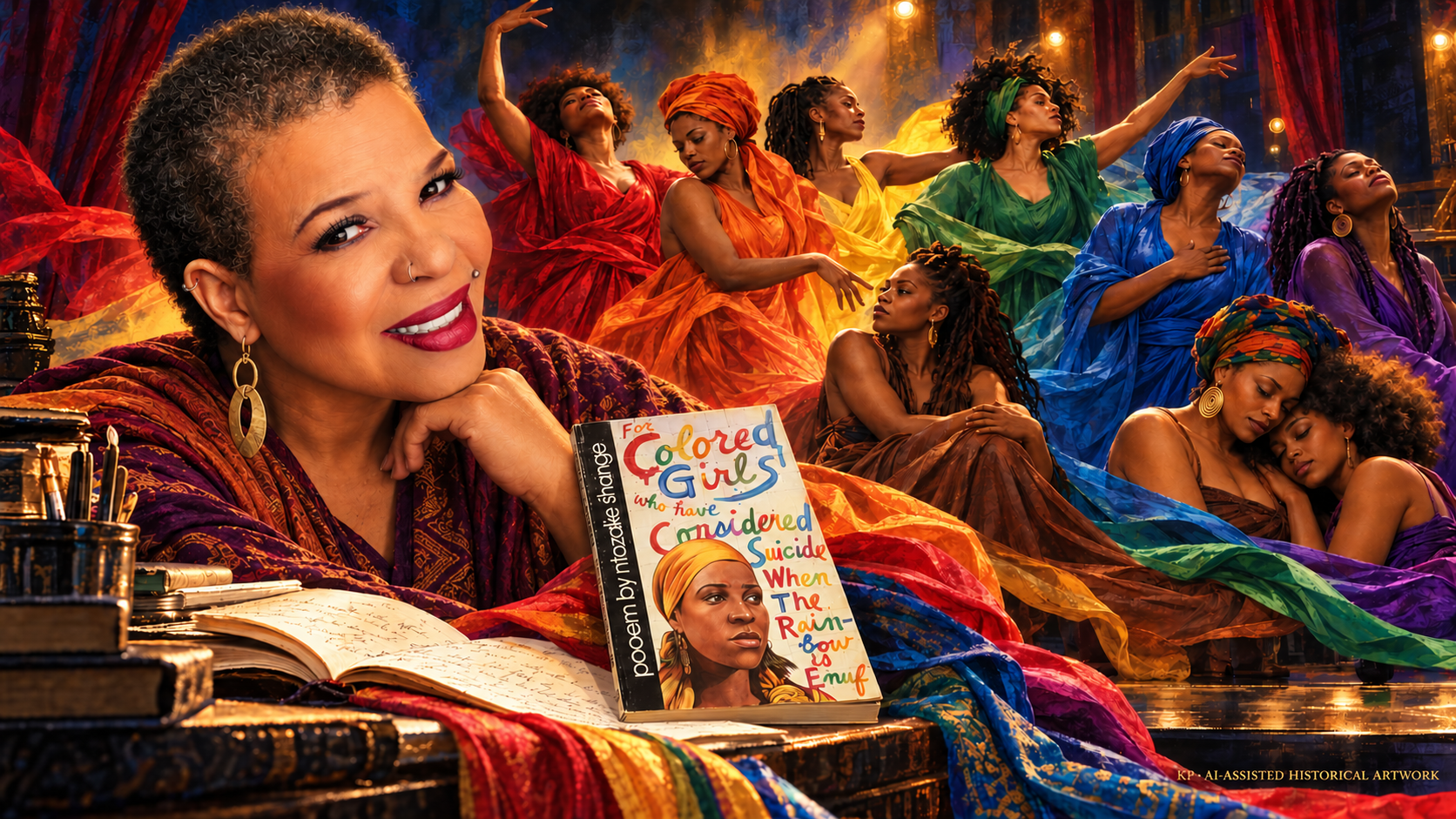
Her defining achievement in this form was for colored girls who have considered suicide / when the rainbow is enuf. Developed through poetry readings and collaborative performance, it reached Broadway’s Booth Theatre in September 1976. The work brings together seven women, identified by colors rather than personal names. Through their stories, Shange explores love, sexual violence, abandonment, motherhood, friendship and the search for self-worth. Individual testimony becomes a shared experience without making the women interchangeable. Each voice retains its own emotional texture. The work’s movement towards affirmation does not erase what the women have endured. Instead, it makes room for recognition, connection, and spiritual discovery. Its declaration, “I found god in myself”, locates sacred value within a self too often denied care and recognition.
The production received major critical attention and an Obie Award, while also provoking debate about relationships between Black women and men. Shange’s refusal to soften difficult experiences challenged expectations about what Black women should disclose in public. Yet the work offered more than an account of suffering: dance, laughter and mutual care were essential to its theatrical life.
A Language That Danced
Shange’s innovations extended from the stage to the page. Lowercase letters, forward slashes, unusual spacing and phonetic spellings became recognizable features of her writing. These choices directed breath, pace and emphasis. They asked readers to listen. Her spelling reflected the language she heard, drawing on Black vernacular and the varied sounds of the African diaspora. Jazz offered another foundation. Phrases stretched, paused, repeated, and shifted direction, carrying the flexibility of musical improvisation.
“I like the idea that letters dance,” she explained. The remark captures the close relationship between her typography and her performance practice. A printed poem could suggest a moving body; a spoken phrase could behave like a musical line. She continued to explore these possibilities in works including spell #7, Boogie Woogie Landscapes and The Love Space Demands. Her adaptation of Bertolt Brecht’s Mother Courage and Her Children also received an Obie Award. Across these projects, she treated theatre as a meeting place for artistic forms rather than a fixed set of conventions.
Fiction, Food and Cultural Memory
Shange’s fiction carried the same appetite for formal experiment. Sassafrass, Cypress & Indigo (1982) blends narrative with recipes, letters, poetry and spells. Its structure makes room for forms of knowledge that conventional literary hierarchies have often overlooked: cooking, domestic creativity, spiritual practice and exchanges between women.
In Betsey Brown (1985), she returned to childhood, family life, and school desegregation. Liliane: Resurrection of the Daughter (1994) explored a Black woman artist’s efforts to remake her life through a sequence of performance-like monologues. With Ifa Bayeza, she later wrote Some Sing, Some Cry (2010), extending her attention to music and family memory across generations.
Food became an especially rich means of tracing cultural connections. In if i can cook / you know god can (1998), recipes accompany essays about history, travel and Black communities across the diaspora. The shared meal becomes a way to remember and belong. Cooking is not incidental to cultural life; it is one of the practices through which people preserve and renew it.
Her range also included poetry collections such as Nappy Edges, A Daughter’s Geography, and Wild Beauty, as well as children’s books, essays, and collaborations with visual artists and photographers.
Teaching and the Work of Continuance
Alongside her writing, Shange taught at institutions including the University of Houston, Rice University and Prairie View A&M University. Her work as an educator extended her commitment to creative exploration and to developing younger writers.
Serious health difficulties, including strokes beginning in 2004, affected her mobility, speech and ability to write. Recovery was lengthy. In later years, she returned to public readings, new work and conversations with readers and scholars.
In 2016, Barnard College acquired her literary papers. For Shange, preserving the archive meant giving future generations access to creative antecedents: evidence that women before them had made art, challenged expectations and fashioned lives around their own visions.
She died on 27 October 2018, aged seventy, in Bowie, Maryland. Her legacy rests not only in a landmark theatrical work but in a sustained expansion of what literature could hold. She made room for the speaking voice and the dancing body, for recipes and remembered songs, for spiritual searching and irreverent laughter. Above all, she gave Black women’s interior lives the breadth and complexity they deserved.
Sources:
https://officialntozakeshange.com/biography/
https://en.wikipedia.org/wiki/Ntozake_Shange
https://www.poetryfoundation.org/poets/ntozake-shange
https://www.youtube.com/watch?v=sNumwCxebDA
https://poets.org/poet/ntozake-shange