
Dizzy Gillespie was one of jazz history’s most influential trumpeters, composers, and bandleaders. In the 1940s, he and Charlie Parker became central figures in bebop’s development, helping reshape the language of modern jazz through intricate melodies, adventurous harmonies, and rhythmic invention. Across a career spanning more than half a century, Gillespie also became a generous teacher, an international musical ambassador and a pioneering collaborator in Afro-Cuban jazz.
Born John Birks Gillespie on 21 October 1917 in Cheraw, South Carolina, he was the youngest of nine children of James and Lottie Gillespie. His father, a bricklayer and amateur bandleader, kept musical instruments in the home and introduced his children to music. Gillespie began playing the piano as a young child and later took up the trombone and trumpet. His father died in 1927, when he was ten. Hearing trumpeter Roy Eldridge on the radio helped shape his growing musical ambitions.
Gillespie received a scholarship to the Laurinburg Institute, an African American school in North Carolina, where he studied for two years, attended music classes and played in the school band. In 1935, he moved to Philadelphia, where his family was living, and began his professional career with Frank Fairfax’s orchestra. During this period, his playful behavior and exuberant personality reportedly earned him the nickname “Dizzy.”
In 1937, Gillespie joined Teddy Hill’s orchestra and made his recording debut on the band’s version of “King Porter Stomp.” His early playing reflected Eldridge’s influence, but he was already developing the technical command and musical curiosity that would distinguish his own approach. He toured Europe with Hill’s band before returning to a succession of engagements with other ensembles.
Gillespie joined Cab Calloway’s orchestra in 1939. With the band, he recorded one of his early compositions, “Pickin’ the Cabbage,” in 1940, while also writing arrangements for other bandleaders. His relationship with Calloway was sometimes strained: Calloway disliked aspects of his mischievous behavior and unconventional soloing. In 1941, an argument over a spitball Gillespie denied throwing escalated into an altercation involving a knife, after which Calloway dismissed him.
During the early 1940s, Gillespie worked with musicians and bandleaders including Ella Fitzgerald, Benny Carter, Earl Hines and Billy Eckstine. His work in the Hines and Eckstine bands brought him into close musical association with Charlie Parker. Meanwhile, late-night sessions in Harlem, including those at Minton’s Playhouse, gave musicians opportunities to explore new harmonic and rhythmic possibilities.
Bebop emerged from this wider community of experimentation. Alongside Gillespie and Parker, musicians including Thelonious Monk, Charlie Christian, Kenny Clarke, Bud Powell and Max Roach helped transform jazz improvisation and ensemble playing. Rather than a complete break with swing, the new music grew from the knowledge, ambitions and working lives of musicians who had developed within the swing era. These innovations took shape within a music industry marked by racial inequality and unequal opportunities for Black musicians. Bebop created new possibilities for artistic authority and professional independence. Its demanding musical language expressed a much broader creative transformation.
The year 1945 proved decisive. Gillespie’s recordings with Parker helped establish bebop as a compelling new musical language. Pieces such as “Groovin’ High,” “Salt Peanuts,” “Shaw ’Nuff” and “Hot House” revealed an approach that could be startling to listeners accustomed to the more familiar patterns of swing. Gillespie’s dazzling technique, harmonic imagination and rhythmic precision made him one of the movement’s defining voices. He also demonstrated that bebop could flourish beyond the small-group setting. His celebrated big band of the late 1940s combined instrumental virtuosity with sophisticated arrangements by musicians including Tadd Dameron, John Lewis, George Russell and Gillespie himself. Despite its musical achievements, financial pressures forced him to disband the orchestra in 1950.
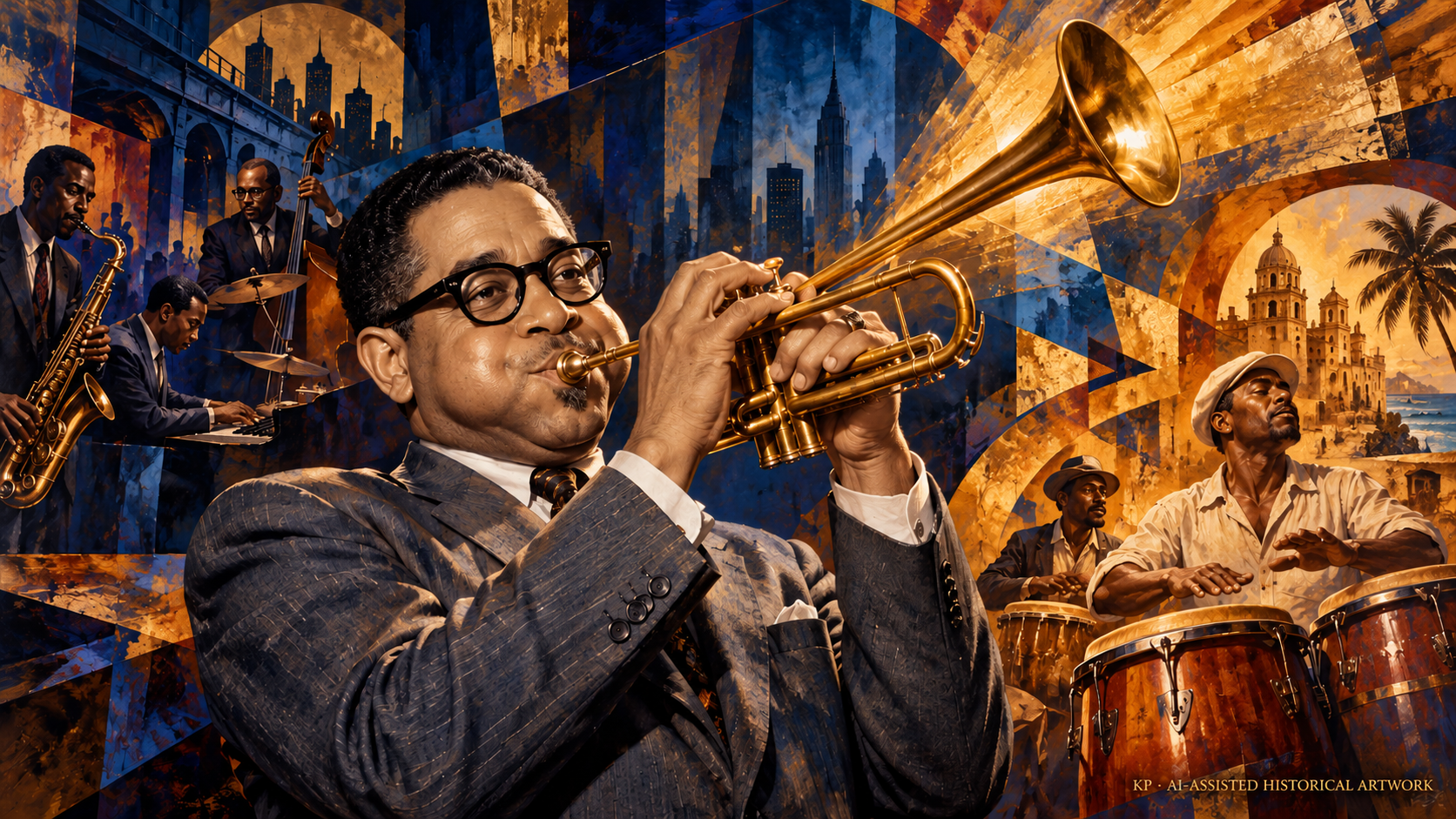
One of Gillespie’s most consequential contributions was his role in developing Afro-Cuban jazz. His friendship with Cuban trumpeter and musical director Mario Bauzá deepened his interest in Afro-Cuban rhythms. In 1947, Bauzá introduced him to Cuban percussionist, composer and dancer Chano Pozo, whose collaboration with Gillespie became a landmark in jazz history. Pozo brought Afro-Cuban rhythmic knowledge, conga playing and compositional ideas into Gillespie’s orchestra. “Manteca,” credited to Gillespie, Pozo and Gil Fuller, became one of the best-known expressions of this collaboration. Gillespie also commissioned George Russell’s “Cubano Be, Cubano Bop,” which featured Pozo. This music—sometimes called “Cubop”—put bebop in dynamic conversation with Afro-Cuban musical traditions.
Gillespie’s own compositions and co-written pieces became enduring parts of the jazz repertoire. Among them were “A Night in Tunisia,” “Groovin’ High,” “Woody ’n’ You,” “Salt Peanuts,” “Blue ’n’ Boogie” and “Con Alma.” His influence extended through both his recordings and his willingness to explain musical ideas to younger players.
In 1953, an accident gave Gillespie another enduring trademark. Someone fell onto it while it stood on a trumpet stand, bending the bell upward. He discovered that he liked the altered sound and projection. Thereafter, he commissioned instruments with bells angled upwards at approximately 45 degrees. Alongside his famously inflated cheeks and irrepressible humor, the bent trumpet became inseparable from his public image.
In 1956, Gillespie led a big band on an overseas tour sponsored by the United States State Department, beginning an important chapter in jazz diplomacy. Further international tours followed. These journeys enabled him to reach new audiences and encounter other musical traditions, while also placing a Black American artist in the complicated position of representing a country still marked by racial discrimination. Gillespie continued to tour and record extensively in the following decades, usually leading small groups but periodically returning to larger ensembles. During the 1970s, his recordings included collaborations with Oscar Peterson and Count Basie. His autobiography, To Be, or Not … to Bop, appeared in 1979.
His generosity as a teacher shaped his influence. Miles Davis was among the younger musicians who learned from him, while later protégés included Arturo Sandoval and Paquito D’Rivera. Gillespie’s bands also provided opportunities for musicians such as John Coltrane, James Moody, Jimmy Heath and Yusef Lateef. In his later years, Gillespie led the United Nations Orchestra, bringing together musicians from different national and musical backgrounds. The ensemble continued his long commitment to collaboration across the Americas. He also appeared in the 1991 film The Winter in Lisbon and composed and performed music for its soundtrack.
Gillespie received numerous honours during his lifetime. He was named an NEA Jazz Master in 1982, received a Grammy Lifetime Achievement Award in 1989, and was honored by the Kennedy Center in 1990. Prize laureate, Gillespie learned of the honor before his death but did not live to attend the ceremony in Stockholm. Wynton Marsalis accepted the award on his behalf.
Dizzy Gillespie died of pancreatic cancer on 6 January 1993 in Englewood, New Jersey, aged 75. He was buried in Flushing Cemetery in Queens, New York. A private funeral service was followed by a public memorial at the Cathedral of St. John the Divine, where fellow musicians, friends and admirers gathered to celebrate his life.
His Bahá’í faith played an important role in his later life, and a Bahá’í service was included in the observances following his death. He was survived by his wife, Lorraine Willis Gillespie, whom he had married in 1940, and his daughter, jazz singer Jeanie Bryson.
Gillespie’s legacy joins extraordinary musical invention with generosity, humor and an expansive sense of human connection. Rooted in African American musical life, his work helped renew the conversation between jazz and the African-derived traditions of Cuba and the wider Americas. His achievement was not simply to bring different sounds together, but to make collaboration itself a source of discovery—opening new possibilities for the musicians who followed him.
In 2014, the New Jersey Hall of Fame posthumously inducted him, another recognition of a musician whose influence continues to resonate across generations and national boundaries.
Source:
http://www.dizzygillespie.com/
http://www.biography.com/people/dizzy-gillespie-9311417#commercial-success
https://en.wikipedia.org/wiki/Dizzy_Gillespie
http://www.pbs.org/jazz/biography/artist_id_gillespie_dizzy.htm
http://www.nytimes.com/learning/general/onthisday/bday/1021.html
http://www.telegraph.co.uk/news/obituaries/5894450/Dizzy-Gillespie.html
https://www.arts.gov/honors/jazz/john-birks-dizzy-gillespie
https://www.polarmusicprize.org/laureates/dizzy-gillespie
https://www.wtju.net/jazz-at-100-hour-23-birth-of-bebop/
https://chum338.blogs.wesleyan.edu/2014/12/26/bebopped-and-rebopped-the-births-of-bebop-and-invisible-man/
https://www.wsws.org/en/articles/1998/05/bop-m22.html
https://www.thejazzarts.org/news/artist-stories/dizzy-gillespie-chano-pozo-and-afro-cuban-jazz/
https://www.prestomusic.com/jazz/articles/4079–classic-recordings-dizzy-gillespie-and-chano-pozos-cubano-bop
https://www.smithsonianmag.com/smithsonian-institution/dizzy-gillespie-and-his-bent-trumpet-114626062
https://www.americanhistory.si.edu/explore/exhibitions/entertainment-nation/online/dizzy-gillespies-trumpet
https://en.wikipedia.org/wiki/Jazz_ambassadors
https://www.grammy.com/artists/dizzy-gillespie/16741
https://www.grammy.com/awards/categories/best-jazz-performance-by-a-soloist/1976
https://www.washingtonpost.com/archive/lifestyle/style/1990/12/02/the-big-daddy-of-the-be-bop-dizzy-gillespie/f5b8f0e3-605e-4946-a2ea-9e3acedfc7d5
https://www.studiocanal.com/title/el-invierno-en-lisboa-1991
https://www.latimes.com/archives/la-xpm-1993-01-14-ca-1661-story.html
https://www.nytimes.com/1993/01/13/arts/thousands-gather-to-hear-praise-for-dizzy-gillespie.html
https://bahai.works/In_Memoriam_1992-1997/John_Birks_%E2%80%9CDizzy%22_Gillespie
https://njhalloffame.org/hall-of-famers/2014-inductees/dizzy-gillespie/
https://musicbrainz.org/release/024f461c-21a0-4661-97c4-93b726563c34