
On 19 October 1840, the American schooner Hermosa struck a reef near Spanish Key in the Abaco Islands. The vessel had left Richmond, Virginia, bound for New Orleans. Alongside cotton goods and tobacco, it carried African American captives being transported for sale in the expanding plantation economy of the Lower South. Within days, the wreck became far more than a maritime accident. It opened an unexpected road to freedom and exposed a widening conflict between two legal worlds.
The liberation that followed is sometimes presented as an automatic consequence of British law. The fuller history is more compelling. Bahamian wreckers chose where to take the survivors. Magistrates and a priest informed the captives of their legal standing. African-descended soldiers protected them from seizure. Nassau’s residents crowded the streets and hearing rooms, making it difficult for American representatives to regain control. Formal law mattered, but law alone did not secure freedom. People did.
The Hermosa belonged to the maritime branch of the United States’ domestic traffic in African Americans. Although Congress had prohibited overseas importation in 1808, people continued to buy and transport them openly within the country. Federal regulations required ship captains to file manifests recording the names, ages, sex, complexion, height, and claimed ownership of those carried between American ports. Bureaucracy made forced migration appear orderly, legitimate, and routine.
Richmond stood near the northern end of this commercial network, while New Orleans became one of its largest receiving markets. Traffickers moved thousands of people from Virginia and the wider Chesapeake into the cotton and sugar regions. These journeys separated families, ruptured communities, and reduced human lives to entries in account books, customs forms, insurance policies, and shipping records.
The Hermosa’s surviving manifest was dated 10 October 1840. It preserves the names of 47 people intended for transport, including Lewis Johnson, aged forty-five; Reuben Francis, sixteen; Edward Parker, thirty-five; ten-year-olds Louisa Gibbs, Dicey Lumkin, and France Toublin; and Betsy Green, aged thirty. Naming them matters. The commercial documents reduced them to transferable assets, but the names reveal individuals of different ages whose lives had already extended far beyond the record their captors created.
Henry N. Templeman, a prominent Richmond trafficker, entered most of the people on the manifest. Others were entered by L. C. Read and Lancaster, Denby & Company. Later testimony collectively associated the group with Robert Lumpkin, another well-known Richmond trafficker, but the manifest shows the voyage’s commercial interests were broader. The familiar description of everyone aboard as belonging to Lumpkin therefore obscures the larger trafficking network.
There is also a numerical discrepancy. The Richmond manifest lists 47 intended passengers, while the later international claim cites 38 people aboard when the schooner foundered. One scholarly account gives a total of 48. The documentary evidence currently supports the careful formulation that 47 were listed for departure, while 38 were present at the wreck and became the subject of the compensation proceedings. What happened to the remaining nine remains unclear.
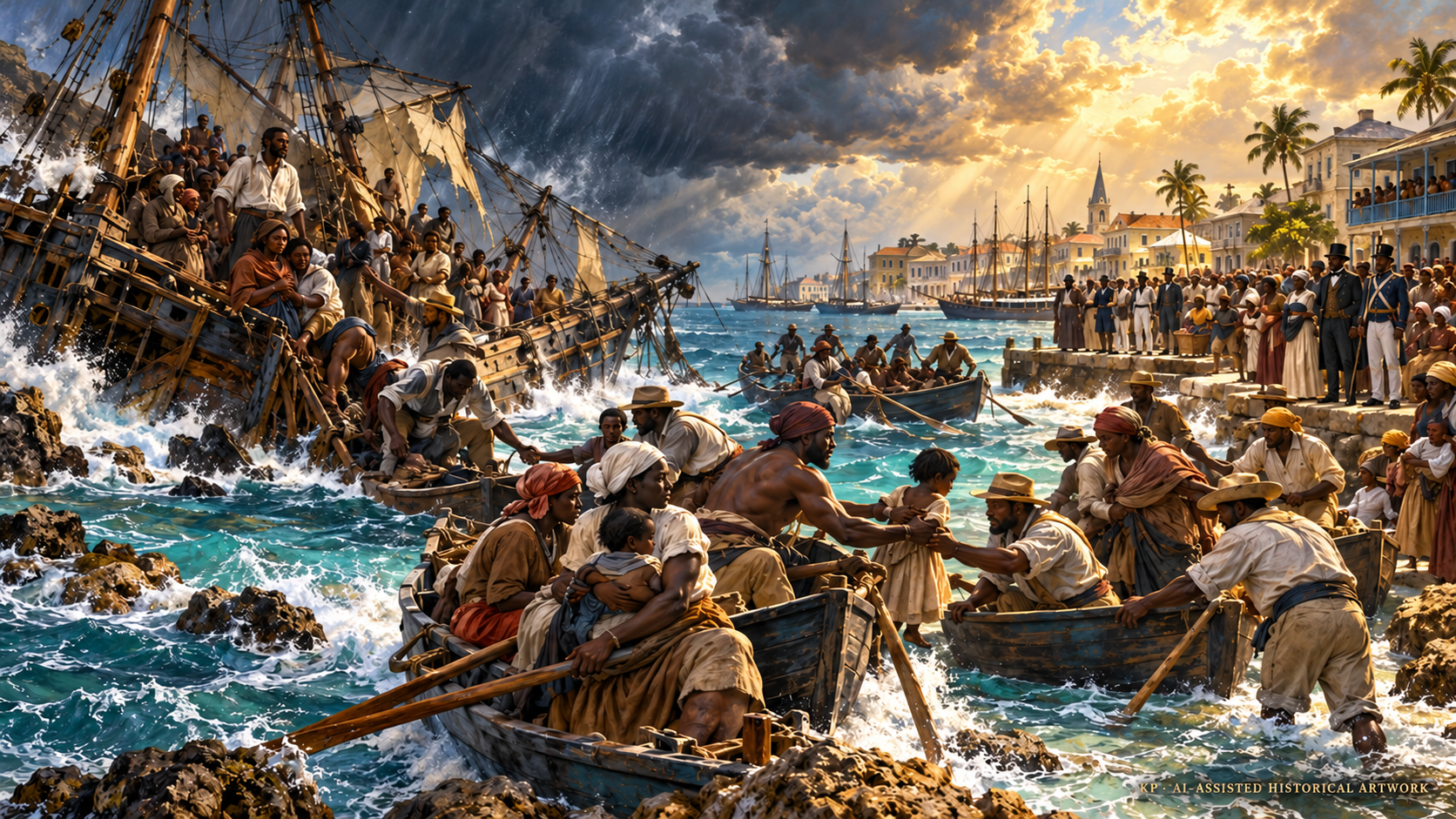
When the Hermosa foundered, Bahamian wreckers reached the vessel and rescued everyone aboard. Wrecking demanded considerable knowledge of reefs, tides, winds, and local waters. Governor Francis Cockburn later acknowledged that the boatmen had saved the captives from probable death. They salvaged the cargo and carried the survivors toward Green Turtle Cay rather than to an American port, despite Captain John L. Chattin’s request.
That decision changed the captives’ future. Britain had ended legal human bondage in most of its Caribbean territories in 1834, although the coercive apprenticeship system continued until 1838. By the time the Hermosa entered Bahamian waters, American documents claiming possession of human beings had no clear standing there. A short stretch of sea had carried the group across a profound legal boundary.
At Green Turtle Cay, Chattin went ashore to dispute the situation with customs officers. During his absence, stipendiary magistrates and a priest boarded the wrecking vessels and told the African Americans that they were free. This marked the first decisive break in the captain’s control: the people learned that the legal relationship imposed on them in Virginia could not simply carry over into the Bahamas.
After the survivors reached Nassau, Chattin consulted the United States consul, John F. Bacon. They tried to keep the people aboard and sought another vessel to carry them onward to New Orleans. They argued that the Hermosa had entered Bahamian jurisdiction by accident rather than choice and that British officials were therefore obliged to help restore the interrupted voyage.
The Nassau magistrates rejected that position. Supported by armed members of the West India Regiment, they boarded the vessel and removed the people. They took the group to a magistrate’s office, where Chattin and Bacon continued their protests. Yet the proceedings did not unfold quietly behind closed doors. Nassau’s residents gathered in such numbers that Chattin complained he could not hear what was being said and that he and Bacon were pushed outside.
The crowd prevented the Americans from quietly transporting the group away. Black soldiers guarded the newly liberated people during their first night in Crown buildings and stopped Chattin from communicating with them. By the following morning, when he tried once more to reclaim them, they had disappeared into the crowds of Nassau’s market.
This disappearance was the practical completion of freedom. The group did not remain gathered for the convenience of the documents that sought to count, value, or recover them. They entered Nassau’s social world and moved beyond the captain’s reach. Unfortunately, the surviving records scholars have examined have not yet revealed what became of most of them. Their later lives remain one of the Hermosa’s most important unanswered questions.
British benevolence alone cannot be credited with the liberation. The legal difference between the United States and the Bahamas created an opening, but Bahamian action made that opening real. Wreckers controlled the rescue route. Magistrates and clergy communicated legal freedom. Soldiers prevented seizure. The people of Nassau turned official proceedings into a public reckoning and provided a human landscape into which the liberated group could safely vanish.
This collective action grew out of earlier encounters. The Comet wrecked in 1831, the Encomium in 1834, and bad weather drove the Enterprise into Bermuda in 1835. Each case brought American claims over captive African Americans into conflict with British Caribbean law and local freedom-making. The Hermosa was therefore part of an emerging maritime geography in which reefs, ports, boats, information networks, and neighboring jurisdictions could interrupt the southward traffic in human lives.
Bahamian participation also unsettles the familiar image of emancipation flowing from legislators and governors. People interpreted and defended freedom in streets, boats, markets, barracks, and crowded hearing rooms. The outcome depended upon people who understood that a legal declaration meant little if the captain retained physical custody. They acted to close the distance between freedom written on paper and freedom lived in the world.
The story traveled quickly. In November 1841, African American captives aboard the Creole took control of that vessel while it sailed from Virginia toward New Orleans. During the uprising, participants demanded to be taken to the British islands—where the people carried by Lumpkin’s vessel had gained their freedom the previous year. Their destination was Nassau.
Their knowledge demonstrates what historian Philip Troutman describes as African American “geopolitical literacy.” News moved through holding pens, markets, docks, vessels, family connections, and conversations among captives and free people. Those threatened with forced transportation studied geography and law because both could become instruments of liberation. The Hermosa offered recent proof that the boundary between the United States and the Bahamas could also be a boundary between captivity and freedom.
The Creole participants turned an accident into a deliberate strategy. They did not wait for weather or shipwreck. They redirected their vessel toward a destination already inscribed in collective memory. In this way, the people freed from the Hermosa shaped one of the most consequential shipboard liberation struggles in nineteenth-century American history, even though the archive preserves only faint traces of their words.
American traffickers, insurers, and government representatives pursued compensation for years. Their case argued that a distressed American vessel remained protected by the law of its flag and that British intervention had caused an unlawful financial loss. The opposing argument held that no foreign document could require the Bahamas to recognize a claim over human beings that its own laws did not sustain.
An Anglo-American claims commission eventually considered the Hermosa alongside the Enterprise and Creole. In 1855, umpire Joshua Bates awarded $16,000—divided equally between the Louisiana State Marine and Fire Insurance Company and the New Orleans Insurance Company. Templeman had transferred his claim to those firms. The liberated people received nothing for abduction, confinement, forced transportation, shipwreck, or the attempt to carry them onward for sale.
The payment reveals the dispute’s moral architecture. Traffickers and insurers treated freedom as a commercial injury. The people whose lives had been priced became almost invisible once the discussion moved into diplomacy and finance. Yet the legal award could not reverse what had happened in Nassau. Thirty-eight African Americans had passed beyond Chattin’s reach, and knowledge of their liberation had already helped others chart the same course.
The Hermosa therefore belongs to a history larger than shipwreck or diplomacy. It shows how African American knowledge traveled, how Bahamian communities turned legal possibility into lived freedom, and how the sea could become a corridor between captivity and self-possession. A wreck on an Abaco reef became a remembered passage—and, for those who followed, a map.
Sources:
https://legal.un.org/riaa/cases/vol_xxix/26-53.pdf
https://resolve.cambridge.org/core/services/aop-cambridge-core/content/view/EDF7324ED06B4C19B1C09A37DE8E550C/9781108476249c3_66-76.pdf/several-cases.pdf
https://cris.brighton.ac.uk/ws/portalfiles/portal/305385/All_We_Have_Done.pdf
https://academic.oup.com/jsh/article/47/4/897/2871023
https://www.archives.gov/research/african-americans/slavery-records-civil.html
https://www.archives.gov/research/african-americans/slave-ship-manifests.html
https://dokumen.pub/rebellious-passage-the-creole-revolt-and-americas-coastal-slave-trade-1108476244-9781108476249-9781108700009.html
https://www.cambridge.org/core/books/rebellious-passage/04285EE7E6F691153D43C3C0EC2BE400/listing
https://doi.org/10.12987/yale/9780300103557.003.0009
https://encyclopediavirginia.org/entries/omohundro-silas-1807-1864
https://legal.un.org/riaa/volumes/riaa_XXIX.pdf
https://www.sciencedirect.com/org/science/article/pii/S1382237323001393
https://academic.oup.com/ahr/article-abstract/128/2/648/7204447
https://www.nationalarchives.gov.uk/explore-the-collection/explore-by-time-period/georgians/1833-abolition-of-slavery-act-and-compensation-claims
https://www.italaw.com/sites/default/files/case-documents/riaa/RIAA-XXIX-26/italaw19501325%20-%20The%20Enterprise,%20the%20Hermosa%20and%20the%20Creole%20%28United%20States%29%20v%20-%20Opinions%20of%20the%20Commissioners%20and%20Decisions%20of%20the%20Umpire%20%28Bates%29,%20December%2023,%201854.pdf
https://czasopisma.uni.lodz.pl/pnh/article/download/6390/9257
https://onlinelibrary.wiley.com/doi/10.1111/glob.12209
https://www.cambridge.org/core/journals/international-review-of-social-history/article/all-we-have-done-we-have-done-for-freedom-the-creole-slaveship-revolt-1841-and-the-revolutionary-atlantic/E3E603AB597D0992A87D59A7D84E9A9C
https://www.cambridge.org/core/services/aop-cambridge-core/content/view/E3E603AB597D0992A87D59A7D84E9A9C/S0020859013000254a.pdf/all-we-have-done-we-have-done-for-freedom-the-creole-slave-ship-revolt-1841-and-the-revolutionary-atlantic.pdf
https://cambridgeblog.org/2019/03/rebellious-passage-the-creole-revolt-and-americas-coastal-slave-trade-2/
https://academic.oup.com/ahr/article/131/3/1224/8812423
https://www.bookey.app/book/the-heroic-slave/quote
https://www.govinfo.gov/content/pkg/SERIALSET-00396_00_00-045-0051-0000/pdf/SERIALSET-00396_00_00-045-0051-0000.pdf
https://cris.brighton.ac.uk/ws/files/5107480/Black_Atlantic_Maritime_Networks_Resistance_and_the_American_Domestic_Slave_Trade.pdf
https://jusmundi.com/en/document/decision/en-the-hermosa-v-great-britain-decision-of-the-umpire-mr-bates-saturday-23rd-december-1854
https://academic.oup.com/book/7497/chapter/152421807