
Bernard Jeffrey McCullough—known to the world as Bernie Mac—was an American comedian, actor, writer, and producer whose fearless stand-up, distinctive Chicago voice, and wide-ranging screen work made him one of the defining Black entertainers of his generation. A member of The Original Kings of Comedy, Mac rose from the comedy clubs of Chicago’s South Side to star in the acclaimed sitcom The Bernie Mac Show and become a memorable presence in films including Ocean’s Eleven, Bad Santa, Guess Who, Mr. 3000, and Soul Men.
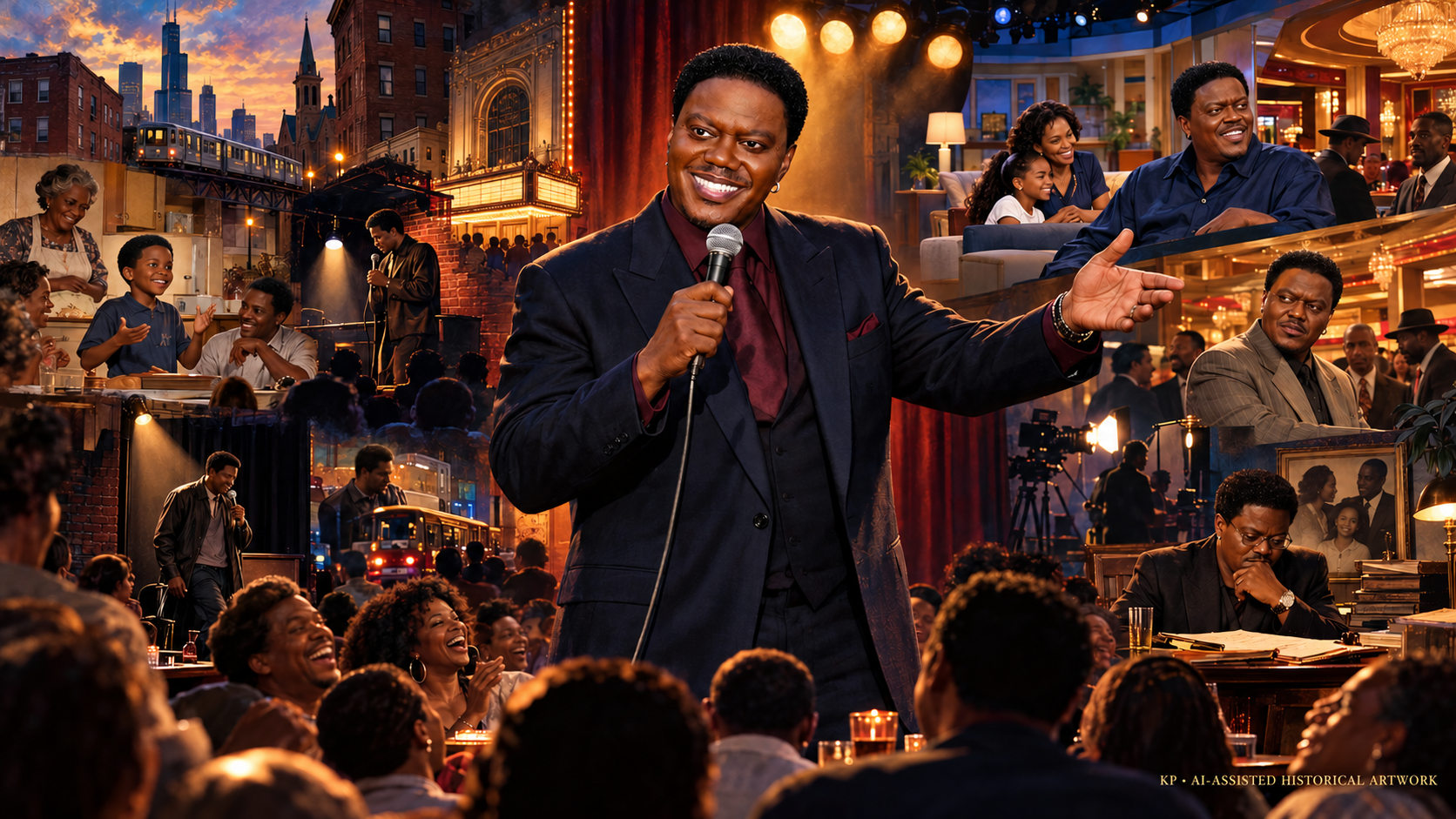
Bernie Mac was born on 5 October 1957 in Chicago, Illinois. He grew up on the city’s South Side in a close but financially struggling family. He lived with his mother, Mary McCullough, and his grandparents, in a household shaped by discipline, humor, faith, and survival. In his memoir, Maybe You Never Cry Again, he recalled a childhood when money was scarce, but laughter became a source of strength and release. Mac’s mother was central to his early life and ambitions. He later remembered seeing her crying when he was a small boy, only to watch her begin laughing at something on television. That moment taught him comedy’s emotional power: laughter could interrupt grief, create relief, and help people endure difficult circumstances. As a child, he began entertaining relatives and churchgoers with impressions and jokes, quickly discovering he could command a room.
When Bernie Mac was sixteen, his mother died of breast cancer. Her death was a devastating loss, but the confidence she had placed in him remained a lasting source of motivation. In Maybe You Never Cry Again, he recalled her belief that he would one day surprise people with what he could achieve. He later endured the deaths of other close family members, experiences that deepened the mixture of pain, toughness, love, and humor that became central to his comedy.
Mac began performing comedy while still young, first at church dinners and local events, then at open-mic nights and comedy clubs across Chicago. He worked a series of jobs while building his career and became a regular master of ceremonies at the city’s Cotton Club. In 1990, he won the Miller Lite Comedy Search at Chicago’s Regal Theatre, a breakthrough that helped bring him national attention. His major television breakthrough came in 1992 on HBO’s Def Comedy Jam. Walking onstage before a difficult audience, Mac opened with the defiant line that became inseparable from his public identity: “I ain’t scared of you [expletive].” The moment revealed the essential qualities of his performance style—directness, bravado, improvisational control, and an ability to transform tension into laughter. It also announced him as a comedian unafraid to confront audiences on his own terms.
Mac’s early acting career developed alongside his stand-up success. He made his film debut in Damon Wayans’s Mo’ Money in 1992, then appeared in films including Who’s the Man? (1993), House Party 3 (1994), Friday (1995), Spike Lee’s Get on the Bus (1996), Don’t Be a Menace to South Central While Drinking Your Juice in the Hood (1996), How to Be a Player (1997), The Players Club (1998), and Life (1999). He also appeared on television, including a recurring role on Moesha, and hosted the 1995 HBO special Midnight Mac.
In 2000, Bernie Mac joined Steve Harvey, Cedric the Entertainer, and D. L. Hughley in Spike Lee’s concert film The Original Kings of Comedy. The film introduced the quartet’s touring show to a far larger audience and established Mac as one of the most powerful comic voices in the United States. His set combined family stories, sharply observed working-class humor, profanity, vulnerability, and a commanding performance style that made him stand out even among an exceptional group of comedians.
The next year, Mac achieved the greatest television success of his career with Fox’s The Bernie Mac Show. Co-created with Larry Wilmore, the sitcom ran for five seasons, from 2001 to 2006, and produced 104 episodes. Mac played a fictionalised version of himself: a successful comedian unexpectedly raising his sister’s three children while speaking directly to the camera about family life, discipline, marriage, work, and the challenges of parenting. The Bernie Mac Show was more than a conventional family sitcom. Its direct-address style allowed Mac to bring the intimacy and force of stand-up comedy into a scripted television format. The show received a Peabody Award and won an Emmy for comedy writing. Mac received two Primetime Emmy nominations, in 2002 and 2003, and two Golden Globe nominations, in 2003 and 2004, for his performance as “Uncle Bernie.”
Mac’s film career continued to flourish during the series’ run. In Steven Soderbergh’s Ocean’s Eleven (2001), he played the quick-witted con artist Frank Catton alongside George Clooney, Brad Pitt, and an ensemble cast that returned for Ocean’s Twelve and Ocean’s Thirteen. He later starred in Bad Santa (2003), Mr. 3000 (2004), Guess Who (2005), Pride (2007), and Soul Men (2008). Guess Who, in which he starred opposite Ashton Kutcher, was a loose comic reversal of the interracial-marriage premise of Guess Who’s Coming to Dinner rather than a direct remake of the 1967 film.
In 1977, Bernie Mac married Rhonda Gore, his high-school sweetheart. They had one daughter, Je’Niece, and remained married for more than thirty years. Rhonda Mac remained one of the most important figures in his life, sharing the uncertainty of his early career and later helping preserve his legacy.
Bernie Mac lived with sarcoidosis, an inflammatory disease that can affect the lungs and other organs. He was diagnosed in 1983 and publicly discussed the condition in 2005, saying that it had gone into remission. In July 2008, he was hospitalized at Northwestern Memorial Hospital in Chicago with pneumonia. He died there on 9 August 2008, aged fifty, from complications of pneumonia after more than two weeks in intensive care.britannica+2
Alongside his work in comedy, film, and television, Mac wrote two books: I Ain’t Scared of You: Bernie Mac on How Life Is (2001), written with Darrell Dawsey, and Maybe You Never Cry Again (2003), written with Pablo F. Fenjves. The second book is a deeply personal account of family, grief, comedy, ambition, and the mother whose faith in him remained a guiding force throughout his life.
Bernie Mac’s legacy rests not only on the catchphrases, films, and awards that made him famous, but on the unusual emotional range of his work. He could be confrontational and tender, profane and deeply family-centered, theatrical and startlingly intimate. His comedy carried the texture of Black Chicago life into American popular culture, and his success opened further space for Black performers to tell family stories with authority, complexity, and unapologetic humor.
Source:
http://www.imdb.com/name/nm0005170/bio?ref_=nm_ov_bio_sm
http://www.foxnews.com/story/2008/08/09/comedian-and-actor-bernie-mac-dies-at-age-50.html
http://www.people.com/people/article/0,,20218110,00.html
http://www.biography.com/people/bernie-mac-9542611#career-highlights
https://www.britannica.com/biography/Bernie-Mac
https://www.televisionacademy.com/features/news/tvfilm-comedy-king-bernie-mac-dies-50
https://www.chicagotribune.com/2008/08/10/bernie-mac-1957-2008
https://www.harpercollins.com/products/maybe-you-never-cry-again-bernie-mac?variant=32205797031970
https://www.berniemacfoundation.org/about
https://www.publishersweekly.com/9780060529284