
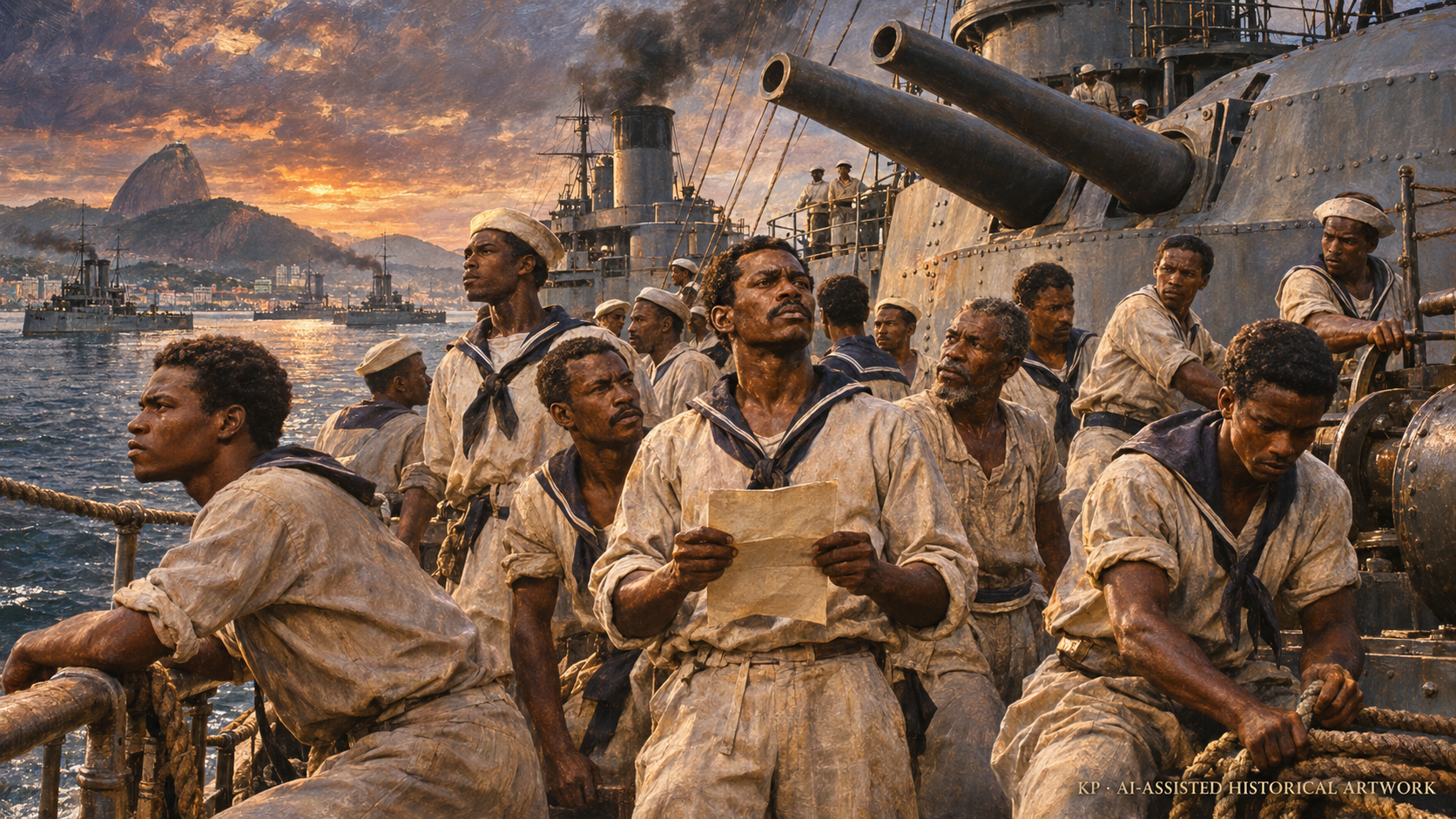
On the night of November 22, 1910, sailors aboard Brazilian warships in Rio de Janeiro rose against the beatings and degrading treatment that structured their working lives. Within hours, they had seized several of the fleet’s most important vessels, including the recently acquired battleships Minas Geraes and São Paulo. Their guns now faced the capital of a republic that demanded their service while denying them dignity.
Known as the Revolta da Chibata— Revolt of the Lash —the uprising brought about 1,500 to 2,000 sailors confronting the Brazilian government. Most were Black or mixed-race men recruited from impoverished communities. Their central demand was unequivocal: the whip had to go. Alongside it came demands for adequate food, better pay, and an end to abusive treatment. For several days, men accustomed to being beaten into obedience compelled the country’s political leaders to negotiate.
A Modern Fleet, an Entrenched Brutality
The revolt exposed a contradiction at the heart of Brazil’s naval expansion. The government had invested heavily in advanced warships, presenting their acquisition as evidence of national progress. Yet the men who operated these vessels continued to endure practices rooted in the country’s plantation past.
Only twenty-two years separated the uprising from Brazil’s legal emancipation of 1888. Freedom had not dismantled the racial inequalities that shaped access to employment, education, and public recognition. Within the navy, those inequalities were particularly stark. Commissioned ranks remained socially exclusive, while crews consisted largely of poor Black and mixed-race Brazilians.
Recruitment could involve coercion, police roundups, and compulsory apprenticeships. Once aboard, sailors faced lengthy commitments, exhausting work, inadequate pay, and poor food. Spoiled provisions and nutritional deficiencies added illness to an already punishing environment.
Physical punishment reinforced these conditions. Sailors could be struck across the hands with a wooden implement or publicly whipped before their shipmates. Although the republic had initially prohibited corporal punishment, subsequent naval provisions preserved avenues for its continued use. The public beating was therefore more than an individual penalty: it demonstrated whose body could be injured with institutional approval.
The same men expected to master sophisticated machinery were denied basic bodily security. Their technical responsibilities belonged to the twentieth century; their treatment carried forward the violence of an earlier social system.
Building Resistance Across the Fleet
The November uprising did not emerge from a single moment of anger. Sailors had discussed their grievances and developed connections across vessels before the confrontation began.
For some, time spent in Britain during the construction and preparation of Brazil’s new battleships sharpened their understanding of what could be different. In Newcastle upon Tyne, Brazilian crews encountered shipyard workers, labor organizing, and working conditions that contrasted with their own. Contact with other maritime workers widened the possibilities they could imagine for themselves.
These experiences did not create the sailors’ grievances. Those came from daily life aboard Brazilian ships. But travel and exchange helped place those grievances within a broader world of collective resistance. Accounts of other naval uprisings, including the 1905 rebellion aboard the Russian battleship Potemkin, also circulated.
Networks and clandestine committees gave the movement a foundation beyond spontaneous protest. The sailors understood both the risks of resistance and the strategic importance of the ships they operated. Their work had given them the knowledge needed to navigate, maintain, and use vessels on which the government had spent enormous sums.
The Beating That Precipitated the Revolt
The immediate catalyst was the public flogging of Marcelino Rodrigues Menezes aboard Minas Geraes. Accounts assembled in the document place the number of strokes between 250 and 350—an extraordinary assault inflicted while fellow sailors were made to watch.
The beating made continued submission intolerable. A punishment intended to frighten the crew instead helped precipitate a coordinated rebellion.
On the evening of November 22, sailors aboard Minas Geraes moved against their officers. Fighting broke out, and the ship’s captain, João Batista das Neves, was killed, along with others. The violence of the seizure marked the opening of a confrontation whose outcome remained uncertain.
The rebellion rapidly extended across the fleet. Alongside Minas Geraes and São Paulo, the sailors took the cruiser Bahia and the coastal-defense vessel Deodoro. João Cândido Felisberto emerged as a leading figure, but the uprising depended on a wider network of organizers and participating crews. Francisco Dias Martins, Gregório Nascimento, and Ricardo Freitas were among those associated with its leadership.
The Capital Confronts the Sailors’ Demands
By November 23, the government faced an extraordinary situation. Some of its most formidable warships were in the hands of men it had expected to remain obedient under the lash.
The insurgent crews maneuvered in Guanabara Bay and directed their heavy guns toward Rio de Janeiro. Messages sent to the newly inaugurated president, Hermes da Fonseca, demanded an end to whipping and other physical punishments, improved food and pay, and the removal of abusive officers.
These were concrete demands arising from working conditions. The sailors sought to transform the terms of naval service: competence and duty could no longer be treated as compatible with routine humiliation and bodily injury.
Their handling of the vessels became part of the confrontation. Maintaining navigation, communications, machinery, and coordinated movements required substantial expertise. By operating the ships without their commissioned officers, the crews demonstrated abilities that racial prejudice had persistently discounted.
The threat to the city was nevertheless real. Gunfire during the confrontation killed civilians, including two children on Castello Hill, according to the document. The sailors reportedly contributed money toward their funerals. Those deaths formed part of the uprising’s human cost, even as the crews sought recognition of their own humanity.
Negotiation and the Promise of Amnesty
An assault on the occupied ships carried serious risks. The government’s remaining naval resources could not easily overcome the vessels held by the sailors, and an extended exchange of fire threatened the capital.
José Carlos de Carvalho, a federal deputy and former naval captain, visited the ships as an intermediary. His assessment reinforced the seriousness of the sailors’ grievances and the difficulty of defeating them through an immediate attack.
In Congress, Senator Rui Barbosa advocated a negotiated settlement. Debate centered on ending the confrontation without exposing Rio de Janeiro to further destruction. Amnesty offered a route toward that settlement by promising protection from prosecution for participation in the revolt.
By November 26, the sailors had accepted the agreement and returned the vessels. Their campaign had forced the rejection of whipping as an acceptable naval practice and secured a public promise of protection. Yet surrendering the ships also meant relinquishing the leverage that had brought the government to the negotiating table.
Retaliation After the Agreement
The settlement did not bring security. Dismissals and punitive measures followed, undermining the promise that the sailors could resume their lives without retaliation.
A separate outbreak among naval infantry on Ilha das Cobras on December 9 provided the government with an opportunity to widen its crackdown. A state of siege followed, and men associated with the November revolt were swept into arrests and detention.
Imprisonment became another form of lethal retaliation. On Ilha das Cobras, eighteen men were confined in a cramped cell, where extreme heat and exposure to quicklime created suffocating conditions. Sixteen died overnight. João Cândido was one of only two survivors.
Other sailors were deported toward the Amazon aboard the steamship Satélite. Deportation exposed them to forced labor, disease, and further violence; some prisoners were killed during the journey. Mass discharges also destroyed livelihoods, separating experienced sailors from the occupation in which they had developed their skills.
The government had negotiated when the crews held the ships. Once those ships had been returned, it pursued many of the men whose grievances it had agreed to address.
A Victory That Did Not Protect Its Participants
The Revolt of the Lash achieved a decisive objective: it forced an end to the whip as an accepted instrument of naval discipline. But that achievement coexisted with imprisonment, expulsion, deportation, and death.
Its significance lies in this unresolved relationship between collective victory and personal devastation. The sailors demonstrated that men subjected to racial contempt could organize across vessels, operate advanced warships, formulate demands, and compel national negotiations. Their treatment afterward exposed how fragile governmental promises could become once the immediate pressure had passed.
The revolt also challenged Brazil’s preferred image of progress. Modern ships did not make a modern institution when the people operating them remained vulnerable to ritualized brutality. In November 1910, the sailors made that contradiction impossible to ignore. They insisted that national advancement could not be measured only in steel, machinery, and international prestige. It also had to be measured by how they treated the men below deck.
Sources:
https://en.wikipedia.org/wiki/Revolt_of_the_Lash
https://www.theguardian.com/world/2024/apr/15/brazil-naval-mutiny-leader-candido-england
https://en.wikipedia.org/wiki/João-Cândido
https://www.youtube.com/watch?v=3XaUu_cF1xg
https://www.youtube.com/watch?v=pgmFiwj8Y5k