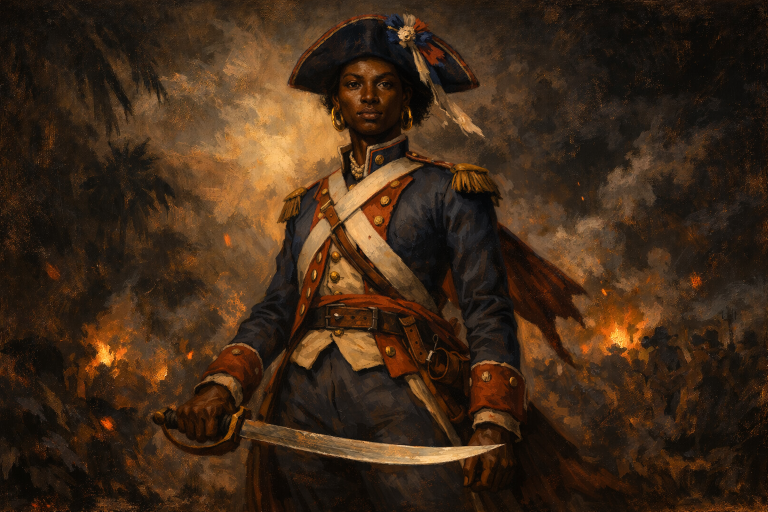

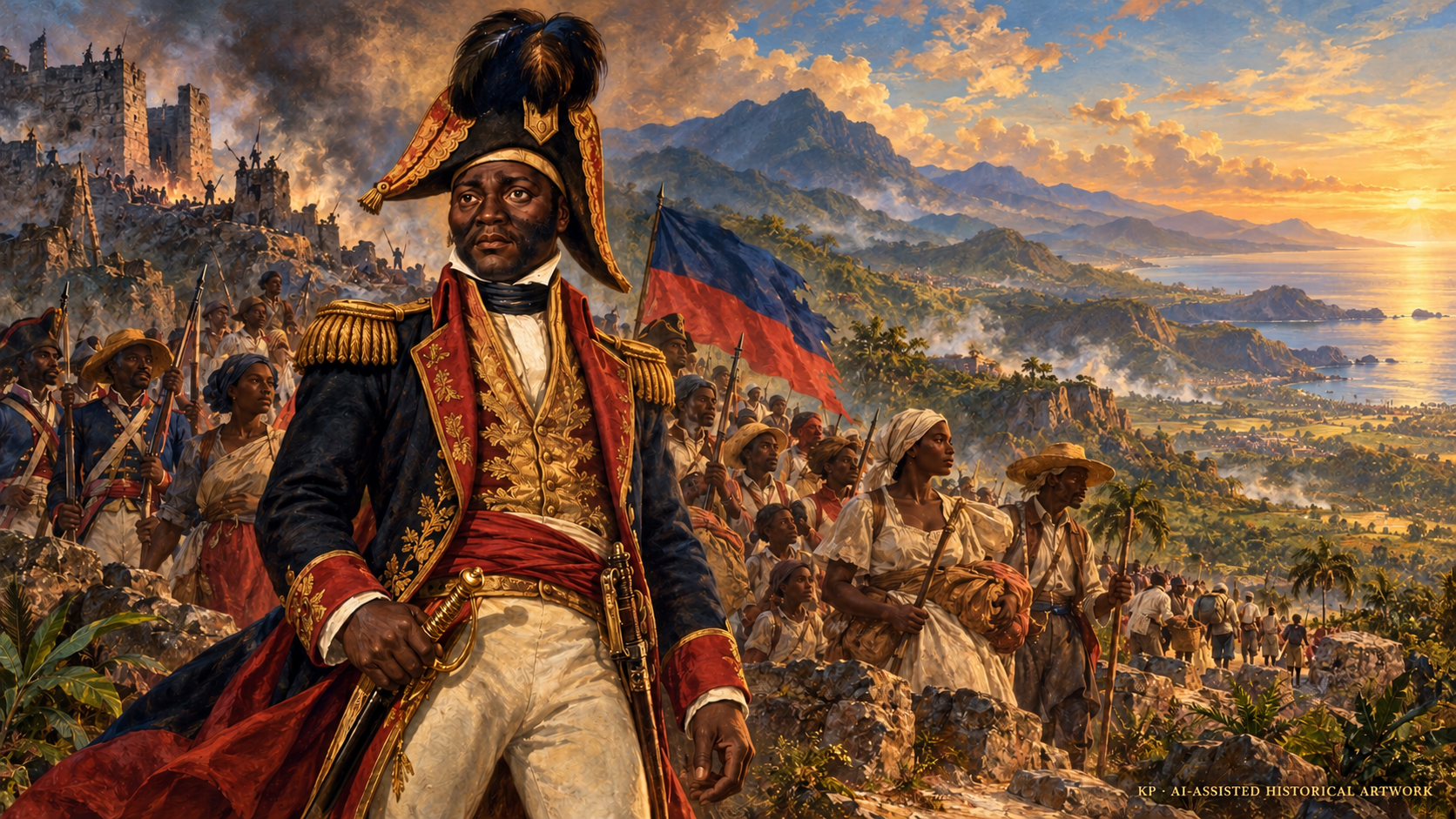
Jean-Jacques Dessalines was a pivotal military leader during the Haitian Revolution and is recognized as the founding father of independent Haiti. Rising from field worker to revolutionary general and Haiti’s first head of state, he orchestrated the decisive campaign against Napoleon Bonaparte’s expeditionary army and declared independence on 1 January 1804, later crowning himself Emperor Jacques I.
Dessalines’s achievements reshaped the course of Atlantic history. However, the nation he established emerged from years of destruction and was surrounded by hostile governments alarmed by Black self-determination. His attempts to defend Haiti, revive agriculture, and resolve land disputes brought him into conflict with rural communities and senior officers alike, tensions that ultimately culminated in his assassination in 1806.
A Life Rooted in Northern Saint-Domingue
Dessalines was likely born around 1758 in Grande-Rivière-du-Nord, in northern Saint-Domingue, the French-held territory that became Haiti. Although some early European writers presented him as African-born, archival evidence supports a local birthplace. Claims about his origins frequently accompanied racist descriptions intended to make his determination appear alien or inherently brutal. His early life remains incompletely documented, but the surviving evidence places him within the working communities of the northern coffee-growing districts.
For roughly three decades, Dessalines lived in bondage, working on coffee estates under several successive proprietors. He was known for a time as Jean-Jacques Duclos and later took the surname Dessalines after associating with a free Black man of that name. He worked as a field laborer and eventually as a commandeur, a foreman who supervised agricultural work. Severe punishment left scars on his body, a lasting record of the violence through which the plantation system maintained itself. During these years, his life was not defined by suffering alone. Relationships with relatives, friends, and fellow workers sustained him, and some endured throughout the revolution. Particularly important was Victoria Montou, remembered as Toya, whom he called his aunt. Haitian tradition credits her with helping develop his physical discipline and fighting skills. Their enduring bond places kinship and care within a life too often narrated exclusively through battle. His relative Joseph also later served under his command.
These connections mattered. Dessalines emerged from communities that preserved family attachments, cultural knowledge, and a capacity for collective action despite repeated attempts to break them apart. His later military career grew from that social world.
From Insurgent to Revolutionary General
The uprising that began across the northern plains in August 1791 opened a new chapter in Dessalines’s life. He joined the insurgency and entered the military networks that would later produce Toussaint Louverture, the revolution’s leading strategist. The conflict soon expanded beyond the plantations into a struggle involving French, Spanish, and British forces, as well as rival local movements with differing visions of the future. Dessalines initially fought within forces aligned with Spain. In 1794, after France formally recognized general emancipation, he followed Louverture into French service. That decision reflected the shifting circumstances of the struggle: the French Republic could, at that moment, serve as a framework within which the revolutionaries defended their hard-won liberty against its enemies.
He became one of Louverture’s most effective commanders. Courageous in battle and exacting in discipline, Dessalines helped secure strategic towns and ports during the southern campaign against André Rigaud in 1799–1800. Dessalines also served as an inspector of cultivation, enforcing Louverture’s agricultural program. The leadership considered export earnings essential to maintaining an army and obtaining weapons. Rural workers, however, often understood emancipation differently: they wanted greater control over their labor, movement, and access to land. Dessalines enforced a system that restricted those choices, exposing a contradiction that would follow him into government.
The French Expedition and the Crisis of 1802
In early 1802, Bonaparte dispatched a large expedition under Charles Leclerc to restore direct French control. Dessalines helped organize resistance, using fortified positions, the mountainous interior, and the destruction of resources that might sustain the advancing army.
The siege of Crête-à-Pierrot in March became one of the struggle’s defining episodes. The fort’s defenders repeatedly resisted French assaults before surviving troops broke through the surrounding lines. Dessalines played an important role in the defense, though the final resistance and withdrawal also depended on officers such as Louis Daure Lamartinière.
Haitian tradition associates Dessalines with a dramatic pledge at the fort: holding a burning torch near a powder supply, he declared that destruction was preferable to surrender. The episode expressed the determination that made Crête-à-Pierrot an enduring symbol of resistance.
By May, leading commanders had accepted an accommodation with Leclerc. Louverture withdrew from active command, while Dessalines and other officers entered French service. Louverture was arrested in June and deported to France, where he died the following year. Dessalines’s conduct during this interval remains a difficult part of his biography. The documentary material records complaints against Louverture and cooperation with French officers; it also describes Dessalines’s participation in campaigns against rural insurgents.
Events elsewhere in the Caribbean clarified the danger. France’s restoration of human bondage in Guadeloupe demonstrated that emancipation could be reversed wherever French military control prevailed. By the autumn of 1802, Dessalines had broken with the expedition and returned to armed resistance. For him, defending liberty now required a complete separation from France.
Building the Army of Independence
Dessalines’s decisive achievement was not simply battlefield leadership. It was his ability to help unite commanders whose earlier rivalries had threatened the revolutionary movement. His alliance with Alexandre Pétion, along with cooperation from other senior officers and rural fighting groups, created the coalition needed to defeat the French expedition. Dessalines became commander-in-chief of the Armée Indigène, the army of independence.
The blue-and-red flag became an emblem of this union. According to national tradition tied to Arcahaie in May 1803, Dessalines removed the white section of the French tricolor and joined the remaining colors. The story expressed a political commitment: Black and mixed-heritage fighters would stand together against the restoration of French oppression.
Victory also required supplies. Dessalines cultivated connections with merchants and ship captains in Jamaica and the United States, securing arms, ammunition, and other necessities. His military strategy worked alongside practical diplomacy. Foreign governments might fear the revolution’s implications, but commercial relationships still offered openings through which the independence movement could sustain itself.
On 18 November 1803, the revolutionary army fought the decisive battle of Vertières, near Cap-Français. The defeat of Donatien de Rochambeau’s forces brought the French position in western Saint-Domingue to collapse. The victory belonged to an army built through years of resistance, sacrifice, negotiation, and renewed solidarity. Dessalines provided the leadership around which the final campaign cohered.
Proclaiming Haiti
On 1 January 1804, Dessalines and the assembled generals proclaimed independence at Gonaïves. The new country took the name Haiti, drawing on an Indigenous name associated with the island and rejecting the identity France had imposed upon its western territory. Dessalines was appointed governor-general for life.
Louis Boisrond-Tonnerre helped put the declaration and its accompanying address in writing. These texts spoke from the experience of people who had fought to recover their humanity and feared that others might still take it from them. The declaration’s central demand was unequivocal: “We must live independent or die.”
Haiti became the first independent Black state of the modern era and established a permanent national commitment to universal emancipation. Although often described as the first Black republic, its initial political arrangements were not republican. In September 1804, Dessalines was proclaimed Emperor Jacques I; he was crowned on 6 October. The distinction matters because Haiti’s founding and its later republican institutions were separate developments.
The title did not resolve the country’s vulnerability. Independence had been declared, but France refused to accept the outcome. Dessalines governed expecting another expedition might arrive, making military preparedness central to the new state’s organization.
Citizenship, Security, and 1804
The constitution issued in May 1805 sought to prevent the restoration of the racial order against which Haitians had fought. Article 14 declared that citizens would henceforth share the designation “Black.” This was a political redefinition of belonging: distinctions previously used to distribute privilege would no longer determine membership in the national community.
The constitution also restricted European property ownership, while providing exceptions that included naturalized Germans and Poles and certain European women and their children. These provisions arose from a specific historical concern: that foreign ownership could become a route through which dispossession and French violence returned. The exceptions also show that Haitian citizenship did not simply exclude every person identified as European.
The most troubling episode of Dessalines’s government occurred before the constitution appeared. Between February and April 1804, he directed killings of French people who remained in Haiti. Dessalines presented it as both retribution and protection against renewed invasion.
The surviving accounts require careful handling. Numbers vary, evidence is incomplete, and hostile reports helped circulate the false claim that every European person in Haiti had been killed. British and American merchants, Polish residents, and some French people survived or received protection.
Land, Labour, and the Difficulties of Government
Sustaining independence became inseparable from organizing agriculture. Dessalines needed revenue to support the army, obtain supplies, and prepare defensive positions in the interior. He therefore retained large estates and enforced agricultural work through military supervision.
For many rural families, this program frustrated the meaning of liberation. They had fought not simply to replace one set of officials with another, but to secure autonomy over work, household life, and land. Requirements that kept them on large estates could reproduce familiar restrictions, even though their legal status had fundamentally changed.
Dessalines also challenged questionable property claims and sought to prevent senior officers and established landholders from appropriating the gains of independence. His investigations into ownership threatened influential interests. Yet his concern for a fairer distribution of national resources did not become a completed program of broad-based land redistribution. The tension remained between his commitment to collective entitlement and his insistence on a tightly directed agricultural economy.
Abroad, he pursued economic connections without obtaining formal diplomatic recognition. Haiti was not completely cut off: ships arrived, merchants negotiated, and practical relationships developed. Nevertheless, other governments’ refusal to recognize the country severely limited its security and international standing. Dessalines’s diplomacy was therefore essential to defending independence, not an incidental activity alongside his military career.
Assassination at Pont-Rouge
By 1806, Dessalines had lost support among important sections of the population and the officer corps. Rural communities resisted agricultural restrictions, while prominent figures resented his demands and feared investigations into their estates. The strict military hierarchy that had helped coordinate the final war proved less effective as a basis for governing the society that emerged from it.
On 17 October 1806, Dessalines was ambushed and killed at Pont-Rouge, near Port-au-Prince, amid a rebellion against his government.
Accounts differ over the precise circumstances and individual responsibilities, but his death resulted from a political rupture within the leadership of independent Haiti.
His remains were subjected to further indignity. Haitian memory honors Dédée Bazile, known as Défilée, for gathering them for burial. Her act of care offers a striking counterpoint to the hostility surrounding his death. The country was subsequently divided between a northern state led by Henri Christophe and a southern republic led by Pétion. Independence survived, but the coalition that had secured it did not.
A Founder in National Memory
Dessalines’s place in Haitian public memory developed unevenly. Early political divisions complicated his commemoration, and his later status as an undisputed national founder should not be projected backward across the entire nineteenth century. Around the centenary of independence, his public standing became more firmly established. Haiti’s national anthem, La Dessalinienne, bears his name.
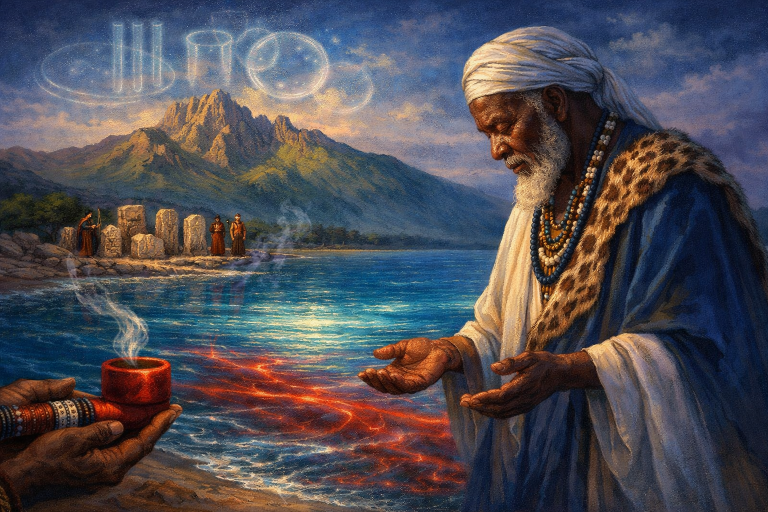
His remembrance also extends beyond official ceremony. In Haitian spiritual traditions, Dessalines is associated with Ogou, the warrior spirit, and remembered by names such as Papa Desalin. These traditions preserve a relationship between the founder and the communities whose struggle made Haiti possible.
Outside Haiti, his reputation long reflected the priorities of those who opposed the revolution. Recent scholarship has challenged that inheritance by examining his correspondence, diplomacy, personal relationships, and political commitments alongside his military actions. The resulting portrait is neither an uncritical celebration nor a repetition of hostile legend.
Dessalines was a liberator whose indispensable achievement was making emancipation irreversible through national independence. He insisted that true freedom could not exist while France wielded influence over Haiti’s future. For him, independence represented not just a change in government, but the assurance that no person would ever again be stripped of their humanity.
Sources:
Mocombe, Paul C. “Jean-Jacques Dessalines the Avenger and Mediator.” Journal of Cultural and Social Anthropology 1, no. 1 (2019)
https://en.wikipedia.org/wiki/Jean-Jacques_Dessalines
https://dukespace.lib.duke.edu/server/api/core/bitstreams/51c327a5-3ab3-41b8-b794-8f5806851c47/content
https://www.davidpublisher.com/Public/uploads/Contribute/64bf5ab0c1cc8.pdf
https://www.researchgate.net/publication/372469257_The_Haitian_Revolution_and_Jean-Jacques_Dessalines_The_End_of_History_and_the_Last_Man_Standing
https://www.researchgate.net/publication/259746011_Jean-Jacques_Dessalines_and_the_Atlantic_System_A_Reappraisal
https://www.youtube.com/watch?v=vCuxrBRkAn0
https://www.amrevmuseum.org/read-the-revolution/i-have-avenged-america-jean-jacques-dessalines-and-haiti-s-fight-for-freedom
https://www.youtube.com/watch?v=_G2ZAaAkwx4
https://www.publicbooks.org/independence-and-abolition-went-hand-in-hand-julia-gaffield-on-jean-jacques-dessalines-and-the-haitian-revolution/