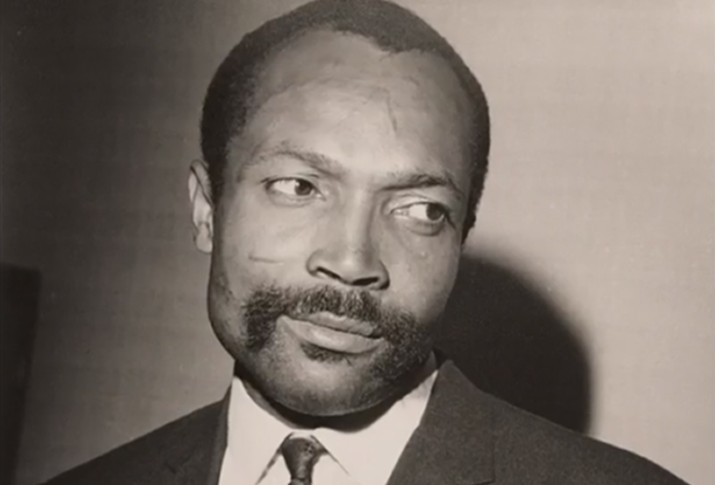

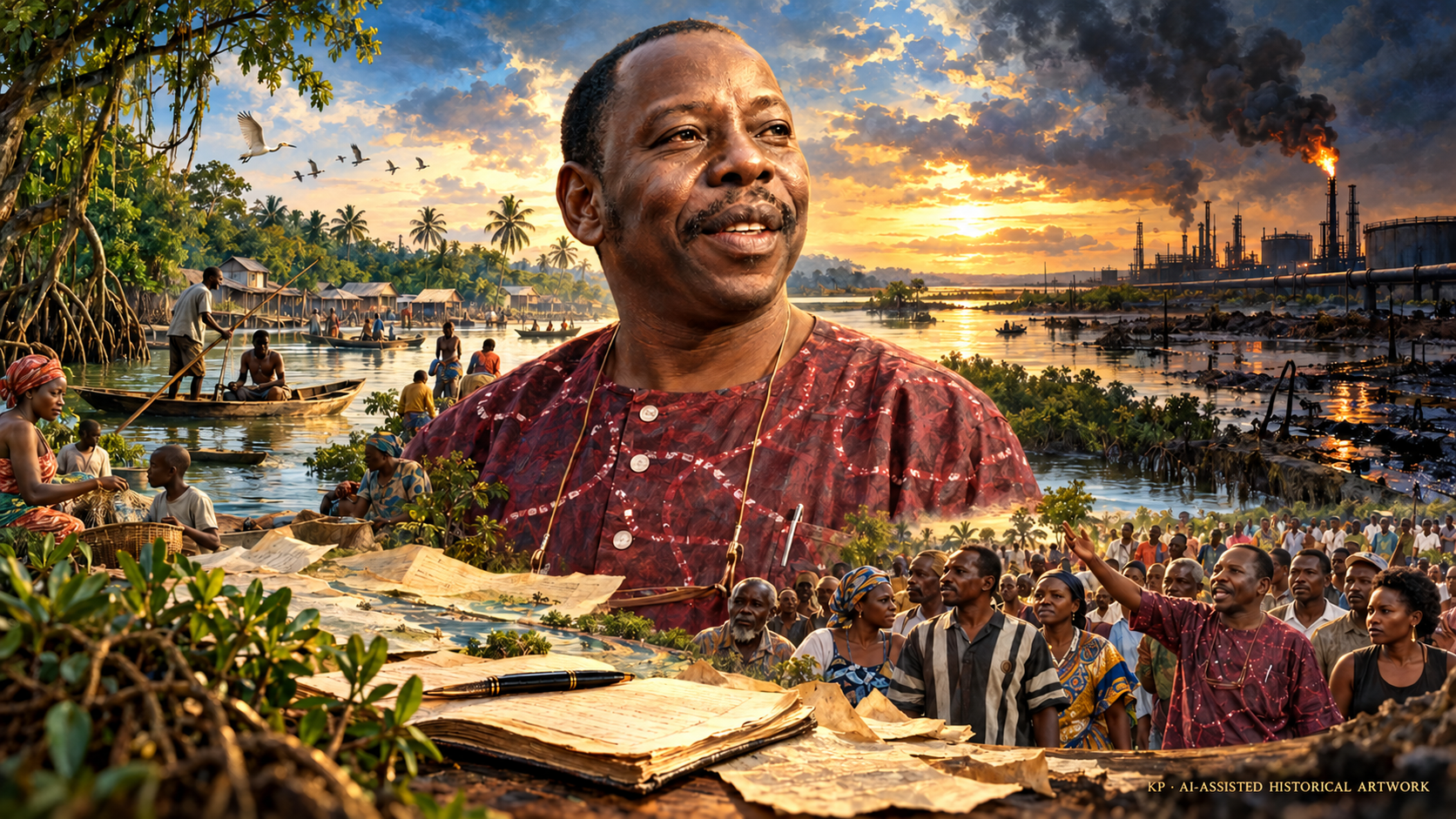
Ken Saro-Wiwa was a Nigerian writer, television producer, businessman, and environmental justice campaigner whose defense of the Ogoni people brought the Niger Delta’s destruction to international attention. Across fiction, journalism, public service and political organizing, he confronted a central injustice: communities living on oil-rich land endured poverty and environmental devastation while the wealth extracted from their homeland enriched others. His campaign linked the right to a healthy environment with political representation, cultural survival and economic justice.
As a member of the Ogoni people, an Indigenous community of the Niger Delta, Saro-Wiwa saw land as more than a source of revenue. It sustained farming and fishing, carried communal memory and connected one generation to the next. When petroleum extraction damaged that inheritance, he turned his literary reputation and organizational skills towards a movement for collective survival. The Nigerian military government executed him and eight other Ogoni campaigners in 1995, but the questions they raised about extraction, state violence and corporate responsibility outlived them.
Childhood, Education and an Emerging Political Consciousness
Kenule Beeson Tsaro-Wiwa was born on 10 October 1941 in Ogoniland and grew up in a large Anglican household rooted in Ogoni community life. His father, Jim Wiwa, worked as a forest ranger, held a local chieftaincy title and managed markets in Bori; his mother was Widu Wiwa. He used the surname Tsaro-Wiwa through the Nigerian Civil War before adopting Saro-Wiwa in the early 1970s.
His awareness of inequality developed early. As a secondary-school student, he heard school workers ridicule Ogoni voters. The experience prompted questions about the exclusion he could see at home: why did so few Ogoni people own market stalls or hold police and clerical posts in Bori? These were not abstract concerns. They shaped his understanding of how a community could inhabit its own homeland yet remain marginalized within the institutions governing everyday life.
After primary school in Bori, he attended Government College Umuahia, where he excelled in English and history and captained the table-tennis team. A scholarship took him to the University of Ibadan to study English. There, academic achievement developed alongside an enthusiasm for performance. He joined a traveling theatre troupe and participated in productions across Nigeria, gaining experience of audiences beyond the university.
In 1964, he wrote The Transistor Radio, a short revue sketch that would eventually provide the foundation for his celebrated television comedy, Basi and Company. The relationship between these works reveals an enduring feature of his career: he moved readily between literary forms and popular entertainment, treating neither as separate from the society around him.
Civil War and Public Service
After university, Saro-Wiwa taught briefly at the University of Lagos and then lectured in African literature at the University of Nigeria, Nsukka. Political violence and the approaching civil war interrupted his academic career, forcing him to leave Nsukka and return to Ogoniland.
During the Nigerian Civil War of 1967–1970, he opposed Biafran secession. His position grew from his concern that non-Igbo communities, including the Ogoni, would remain politically subordinate within the proposed state. He supported the Nigerian federal side, escaped contested territory by canoe and became civilian administrator of Bonny, a strategically important oil port. The appointment placed him close to the fighting and to the relationship between petroleum, territory and government.
This chapter complicates any portrait of Saro-Wiwa as a lifelong outsider to the Nigerian state. He served within its institutions before becoming one of its most forceful critics. His later writing about the war highlighted communities whose experiences were often overshadowed by accounts centered on the principal combatants. For him, the conflict also raised questions about whether Nigeria’s political arrangements could protect its smaller ethnic communities.
After the war, he held several cabinet portfolios in Rivers State, including responsibilities for works, land and transport; information and home affairs; and education. His public career ended in 1973 when he was dismissed, amid disagreements over Ogoni autonomy and friction with political rivals. He later built businesses in property, retail, and publishing while expanding his work as a writer and producer. Financial independence gave him room to pursue projects beyond government employment.
A Literary Career Across Forms
Saro-Wiwa wrote novels, short stories, poetry, plays, children’s books, newspaper columns and political nonfiction. His range reflected a determination to reach different audiences rather than confine himself to a single literary tradition. He also founded Saros International Publishers, with operations in Port Harcourt and London, to publish and circulate much of his own work.
His early novels included Tambari (1973) and Tambari in Dukana (1979). Later publications included the poetry collection Songs in a Time of War (1985), the short-story collections A Forest of Flowers (1986) and Adaku & Other Stories (1989), and the wartime memoir On a Darkling Plain (1989). Across these forms, he explored social inequality, political corruption, ordinary survival and the consequences of violence. Environmental damage also appeared in his fiction before it became the central focus of his public campaigning.
His best-known novel, Sozaboy: A Novel in Rotten English (1985), follows Mene, a village boy attracted by the status and excitement of becoming a soldier. Military service destroys his expectations. Instead of honor and belonging, he encounters confusion, brutality, and the collapse of the world he thought he understood. Through Mene’s experience, Saro-Wiwa strips warfare of its grand claims and shows what it does to people drawn into conflicts they cannot control.
The novel’s language is integral to that vision. Saro-Wiwa’s “Rotten English” combines Nigerian Pidgin, standard English, and vernacular expression. The phrase names a deliberate literary construction, not a judgment on the worth of its speakers. Mene’s voice unsettles the assumption that polished standard English must measure serious literature. His limited understanding of military rhetoric exposes its evasions: readers encounter war through someone who suffers its consequences without mastering its official explanations.
On a Darkling Plain approached the civil war from a different direction, drawing on Saro-Wiwa’s experience as an administrator. Where Sozaboy used an invented voice to dismantle military glamour, the memoir foregrounded the experiences of Niger Delta minorities. Together, the works show how his literary practice and political concerns developed alongside one another.
Popular Television and the Public Voice
Saro-Wiwa’s largest domestic audience came through Basi and Company, the television comedy he created, wrote and produced. Broadcast in the second half of the 1980s, it ran for about 150 episodes and reportedly reached around 30 million viewers. Its central character, Basi, or “Mr. B”, pursued schemes for sudden wealth that repeatedly failed.
Set in Lagos, the series used farce to examine corruption, pretension and the promise of effortless riches. Its humor made social criticism accessible without turning every episode into a lecture. Saro-Wiwa extended its reach through published television plays and children’s books featuring Mr. B, moving characters and ideas between the screen and the printed page.
He also wrote newspaper columns for publications including Vanguard, Punch and the Sunday Times. The latter canceled his “Similia” column in 1990 after political criticism antagonized Ibrahim Babangida’s military government. By then, Saro-Wiwa had established a public voice that moved between entertainment, argument, and direct political challenge.
For him, writing carried obligations beyond observation. He argued that writers should help shape society rather than merely describe its injuries. This conviction explains the continuity between his literary career and the organizing work that came to dominate his final years. Activism did not replace writing so much as extend its purpose.
Ogoni Survival and Environmental Justice
By 1990, Saro-Wiwa had made the Ogoni struggle his principal commitment. Decades of oil extraction had damaged farmland and waterways, undermining livelihoods dependent on agriculture and fishing. Oil spills and gas flaring brought environmental harm into the spaces where people lived and worked. Yet the communities bearing those costs saw little corresponding improvement in essential services or economic opportunity.
Saro-Wiwa described this destruction as an “ecological war”. The phrase challenged the separation of environmental damage from violence: poisoned water, ruined soil, and lost livelihoods could devastate a population without resembling a conventional battlefield. He directed his criticism at oil companies, particularly Shell, and at the Nigerian governments whose arrangements sustained extraction while leaving local communities exposed to its consequences.
He helped establish the Movement for the Survival of the Ogoni People, or MOSOP, in 1990. The movement brought together women, young people, teachers, professionals and community leaders. Its strength lay in collective participation. Saro-Wiwa became its most internationally recognizable voice, but the campaign rested on a wider Ogoni effort to articulate rights and organize resistance.
The Ogoni Bill of Rights set out demands for political autonomy within Nigeria, a fair share of locally generated resources, and protection and restoration of the environment. These demands did not call for separation from Nigeria. They sought a different relationship within it—one in which Ogoni people could influence decisions affecting their homeland and benefit from its resources. Saro-Wiwa summarised the connection between ethnic autonomy, resource control and environmental protection through a philosophy he called “erectism”.
His insistence on nonviolent mobilization shaped the campaign. On 4 January 1993, an estimated 300,000 Ogoni people participated in peaceful demonstrations. The scale of participation made it difficult to dismiss the movement as the concern of a few individuals. Shell suspended its operations in Ogoniland later that year amid sustained community opposition.
Saro-Wiwa also sought solidarity beyond Nigeria, working with environmental organizations, human rights groups and the Unrepresented Nations and Peoples Organization. His campaign clearly linked ecological destruction to human rights: a community’s freedom meant little if its water, food sources, and means of subsistence were being destroyed.
Detention, Trial and Execution
The visibility of the Ogoni campaign brought increasing danger. Saro-Wiwa experienced repeated arrests before his final detention in May 1994, following the killing of four Ogoni community leaders during local unrest. Sani Abacha’s military government accused him of inciting the murders. He maintained his innocence and had been prevented by military personnel from entering the area on the day of the killings.
Saro-Wiwa and other defendants faced a special tribunal whose proceedings drew condemnation from human rights organisations and international observers. The prosecution of a leading nonviolent campaigner unfolded within a broader campaign of repression against Ogoni resistance. The death sentences transformed the tribunal into a decisive confrontation between the military government and a movement demanding accountability for the treatment of its people.
In his statement to the tribunal, Saro-Wiwa placed his own prosecution within that wider history:
“We all stand before history. I am a man of peace, of ideas.”
He described his commitment to people living in poverty on a richly endowed land and insisted that Shell’s conduct, too, would face historical scrutiny. The statement refused the narrow frame that allowed only the defendants’ actions to matter. It redirected attention to the environmental destruction and political exclusion that produced the campaign.
On 10 November 1995, Saro-Wiwa and eight other Ogoni campaigners—the Ogoni Nine—were hanged in Port Harcourt prison. He was fifty-four. The words widely reported as his last were: “Lord take my soul, but the struggle continues.”
International condemnation followed, and the Commonwealth suspended Nigeria. Saro-Wiwa had already received the Goldman Environmental Prize and the Right Livelihood Award for his campaigning. Neither international recognition nor appeals for his release prevented his execution.
Writing, Family and the Unfinished Struggle
Detention did not silence Saro-Wiwa’s writing. His A Month and a Day: A Detention Diary documented his political engagement and imprisonment. Letters and poems sent from detention, including correspondence with Majella McCarron, later appeared in Silence Would Be Treason. Their preservation at Maynooth University helped sustain a record of his thought and relationships beyond the public image of the condemned activist.
His family also carried forward different aspects of his legacy. His eldest son, Ken Wiwa, explored their relationship in In the Shadow of a Saint (2000). His brother, Owens Wiwa, continued environmental and human rights advocacy and campaigned for the recovery of his remains. His daughters, Noo and Zina, developed literary, journalistic, and artistic work that engaged with family memory and Nigerian life. Their work resisted reducing either their father or the Niger Delta to a single story of death and pollution.
Legal action kept corporate responsibility in view. In 2009, Shell agreed to a $15.5 million settlement in litigation brought by members of the Wiwa family and other plaintiffs; part of the settlement supported a trust for Ogoni development. Separately, the United Nations Environment Program’s 2011 assessment documented extensive contamination in Ogoniland, reinforcing the urgency of the environmental concerns Saro-Wiwa had raised.
In June 2025, Nigeria announced posthumous pardons and national honors for the Ogoni Nine. The language of pardon remained contested. Families and campaigners seeking exoneration argued that forgiveness for a supposed offense was not the same as clearing the names of people unjustly convicted. The distinction placed the question of justice beyond commemoration alone.
Saro-Wiwa’s legacy encompasses both literary invention and collective organizing. He gave fictional characters memorable voices, brought satire to a mass television audience and helped make the Ogoni demand for survival audible internationally. His life demonstrates how cultural work can become an instrument of political action—and how the defense of a community’s land is inseparable from the defense of its dignity, memory, and future.
Sources:
https://warwick.ac.uk/fac/arts/english/currentstudents/postgraduates/pgmodules/resourcefictions/oil09/wiwamonthday.pdf
https://shura.shu.ac.uk/31896/1/Attached%20standard%20file_%5B62912%5D.pdf
https://mural.maynoothuniversity.ie/id/eprint/13526/1/manofpeaceJan.pdf
https://gsarpublishers.com/wp-content/uploads/2025/09/GSARJMS2512025-Gelary-script.pdf
https://www.cambridge.org/core/journals/african-studies-review/article/afterlife-of-ken-sarowiwa-thirty-years-after/8CA651CBD915FF2EBF91BFFF837BD98E
https://wiredspace.wits.ac.za/server/api/core/bitstreams/e6e84f08-1d4b-462d-b96e-b998813959bf/content
https://www.researchgate.net/publication/332562279_Writing_against_tyranny_Ken_saro-wiwa_and_the_burden_of_ogoni_nation_in_A_vmonth_and_a_day_A_detention_diary
https://en.wikipedia.org/wiki/Ken_Saro-Wiwa
https://www.theguardian.com/books/2000/nov/19/biography.sandrajordan
https://www.youtube.com/watch?v=FcJIaSw8-98
https://www.washingtonpost.com/news/monkey-cage/wp/2016/07/29/the-complex-life-death-of-ken-saro-wiwa/