
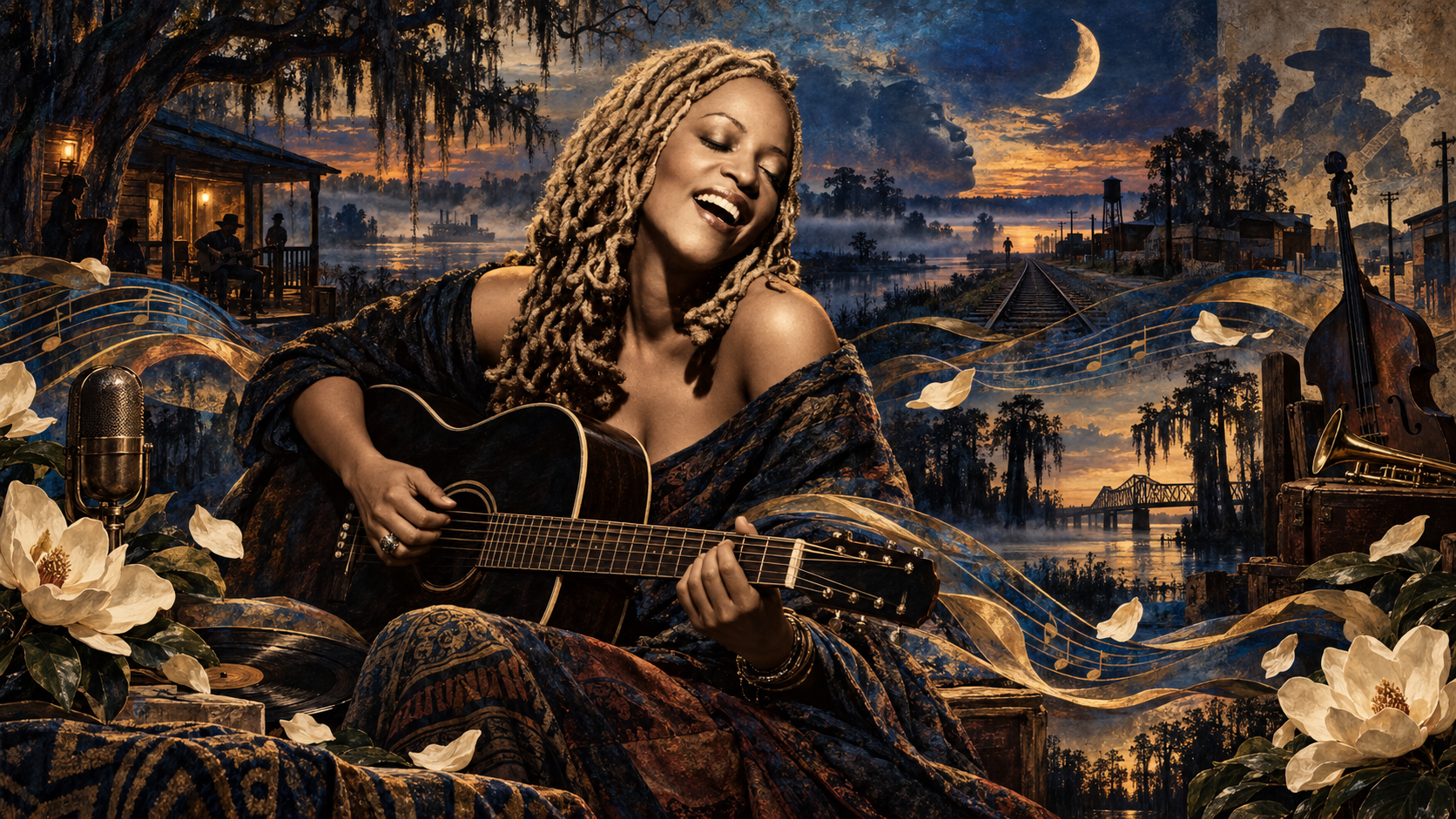
Cassandra Wilson was one of the most original vocal artists in American music: a jazz singer, songwriter, guitarist, producer, and interpreter whose deep contralto carried Mississippi’s tonal memory into a strikingly modern musical world. Across more than four decades, she created a body of work that crossed and unsettled musical boundaries—joining jazz to Delta blues, folk, soul, country, rock, gospel, and experimental improvisation—without ever seeming eclectic for its own sake. Her recordings were unified by the unmistakable authority of her voice: low, grainy, sensuous, unhurried, and attentive to silence as much as sound.
Wilson was born in Jackson, Mississippi, on 4 December 1955. She died at her home in Jackson in September 2026, aged seventy. Between those dates, she became a two-time Grammy Award winner, a recipient of the Mississippi Blues Trail marker, and an NEA Jazz Master, one of the highest honors bestowed on an American jazz artist. Yet the institutional recognition, considerable as it was, only partially conveys her significance. Cassandra Wilson changed how a singer might approach a song. She showed that vocal jazz could be rooted in history without becoming conservative; that the blues could be ancestral without being fixed in the past; and that a familiar lyric could be made strange, intimate, and newly true when placed in the hands of an artist determined to hear what lay beneath its surface.
A Mississippi Beginning
Wilson was born Cassandra Fowlkes into a household that valued music and learning equally. Her father, Herman Fowlkes Jr., was a jazz guitarist, bassist, and music teacher. Her mother, Mary McDaniel, was an elementary-school teacher who held a doctorate in education. From her father came an immersion in jazz: a large record collection, the sound of instrumental improvisation, and early encounters with figures such as Miles Davis and Thelonious Monk. Wilson remembered Miles Davis’s Sketches of Spain as one of the first records she heard and retained a lifelong appreciation for its atmosphere, openness, and sense of tonal adventure. From her mother came Motown, soul, rhythm and blues, and the direct emotional force of popular Black music. Thus, she grew up in a Black Southern home, where records, radio, musicianship, education, church-inflected feeling, and Mississippi’s larger culture coexisted.
Wilson began studying classical piano at six years old. Around twelve, she took up the guitar, taught herself, and began writing her own songs. The guitar brought her toward folk music and the singer-songwriter tradition, which would prove as important to her artistic formation as jazz itself. As a young performer, Wilson was particularly drawn to Joni Mitchell and Robert Johnson. That pairing might initially appear unlikely: Mitchell, the Canadian singer-songwriter whose work moved through folk, jazz harmony, and personal lyricism; Johnson, the mythic Delta blues musician whose songs were marked by loneliness, erotic tension, spiritual unease, and fierce economy. Yet their influence helps explain Wilson’s later music. From Mitchell she learned that a singer could write and interpret with psychological complexity, moving outside fixed genre expectations. From Johnson she absorbed the blues as a language of compressed feeling—a language in which longing, fear, humor, desire, heartbreak, and endurance could coexist in a few lines.
She also listened to Odetta, Richie Havens, James Taylor, and Bob Dylan. These artists expanded her sense of what a song could hold and how a performer might use the voice to tell a story. Long before Wilson became known as a jazz vocalist, she had developed the instincts of a songwriter and acoustic performer. Her later career never abandoned those beginnings. Even at her most sophisticated or experimental, her recordings retained an intimacy that belonged to someone sitting with a guitar, testing the weight of a phrase and allowing a song to reveal its meaning slowly.
Jackson itself was among her deepest influences. Wilson recalled the vibrant local music around Farish Street, where her father often worked. The city was not merely her birthplace; it was an aural and emotional education. The cadence of Southern speech, the measured force of the blues, the noise and quiet of hot Mississippi nights, the hum of electric fans, outdoor music, and the feel of acoustic instruments in open air all remained part of her sensibility. She would later return deliberately to those sensory impressions in her recording work, seeking not to reproduce a romanticized South but to recover the mood, ancestral memory, and musical spaciousness that had formed her.
Learning the Language of Jazz
Wilson’s path into jazz was neither automatic nor conventional. In Jackson, the drummer Alvin Fielder—an important figure in the city’s Black Arts Music Society—became an early mentor, introducing her to bebop and avant-garde improvisation. That encouragement helped her move beyond the folk-oriented songs she began writing as a teenager and toward the wider possibilities of jazz.
She attended Jackson State University, the historically Black university in her home city, and graduated with a degree in mass communications. Though she did not pursue formal conservatory training, her university education gave her a strong grounding in language, communication, and storytelling. These became central to her later work. Wilson was never merely a vocalist who selected songs; she was a narrator and a constructor of atmosphere. She thought of songs as texts, with histories they carried, and of the transformation that could occur when an interpreter altered their rhythm, arrangement, tonal center, or emotional point of view.
After graduating, Wilson moved to New Orleans in 1981. She worked at a local television station during the day and spent her evenings learning in the city’s fertile jazz community. There she came into contact with musicians including Ellis Marsalis Jr., Earl Turbinton, Alvin Batiste, and drummer James Black. New Orleans gave Wilson a practical, exacting musical education. It taught her that jazz was not a distant canon but a living practice, shaped by community, discipline, listening, and the ability to enter a musical conversation without losing one’s own voice.
Her next move, to New York, placed her at the heart of a developing experimental scene. In the early 1980s, she became a founding member and principal vocalist of the M-Base Collective, the circle of musicians associated with saxophonist Steve Coleman. M-Base was a progressive artistic movement, drawing on jazz improvisation, funk, rhythmic complexity, and Black musical traditions while resisting easy commercial categorization. Within that milieu, Wilson learned to treat the voice as an instrument among instruments. It could provide rhythm, color, counterpoint, texture, and abstract sound as well as lyrical narrative.
The M-Base years sharpened Wilson’s sense of musical autonomy. They encouraged her to pursue original composition and to resist the expectation that jazz singers should simply reproduce earlier vocal models. The great singer Abbey Lincoln also became a decisive influence and mentor. Lincoln urged Wilson to tell “the story of your times,” a principle that moved beyond aesthetics. It suggested that artists should engage the emotional, political, and historical realities of their world, including subjects that were difficult, painful, or inconvenient. Betty Carter’s daring phrasing and vocal agility offered another important example, but Wilson did not imitate her predecessors. She developed a style founded on low-register depth, restraint, delayed emphasis, and a willingness to give the song time.
A Voice of Singular Power
Cassandra Wilson’s voice has often been described through images because ordinary technical descriptions do not entirely capture its effect. Critics heard smoke, honey, aged wood, earth, dusk, “late-morning sunlight and bittersweet molasses,” “maplewood smoke,” and “wildflower honey.” The metaphors point toward a voice that was warm but never bland, beautiful but edged with grain and shadow. It was a contralto of unusual darkness and flexibility, but its power did not rest only in its range or texture.
Wilson’s genius lay in her handling of time. She was not a singer who relied on volume, elaborate vocal display, or the climactic flourish. She preferred nuance. She could stretch a vowel, bend the center of a pitch, suspend a syllable, or pull a phrase slightly behind the beat until a familiar song seemed to disclose another emotional life. Her pauses mattered. Silence around a line could make the listener aware of its ache, irony, threat, or tenderness. She did not simply perform the music; she created a charged space in which it could be heard anew.
Her approach made even widely known material feel as if it had been discovered in a different country. She possessed what might be called an alchemical gift for reinterpretation. A folk song, blues number, pop ballad, country song, or standard might enter her repertoire with an established history and leave it bearing her distinctive mark. Wilson did not cover songs in the conventional sense. She excavated them. She searched their lyrics for concealed tension, recast their grooves, stripped away excess, and brought them into a musical world formed by Mississippi blues, New York improvisation, and a deeply personal sense of emotional proportion.
The critic Gary Giddins praised Wilson’s “unmistakable timbre and attack,” a useful description because it acknowledges both her voice’s sensual beauty and its intelligence. She could be languid without ever being passive. Her delivery might arrive softly, but it carried intent. The grain of her voice gave language weight; the measured pace of her phrasing made listeners attend to words they thought they already knew. In Wilson’s work, a lyric was not an accessory to the tune. It was an inhabited place.
Restlessness and Reinvention
Wilson’s career was defined by a creative restlessness that kept her moving beyond artistic comfort. Her early solo recordings displayed the complexity and experimental energy of the M-Base period. Yet in 1988, she made Blue Skies, an acoustic album of standards that revealed the depth of her relationship with the jazz tradition. Recorded in a single day on a modest budget, the album was admired for the poise and intelligence of its interpretations and was named Jazz Album of the Year by Billboard.
That success might have encouraged a less adventurous artist to repeat the formula. Wilson instead moved in another direction, making work that remained challenging and exploratory. Her resistance to artistic confinement was essential to her character. She did not pursue a stable market identity at the expense of her own curiosity. Her music moved wherever her ear and imagination led: toward original songs, electric textures, standards, Delta blues, folk material, popular music, and atmospheric acoustic arrangements.
A major turning point arrived when she signed with Blue Note Records and began working with producer Craig Street. Their collaboration yielded Blue Light ’Til Dawn in 1993, a landmark album that gave Wilson’s eclectic vision a new clarity. The record’s arrangements were spare, acoustic, and spacious. It did not announce its innovations with noise. Instead, it created a world in which the space around the instruments mattered as much as the notes themselves. Wilson sang Robert Johnson’s “Come On in My Kitchen,” Van Morrison’s “Tupelo Honey,” and other material with an intimacy that felt at once ancient and contemporary.
Blue Light ’Til Dawn changed the terms of the conversation around vocal jazz. Wilson demonstrated that a contemporary jazz singer could work with songs from outside the standard canon without treating them as lightweight or apologising for their origins. She located the blues, folk, country, rock, and jazz traditions within a common emotional geography. Her recordings suggested that these forms had always been in conversation, especially in the American South, where Black and white musical traditions developed through contact, conflict, borrowing, concealment, exchange, and unequal power. Wilson’s work did not erase those histories; it made their interconnections audible.
Her subsequent album, New Moon Daughter (1995/96), carried that vision further. Its repertoire drew together Son House, Neil Young, U2, and the Monkees, yet the album had a coherent atmosphere because Wilson’s voice provided its centre of gravity. Her version of Son House’s “Death Letter” became one of her signature performances: haunted, deliberate, spare, and charged with a grief that did not need theatrical emphasis. She treated the song as a living blues narrative rather than a museum piece. New Moon Daughter won Wilson her first Grammy Award for Best Jazz Vocal Performance and confirmed that a large audience could follow an artist who refused to simplify her musical identity.
Her artistry continued to broaden. She contributed to Wynton Marsalis’s Blood on the Fields, the oratorio that became the first jazz work to receive the Pulitzer Prize for Music. She recorded Traveling Miles (1999), an imaginative tribute to Miles Davis, and Coming Forth by Day (2015), a deeply considered re-engagement with the art and legacy of Billie Holiday. In each case, Wilson avoided imitation. She approached her influences as living presences and asked what they could mean in her own time.
Music as a Search
At the centre of Wilson’s work was a profound search for emotional truth. Her music was full of intimacy, but it was never limited to romantic longing. She sang of love and desire with rare sensuality, yet she also used song to explore anxiety, solitude, grief, fear, historical memory, and the difficult pursuit of happiness. Her art recognised that these experiences are often entangled: that longing may contain loneliness, that pleasure may coexist with sorrow, and that a person may seek refuge without denying the world’s harshness.
Wilson spoke of music as a balm during periods of emotional strain. Anxiety, frustration, fear, and pain were not feelings to be hidden from the work; they could become part of its material. Music, in her understanding, offered protection and space. It permitted strong emotions to be lived through rather than suppressed. That belief helps explain the remarkable emotional discipline of her recordings. She did not turn vulnerability into spectacle. She created an atmosphere in which feelings could exist without immediate explanation or resolution.
Her interpretations of songs about desire show this especially well. On “Closer to You,” she turned a ballad into something resembling a private confession: hushed, close, and exposed. Her performance of Willie Dixon’s “I Want to Be Loved” slowed the song into an unhurried, playful form of yearning. In such moments, Wilson’s sensuality was inseparable from her intelligence. She understood intimacy as attention, patience, and the difficult wish to be recognised by another person.
But Wilson also gave herself to songs that bore the weight of collective history. Her performances of “Strange Fruit,” Billie Holiday’s devastating indictment of racial lynching, carried the seriousness of a singer who understood the South as a place of beauty and creative abundance, but also as a landscape marked by racial terror and historical trauma. Following Abbey Lincoln’s counsel, she did not avoid uncomfortable stories. Her music could hold the private and public together: erotic desire and ancestral grief, personal unease and cultural memory.
Mississippi as Memory and Method
The South was not an image that Wilson wore; it was a source of method. She was called “the voice of the South” because listeners heard Mississippi in the sound and pace of her singing, in her reverence for the blues, and in the way she allowed space, silence, and feeling to shape a performance. Fellow musician Jon Batiste said that Wilson “sounded like the South,” observing that her Mississippi inheritance remained present no matter how wide-ranging her artistry became.
For Wilson, the blues was not a narrow stylistic label. It was a fundamental mode of storytelling, rooted in space, tension, memory, and feeling. She believed that “everything is connected with the Blues,” and her recordings made that conviction audible. Blues could infuse a Robert Johnson song, a jazz standard, a Joni Mitchell composition, a Neil Young ballad, or a rock song transformed by her slow-burning contralto. It was not a matter of adding blues colour to another genre. It was a way of hearing the emotional foundation beneath the song.
Her 2002 album Belly of the Sun offered one of the clearest expressions of this connection. Wilson returned to Mississippi and recorded in a converted train station in Clarksdale, seeking the physical and sensory atmosphere of the region. She wanted the sound of heat, dirt, acoustic instruments, outdoor evenings, and the remembered hum of fans in rooms without air-conditioning. The record was not an exercise in nostalgia. It was an act of return: a way of acknowledging that the emotional and musical materials of her childhood had continued to shape her, even after decades of work in New York and on international stages.
An Enduring Legacy
Cassandra Wilson left behind a legacy of artistic courage, sonic beauty, and intellectual freedom. She expanded the possibilities of vocal jazz by refusing to accept the genre as a closed inheritance. She brought folk, country, rock, Delta blues, gospel, soul, and popular song into an evolving conversation with jazz, proving that openness need not mean dilution. Her work gave later singers a powerful example of how to move across traditions without losing depth, history, or self-possession.
Her honours reflected that achievement. Wilson won two Grammy Awards, for New Moon Daughter and Loverly; received recognition on the Mississippi Blues Trail in 2010; and was named an NEA Jazz Master in 2022. In 2001, Time called her “America’s Best Singer,” an expansive appraisal for an artist whose work had always exceeded simple genre boundaries.
Yet her deepest legacy lies not in any award or title, but in the listening she taught. Cassandra Wilson asked listeners to slow down. She showed that a song could contain more than its obvious mood, that the past could be carried forward without being embalmed, and that a voice could be both an instrument of personal feeling and a vessel for collective memory. Her music did not offer easy consolation, but it offered something more durable: a place where longing, sorrow, desire, history, and the elusive possibility of happiness could be held together.
Above all, Cassandra Wilson was an artist of transformation. She transformed standards into whispers, blues songs into contemporary testimonies, and popular music into richly shadowed landscapes of feeling. She carried the sound of Mississippi wherever she traveled—not as a fixed regional identity, but as a living inheritance continually remade through imagination. Her voice remains one of the great voices of modern music: restless, intimate, darkly luminous, and vast enough to make a sanctuary of song.
Sources:
https://www.theguardian.com/music/2026/sep/02/cassandra-wilson-jazz-singer-dies
https://en.wikipedia.org/wiki/Cassandra_Wilson
https://www.thebluesmagazine.com/cassandra-wilson-dies-70-blues-jazz-mississippi-legacy/
https://www.cassandrawilson.com/biography.html
https://www.bluenote.com/artist/cassandra-wilson/
https://www.allmusic.com/artist/cassandra-wilson-mn0000197460
https://www.jazztimes.com/features/profiles/cassandra-wilson-golden-age/?v=7885444af42e
https://www.arts.gov/honors/jazz/cassandra-wilson
https://www.npr.org/2026/09/02/nx-s1-5954558/cassandra-wilson-grammy-winning-jazz-vocalist-dies-at-70
https://www.independent.co.uk/arts-entertainment/music/news/cassandra-wilson-death-singer-jackson-mississippi-b3043920.html