
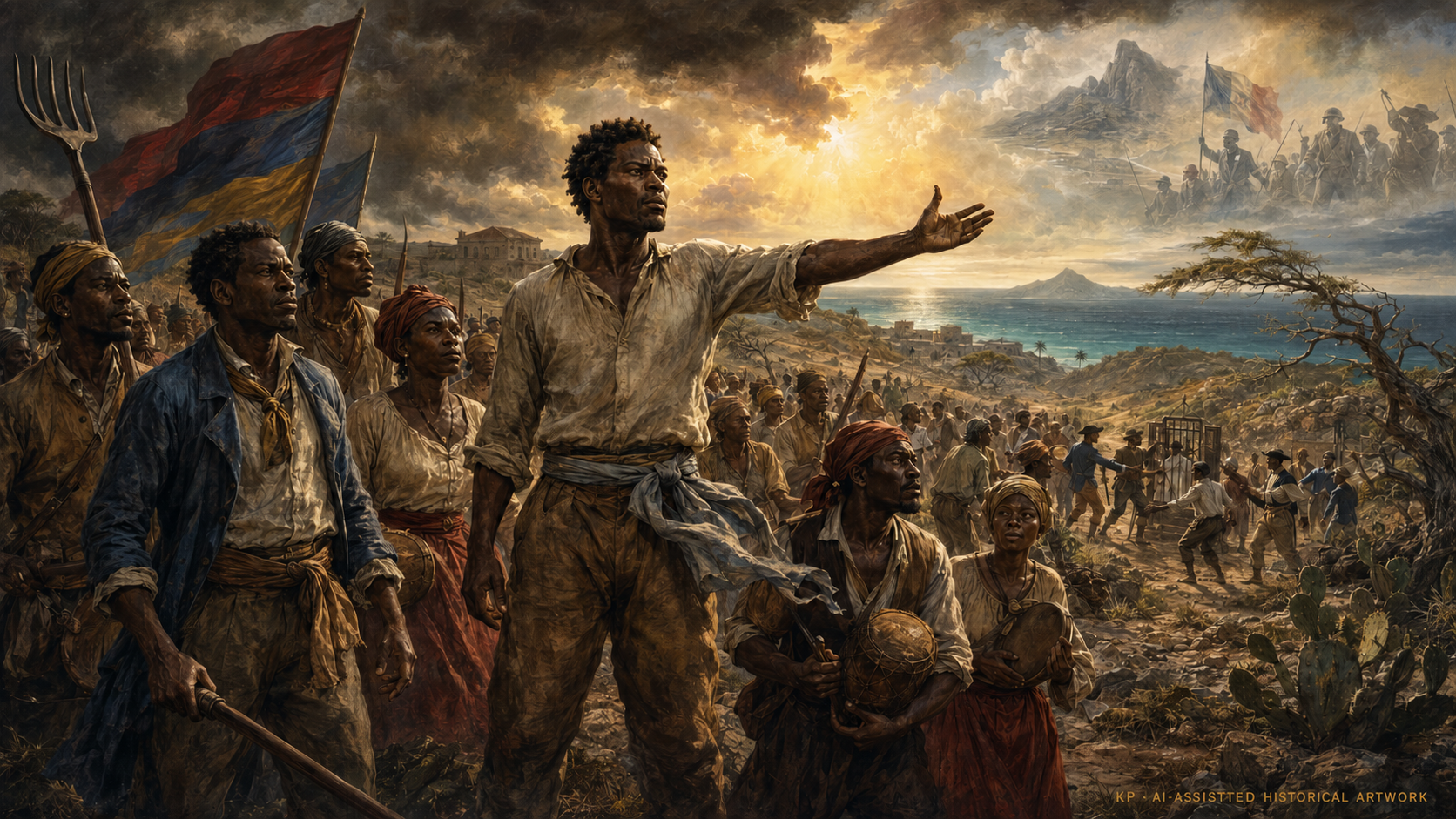
On August 17, 1795, the Dutch Caribbean island of Curaçao witnessed one of the most significant and far-reaching uprisings in its history, now remembered as Tula’s Revolt. Tula, a visionary leader, drew inspiration from the Haitian Revolution and maintained that the French occupation of the Netherlands should lead to the abolition of the Maafa on the island. Eyewitness accounts portray Tula as an eloquent leader with a formidable presence, committed to securing basic human rights and ending systemic abuse. Although he sought to negotiate for collective freedom, the Dutch oppressors ultimately suppressed his movement and executed him in October of that year. Today, Tula is honored as a national hero, with monuments commemorating his resolute stand against Dutch injustice.
On the eve of the revolt, Curaçao’s society was marked by a deeply entrenched and unequal demographic structure. The 1789 census recorded nearly 21,000 inhabitants: approximately 12,864 Africans subjected to forced labor, 3,714 free people of African descent, and 4,410 Europeans. Those forced into servitude constituted well over half the population. Unlike the expansive sugar-plantation economies elsewhere in the Caribbean, Curaçao’s economy was based on smaller hacienda-style estates focused on subsistence farming, alongside Willemstad’s bustling port, a principal hub of Atlantic trafficking. Despite the relatively modest scale of plantation agriculture, resistance and the pursuit of freedom were deeply woven into the island’s social fabric.
By 1795, conditions had become especially brutal on estates like Knip, or Kenepa, where Tula lived in captivity and under forced labor. African-descended peoples were increasingly forced to work even on Sundays—a day traditionally reserved for rest—while those who claimed ownership over them routinely leased out their labor to maximize profit. Collective punishment was imposed indiscriminately: if one person was accused of an infraction, the entire community endured the consequences. These injustices—forced Sunday labor, collective punishment, and restrictions on where people in captivity could purchase goods—would become the explicit demands Tula voiced when he confronted the Dutch oppressors. While the colonial record reveals little about Tula’s personal life, those who encountered him described an articulate leader of commanding presence, whose vision and resolve inspired thousands to join the struggle for liberation.
The uprising must be situated within the revolutionary currents remaking the Atlantic world, above all the African-led revolution in Haiti. Tula and his comrades knew that African people under French oppression had risen to overthrow a violent system that trafficked in, exploited, and attempted to control human beings. Their struggle forced those administering the French regime to confront a freedom that Africans had asserted and defended for themselves. Curaçao’s freedom fighters followed the emergence of leaders such as Toussaint Louverture and understood the language of liberty, equality, and fraternity not as a European gift, but as principles African people had made real through organized resistance. Tula’s adoption of the name “Rigaud,” associated with the Haitian revolutionary general André Rigaud, expressed this Black Atlantic political consciousness. It declared that the movement in Curaçao was neither an isolated disturbance nor a petition for benevolence. It formed part of a wider African struggle to dismantle European oppression, restore collective dignity, and live in the freedom that was theirs by birth.
On the morning of 17 August 1795, Tula led an initial gathering of forty to fifty people at Knip (Kenepa), refusing to continue forced labor and declaring to Caspar Lodewijk van Uijtrecht that their days of subjugation were over. Unable to suppress this collective act of resistance, van Uijtrecht attempted to redirect them to the colonial seat at Fort Amsterdam in Willemstad. Instead, the group moved to Lagún, where they liberated twenty-two people held in confinement, and then proceeded to the Santa Cruz plantation. There, more freedom fighters led by Bastiaan Karpata joined the movement, significantly increasing their numbers. The liberation struggle quickly spread as Tula moved from farm to farm, freeing workers, while plantation owners, gripped by panic, abandoned their estates and sought refuge within the city. Meanwhile, a parallel group led by Louis Mercier, a man of African descent connected to the French Caribbean, captured the Dutch commandant Van der Grijp and ten soldiers near Santa Cruz, secured weapons at Knip, and rejoined Tula’s main force. By day’s end, the collective had grown to thousands and established a stronghold at Portomari.
The principal Dutch oppressor, Johannes de Veer, first responded by sending a contingent of sixty-seven men, but this force was decisively overcome at Portomari on 19 August. What the colonizers assumed would be a quick suppression instead became a major crisis for the regime. In retaliation, a larger force of ninety-three heavily armed mounted fighters was assembled under Baron van Westerholt, with instructions to offer so-called leniency for surrender. The Franciscan priest Father Jacobus Schinck was sent to negotiate, and to him Tula clearly expressed three core demands: an end to collective punishment, an end to compulsory Sunday labor, and the right to purchase goods from vendors beyond the colonial estate system. Tula insisted, “We have been abused too much. We do not seek to harm anyone, and we are just seeking our freedom. French Africans gained their freedom. Holland was occupied by the French, then we must be free here.” Tula made it clear that half-measures were not acceptable, reminding Schinck of the shared humanity of all people and questioning why those held in bondage suffered treatment worse than animals. When Tula refused anything less than total liberation, negotiations broke down, and Westerholt commanded his men to fire on any armed freedom fighter. In the ensuing battle, Tula’s forces suffered casualties—nine killed and twelve captured—but many retreated to continue the struggle in the island’s rugged interior.
Following this setback, the freedom fighters adapted to guerrilla tactics—poisoning wells and reclaiming food stores—in order to sustain their resistance under intensifying colonial repression. The uprising ended when Tula and Karpata were betrayed and captured on 19 September 1795, roughly a month after the liberation struggle began. Mercier had already been seized at Knip, and Wakao was apprehended soon after.
On 3 October 1795, at a site called “Rif” (the Reef) in Otrabanda, Tula was publicly tortured and executed in a violent display meant to terrorize those seeking freedom. Karpata, Mercier, and Wakao were also executed soon after. Beyond these principal leaders, a memorial pillar later erected at the National Archives lists the names of twenty-nine freedom fighters who participated in the uprising—a small fraction of the many who were killed or executed during the struggle and its brutal suppression.
In the immediate aftermath, the Dutch regime granted people in captivity on Curaçao a set of limited rights and protections—concessions shaped directly by the demands voiced by Tula and other leaders during the negotiations. These measures, however, were implemented primarily to prevent further resistance, not to recognize the African community’s humanity or dignity. The colonial authorities’ anxiety following the uprising also led to new restrictive policies, such as banning the arrival of people from Haiti to block the spread of revolutionary ideas. True emancipation would not come for nearly seven more decades, with the Maafa only ending on the island in 1863.
Honoring his role in the liberation struggle, Curaçao recognizes Tula as a national hero. Since 1985, 17 August—the day the revolt began—has been observed as an official Memorial Day, marked by mass gatherings and reflection on the ongoing pursuit of freedom and justice. Tula’s legacy lives on through the Tula Monument at Rif, the site of his execution; the 1989 monument Desenkadena (Unchained) by artist Nel Simon; and Museum Tula, established in 2007 at Landhuis Kenepa, the former Knip estate where the uprising was ignited.
The 2013 film Tula: The Revolt, directed by Jeroen Leinders, brought Tula’s story to international audiences, and his life has become central to efforts to decolonize historical education and foster historical consciousness among younger generations. Tula endures as a symbol of resistance and an inspiration for the ongoing process of mental and social liberation—his defiance in 1795 stands as the opening chapter in Curaçao’s long struggle for freedom.
Sources:
https://www.curacaohistory.com/detail/1795-tula
https://en.wikipedia.org/wiki/Cura%C3%A7ao_Slave_Revolt_of_1795
https://cirs.qatar.georgetown.edu/geographies-and-genders-of-revolt/
https://www.youtube.com/watch?v=Gfp7DLevBqU