
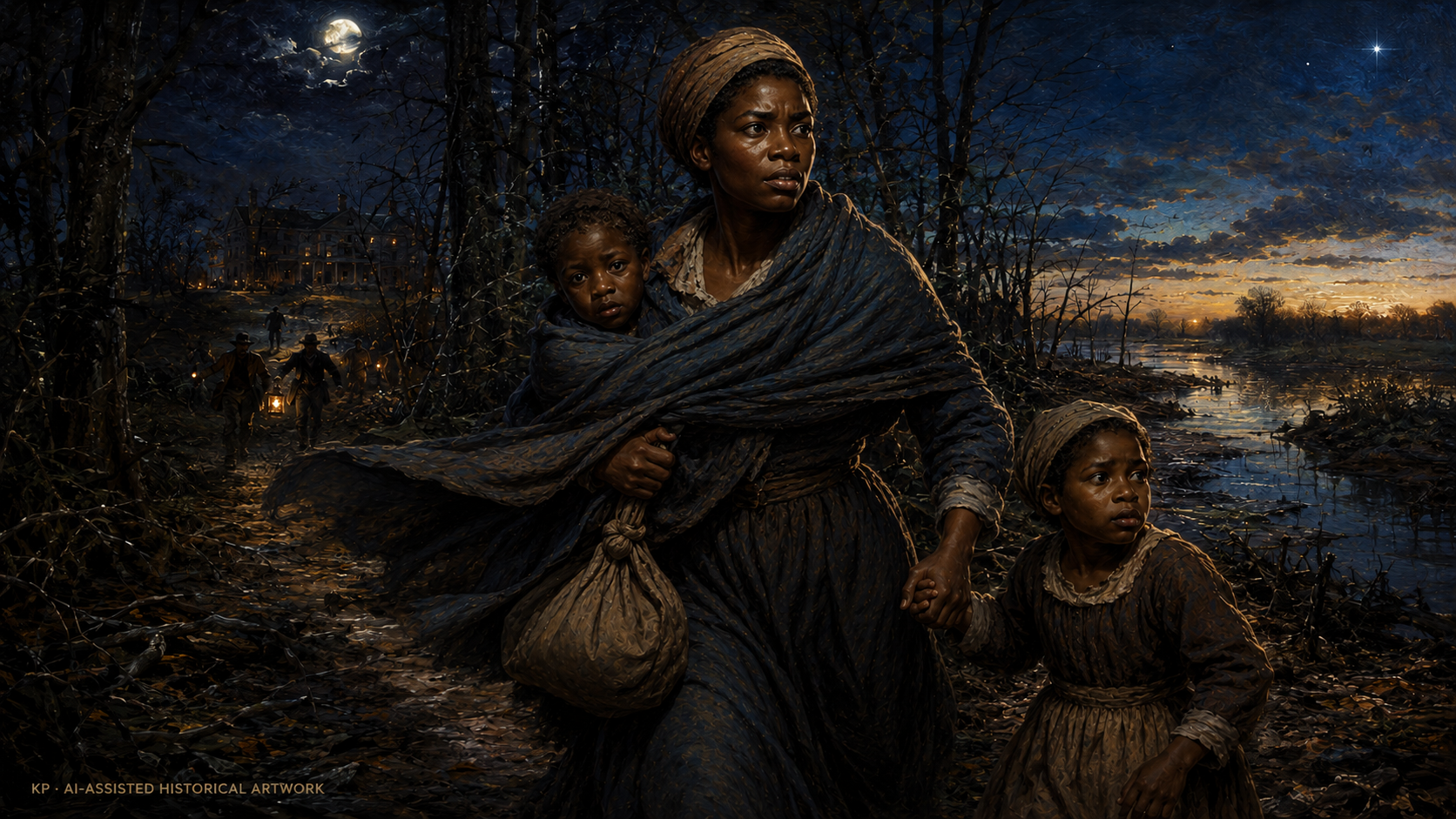
Charity Still—born Sidney Steel—was the mother of abolitionist William Still and a foundational figure in the Still family’s history of resistance. She liberated herself from the Maafa twice. During her first attempt, she fled Maryland with her four young children, only to be captured and forced back into bondage. In her second attempt, she reached New Jersey with her daughters, Mahalah and Kitturah, but had to leave her sons, Levin Jr. and Peter, behind. Her courage, strategic resolve, and refusal to accept captivity shaped the lives of generations of her descendants.
Sidney was born on Maryland’s Eastern Shore, probably in the late eighteenth century. Details of her early life—including her precise birth year and the circumstances of her father’s death—remain difficult to verify. What is clear is that she married Levin Steel while both were in bondage in Maryland, and that the couple’s determination to live free became the defining struggle of their young family.
Levin Steel purchased his own freedom in 1798. He later made his way to New Jersey, while Sidney and their children remained in Maryland. Around 1805, Sidney attempted to join him. She fled with their four children: Levin Jr., Peter, Kitturah, and Mahalah. The family’s first effort at freedom failed when they were captured.
Soon afterward, Sidney made a second attempt. This time, she fled with her daughters, Kitturah and Mahalah, leaving Levin Jr. and Peter behind. After reaching safety in New Jersey, she adopted the name Charity.
The separation from her sons was devastating. Accounts differ over the boys’ precise legal status at the time they were taken: Kate E. R. Pickard’s 1856 narrative describes them as kidnapped from their mother’s home in New Jersey, whereas the Maryland State Archives states that Saunders Griffin sold them to John Fisher, a Lexington, Kentucky, brickmaker. What is beyond dispute is that the brothers were torn from their mother and transported to Kentucky.
Levin died in Alabama. Peter survived approximately forty years, married Vina Still, and became the father of three children. Eventually, he earned and paid $500 to purchase his freedom.
On August 6, 1850, Peter—then using the name Peter Freedman—arrived at the office of the Pennsylvania Anti-Slavery Society in Philadelphia. He was looking for the mother from whom he had been separated as a child. There he encountered William Still, who listened to his story and recognized details of his own mother’s life in the stranger’s account. William soon realized that Peter was the older brother he had never met. The following day, the two brothers traveled to New Jersey, where Peter was reunited with Charity after about four decades of separation.
That reunion had a lasting effect on William Still. Already active in anti-Maafa work, he became one of the principal organizers of the Underground Railroad’s Eastern Line and carefully recorded the stories of people seeking freedom. Those records later formed the basis of his landmark book, The Underground Rail Road, a major historical source for the study of Black resistance and antislavery organizing.
Charity Still died in 1857. She and Levin had a large family; according to family history, Charity gave birth to fourteen children after reaching New Jersey, in addition to the four children born before her final escape. Her children included William Still; James Still, the renowned herbal practitioner known as the “Black Doctor of the Pines”; and Peter Still, whose remarkable journey became the subject of Kate E. R. Pickard’s The Kidnapped and the Ransomed (1856).
Her descendants continued the family’s tradition of intellectual, professional, and community achievement. Her granddaughter Caroline Still Anderson became a physician and educator. Her grandson James Thomas Still, son of James Still, graduated with honors from Harvard Medical School in 1871 and practiced medicine in Boston. The Still family’s legacy endures in New Jersey, particularly in the communities of Burlington County and South Jersey. Charity Still’s life should be remembered not simply as a story of suffering, but as one of purposeful resistance: a woman who repeatedly claimed freedom for herself and her children in the face of extraordinary danger.
The Other Land From: Early Recollections and Life of James Still
Through this dark wilderness
We all must travel on, To a land unseen by mortal eyes,
Where many thousands have gone.
Beyond this vale there is a land,
Where night is changed to day.
Nothing there to mar our peace,
Or clouds to pass away.
A happy home where the good may rest,
No sorrow there may come.
For tears are wiped from every eye,
In that heavenly, happy home.
No sorrow there, or crying heard,
Joy is the crown all wear,
Robed in linen clean and white,
While conquering palms they bear.
There candles we shall never need
To light our path along,
The Lamb himself is the light thereof,
The theme of harp and song.
The streets are of transparent gold,
Rivers of life do flow,
Where all may drink and drink again,
Till they God’s fullness know.
by Dr. James Still
Sources:
Past and Promise: Lives of New Jersey Women by The Women’s Project Of New Jersey
https://en.wikipedia.org/wiki/Charity_Still
https://www.awesomestories.com/asset/view/Peter-Still-and-Charity-Still
Kate E. R. Pickard, The Kidnapped and the Ransomed (1856), https://docsouth.unc.edu/neh/pickard/pickard.html
William Still, The Underground Rail Road (1879 revised edition), Library of Congress: https://www.loc.gov/item/31024984/
Maryland State Archives, “Peter Still” biographical entry:
https://msa.maryland.gov/megafile/msa/speccol/sc5400/sc5496/015200/015222/html/015222bio.html
William C. Kashatus, William Still: The Underground Railroad and the Angel at Philadelphia, University of Notre Dame Press:
https://undpress.nd.edu/9780268200398/william-still/
Dr. James Still Historic Site and Education Center, “Still Family History”:
http://www.drjamesstillcenter.org/drjamesstill/StillFamily.html
https://www.nps.gov/articles/000/inde-underground-railroad-wstill-1872.htm