

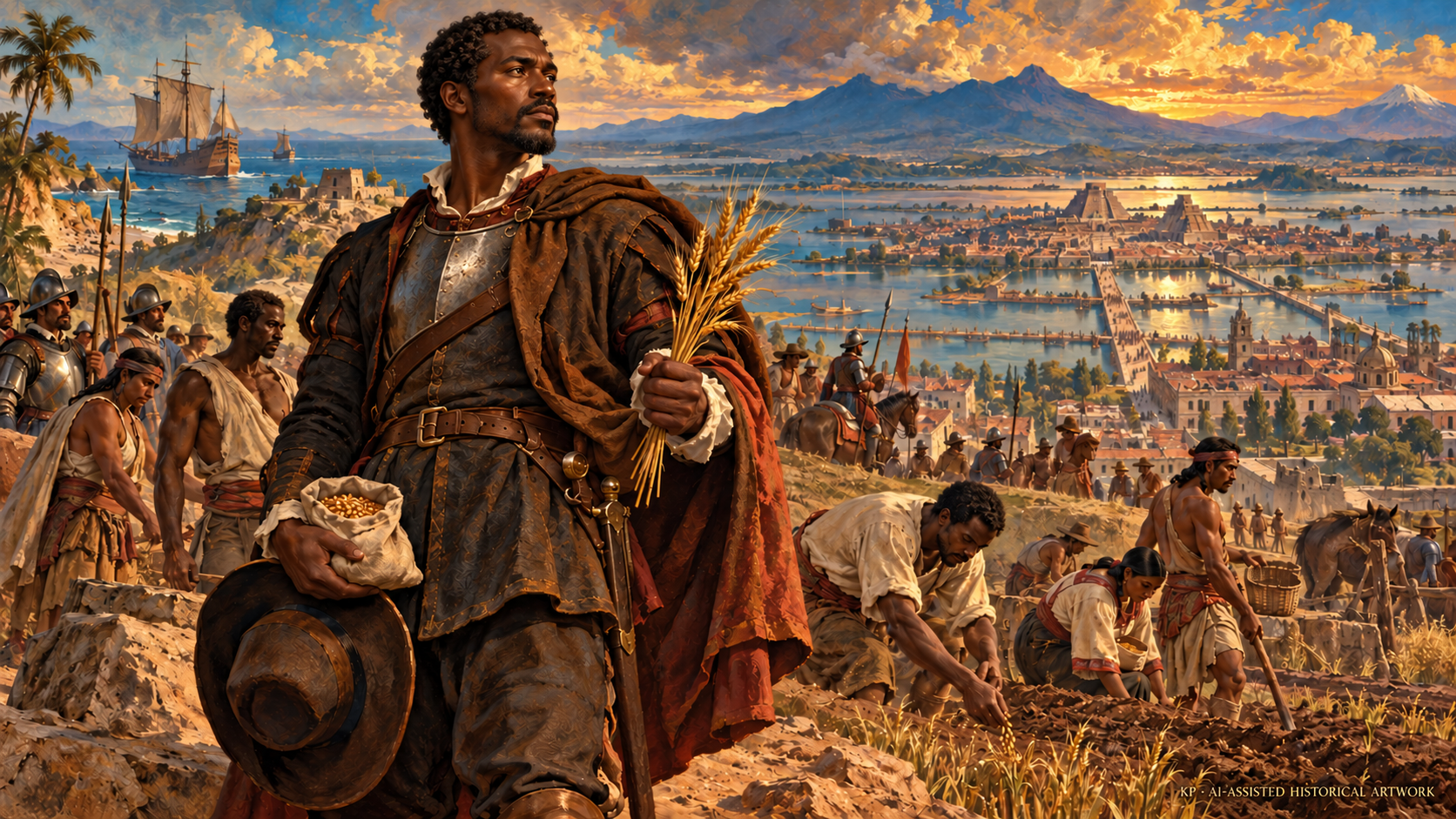
Juan Garrido was an African-born, free Black man who participated in the early Spanish invasions of the Caribbean, Florida, and Mexico. He is widely regarded as the first African known to have reached territory that is now the United States, having traveled with Juan Ponce de León’s 1513 expedition to La Florida. He later became a landholder, municipal employee, and agricultural experimenter in Mexico City, where he claimed to have been the first person to sow wheat in New Spain.
Much of what is known about Garrido comes from a probanza de méritos—a formal proof-of-service petition—dated 27 September 1538. In it, he sought royal recognition and recompense for approximately three decades of service to the Spanish. The document is both a rare first-person record of an African-descended participant in the early Spanish empire and a carefully constructed petition intended to establish Garrido’s worthiness for favor.
Garrido was probably born in West Africa around 1480, perhaps in or near the Kingdom of Kongo, though the evidence does not establish his exact birthplace. As a young man, he traveled to Lisbon, Portugal, and later to Seville, Spain. He appears to have been baptized and acquired the Christian name Juan Garrido there or during this early period of his life. His birth name is unknown. However, Spanish documentation identifies Garrido as a free Black man by the time he crossed the Atlantic. He is regarded as “the first Black conquistador,” although it may be more accurate to call him one of the earliest and best-documented Black conquistadors in the Spanish Americas.
Around 1502 or 1503, Garrido sailed from Spain to the Caribbean island now shared by Haiti and the Dominican Republic. There he participated in Spanish campaigns against the Taíno and entered the orbit of Juan Ponce de León. In 1508, he accompanied Ponce de León during the Spanish invasion of Puerto Rico. He later participated in the Spanish aggression against Cuba under Diego Velázquez de Cuéllar.
In 1513, Garrido traveled with Ponce de León on the expedition that claimed La Florida for Spain. This journey makes him the first African known to have reached the territory of the present-day United States. A popular claim is that the expedition searched for the Fountain of Youth; however, the story is a later, much-contested association rather than a secure explanation of the voyage’s purpose.
By late 1518, Garrido had joined Hernán Cortés’s expedition to Mexico. He was present during the Spanish-led and Indigenous-allied invasion that culminated in the fall of Tenochtitlan in 1521. The siege, warfare, starvation, and disease that accompanied the aggression had catastrophic consequences for the Nahua people and other Indigenous communities of central Mexico. Garrido later stated that he helped bury Spanish dead after the fighting and erected a small chapel commemorating them, at or near the site later associated with the church of San Hipólito de los Mártires.
After the invasion, Garrido established himself in Mexico City. On 10 February 1525, he received a house plot in the Spanish sector of the city and became a vecino, or citizen-resident, with the associated privileges and duties. He also held municipal positions as a portero—a doorkeeper or guard—town crier, and guardian of the Chapultepec aqueduct. These posts gave him some standing, although he still faced the racial hierarchy and economic insecurity of colonial society.
Garrido’s most enduring historical claim concerns wheat. In his 1538 probanza, he said he was the first person “to have the inspiration to sow wheat here in New Spain and to see if it took,” doing so at his own expense. Historians commonly identify him as the first known cultivator of wheat on the American mainland. Wheat was valuable to Spanish occupiers and the Catholic Church, whose sacramental practices required bread made from wheat rather than Indigenous staples such as maize or cassava.
Juan Garrido’s Memoir to Charles V of Spain, 1538
I, Juan Garrido, Black resident of this city [Mexico City], appear before Your Mercy and state that I am in need of making a probanza to the perpetuity of the king, a report on how I served Your Majesty in the conquest and pacification of this New Spain, from the time when the Marqués del Valle [Cortés] entered it; and in his company I was present at all the invasions and conquests and pacifications which were carried out, always with the said Marqués, all of which I did at my own expense without being given either salary or allotment of natives or anything else. As I am married and a resident of this city, where I have always lived; and also as I went with the Marqués del Valle to discover the islands which are in that part of the southern sea [the Pacific] where there was much hunger and privation; and also as I went to discover and pacify the islands of San Juan de Buriquén de Puerto Rico; and also as I went on the pacification and conquest of the island of Cuba with the adelantado Diego Velázquez; in all these ways for thirty years have I served and continue to serve Your Majesty – for these reasons stated above do I petition Your Mercy. And also because I was the first to have the inspiration to sow maize [wheat] here in New Spain and to see if it took; I did this and experimented at my own expense.
Garrido’s agricultural work was inseparable from colonial systems of coercion. Like other occupiers and conquistadors, he sought wealth through land, mining, and the exploitation of captive Indigenous and African people. In the late 1520s he participated in unsuccessful gold-mining ventures, including an expedition to Zacatula. In the 1530s, he joined Cortés’s expedition toward Baja California, where Spanish colonizers pursued imagined islands of wealth and pearls. This legendary island was supposedly filled with Black Amazonian women. Garrido returned to Mexico City with little financial success.
In 1538, facing financial difficulty, Garrido submitted his probanza de méritos to the Spanish Crown. The petition records his service in Puerto Rico, Cuba, New Spain, and the Pacific expedition under Cortés. He later traveled to Spain to present his case personally. Despite his long record of military and civic service, he did not achieve the prosperity or lasting reward he sought.
Garrido appears to have died in Mexico City sometime between 1547 and 1550. He was married to Francisca Ramírez, a Spanish woman, and they had three children. His life complicates simplified narratives of the early Americas: he was an African-born man who navigated precarious freedom and anti-Black discrimination, while also participating in—and at times benefiting from—the violence, dispossession, and captivity systems of Spanish colonial expansion.
Source:
http://www.theroot.com/who-was-the-first-african-american-1790893808
http://www.blackpast.org/gah-garrido-juan-c-1480-c-1550
https://www.visitstaugustine.com/history/black_history/juan_garrido/mexico_city.php
https://www.jstor.org/stable/1008141
https://muse.jhu.edu/article/32688/summary
https://enslaved.org/fullStory/16-23-101310
https://www.gilderlehrman.org/ap-african-american-studies/unit-2/origins-enslavement/juan-garrido-probanza-1538
https://www.nps.gov/people/juargarrido.htm


3 Responses
As a member of the Moorish Science Temple of America, Prophet Noble Drew Ali founder, the nationality of the Moors were taken away in 1774 and lasted till 1865, and the slave names of nero, black colored, etc was given. This article speaks of the Moors in Spain (Al Andalusia from 700-1492) when they were driven out or forced to convert or be executed. To become a conquistador as this person was not a noble thing in the sight of those who were executed by them.
Have you thought to read Ivan Van Sertima’s, “They Came Before Columbus”. The information from this renown historian’s research, places Juan Garrido about 50,000 places back in the queue.
I have read “They Came Before Columbus”. In fact, I am looking at it on my bookshelf as I type this response. Ivan Van Sertima is one of my favorite Afrikan-centered historians. In fact, he is one of the inspirations for this website. This post is about the first recorded/named person in America. Please read the post for what it is.