
Thomas Mundy Peterson—also recorded during his lifetime as Thomas Peterson, Thomas Mundy, Thomas Peterson-Mundy, and Thomas H. or Thomas Henry Peterson—was a Black New Jersey resident whose vote in Perth Amboy on 31 March 1870 became a national symbol of the Fifteenth Amendment’s promise. He is widely recognized as the first African American to cast a ballot under the amendment after the federal government formally certified it. His story marks an important moment in the continuing struggle for Black political citizenship in the United States.
Peterson was born in New Jersey in 1824 and spent much of his adult life in Perth Amboy. Modern accounts commonly give his birth date as 6 October 1824 and identify Metuchen as his birthplace, though nineteenth-century documentary records use varying forms of his name. His parents were Thomas Peterson and Lucy Green. Family histories state that his father worked for the Mundy family and that his mother, Lucy Green, had been held in bondage by Hugh Newell before gaining freedom under the terms of Newell’s will.
The Fifteenth Amendment declared that the right of United States citizens to vote could not be denied or abridged by the federal government or by any state “on account of race, color, or previous condition of servitude.” It was ratified on 3 February 1870 and formally certified and proclaimed by Secretary of State Hamilton Fish on 30 March 1870. The next day, 31 March, Perth Amboy held a municipal referendum on the future of its city charter.
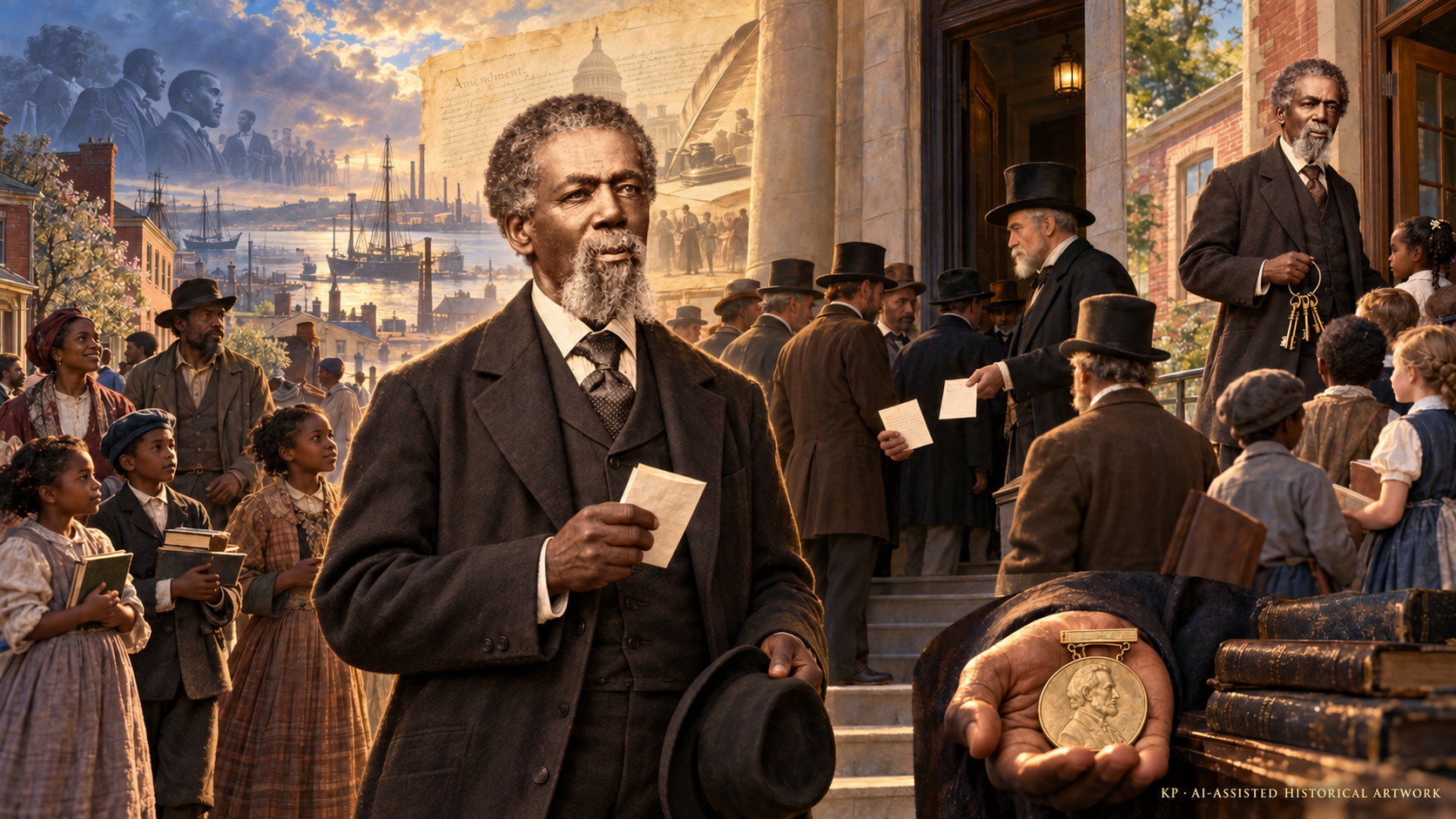
The vote concerned whether Perth Amboy should revise its existing charter or abandon it in favor of a township form of government. Peterson went to Perth Amboy City Hall and cast his ballot for a revised charter. In doing so, he became the first Black American widely recognized as having exercised the Fifteenth Amendment’s new constitutional protection. It is important to state this carefully: Peterson was not the first Black person ever to vote in the United States. Free Black men had voted in several states before racist disfranchisement laws narrowed or eliminated that right during the nineteenth century. His distinction lies in voting immediately after the Fifteenth Amendment’s formal adoption and in the national symbolic weight later attached to that act.
Peterson participated in Perth Amboy civic life beyond this historic ballot. He worked as a laborer and handyman and became the custodian of Public School No. 1, Perth Amboy’s first public school, after it opened in 1871. He held that position during the 1870s. Local tradition also credits him with serving on a city-charter revision committee, sitting on a jury, and holding public office, but those specific claims require direct archival documentation before they should be presented as established fact.
In 1884, the citizens of Perth Amboy raised $70 to commission a gold medal honoring Peterson’s historic vote. Presented on Decoration Day—now Memorial Day—on 30 May 1884, the medal bore a profile of Abraham Lincoln and an inscription acknowledging Peterson as “the first [Black American] voter in the U.S. under the provisions of the 15th Amendment” at an election held in Perth Amboy on “March 31st, 1870.”
The medal survives as an important object of Black voting-rights history and is preserved by Xavier University of Louisiana’s Archives and Special Collections. It embodies both the pride Black citizens and their allies felt in achieving constitutional voting rights and the fragility of those rights in the decades after Reconstruction.
Peterson died on 4 February 1904 and was buried in the cemetery of St. Peter’s Episcopal Church in Perth Amboy. His legacy has been formally recognized in New Jersey: on 3 April 1998, the state approved a joint resolution designating 31 March of every year as Thomas Mundy Peterson Day.
Perth Amboy also memorialized Peterson through its public-school system. In 1989, Public School No. 1—where he worked as custodian—was renamed the Thomas Mundy Peterson School. Located on State Street, it connects his historic act of voting to the ordinary labor and community life through which he sustained himself and his city.
Thomas Mundy Peterson’s ballot was cast in a local charter referendum, not in a presidential election. Yet its significance was national. It represented a hard-won constitutional transformation made possible by abolition, Black military service, Reconstruction politics, and generations of Black activism. At the same time, the later destruction of Black voting rights through violence, intimidation, discriminatory law, and exclusion reminds us that the Fifteenth Amendment was never self-enforcing. Peterson’s vote should therefore be remembered not as the completion of democratic inclusion, but as a moment in the long and unfinished struggle for equal political power.
Sources:
https://en.wikipedia.org/wiki/Thomas_Mundy_Peterson
https://historyengine.richmond.edu/episodes/view/5614
https://nj.gov/state/historical/assets/pdf/it-happened-here/ihhnj-er-peterson.pdf
https://nmaahc.si.edu/object/nmaahc_2015.190
https://www.si.edu/object/thomas-mundy-peterson:npg_NPG.2023.87
https://pub.njleg.gov/bills/9899/pl98/1001_.htm
https://www.xula.edu/news/2026/06/xaviers-historic-thomas-mundy-peterson-medal-selected-for-inaugural-exhibition.html
https://www.hmdb.org/m.asp?m=93943