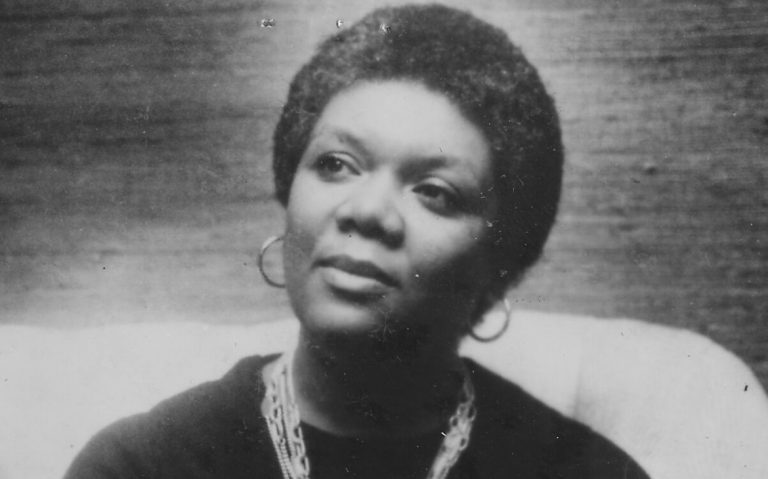

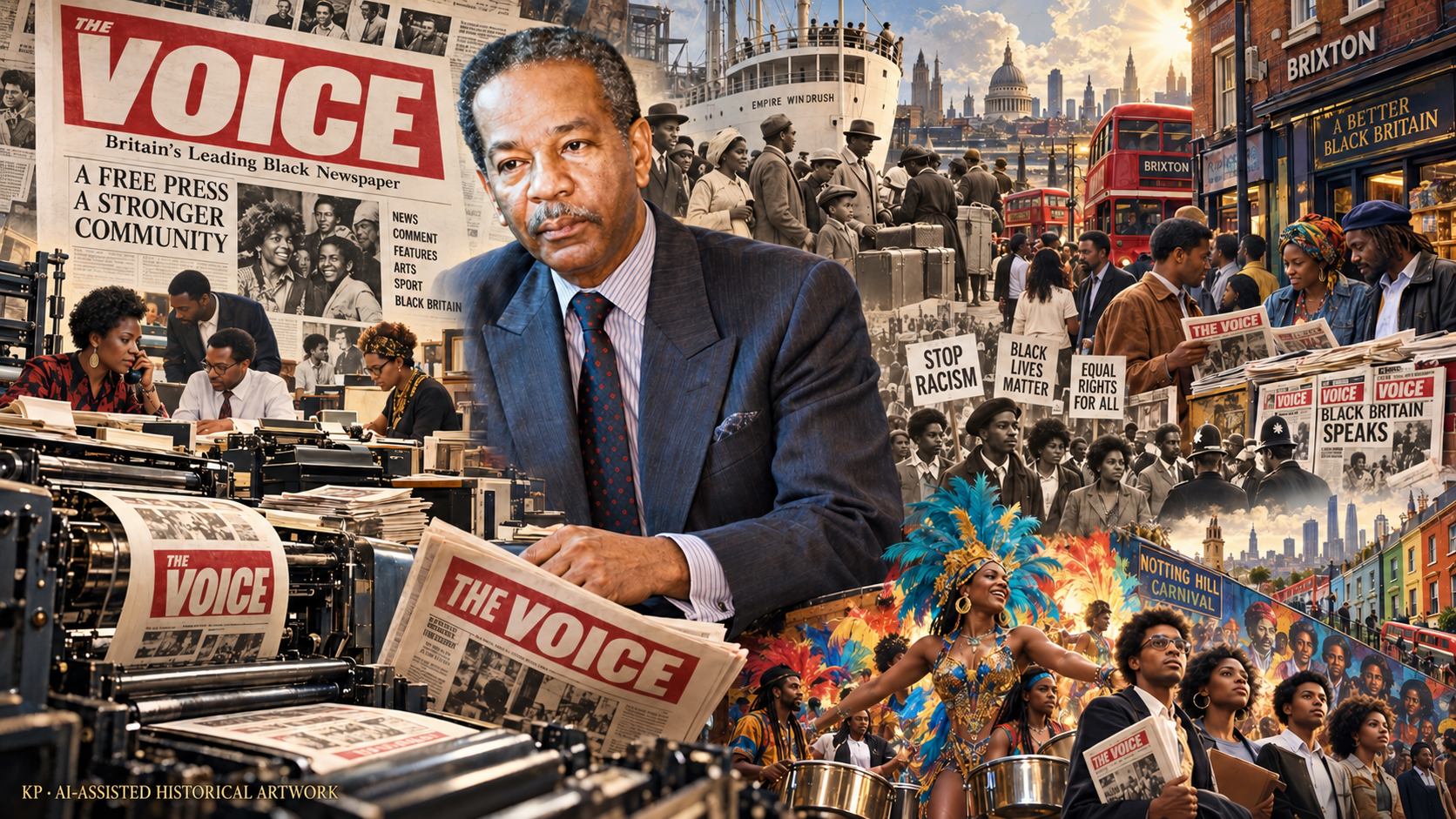
Val Irvine McCalla was a Jamaican-born British accountant and media entrepreneur who founded The Voice, transforming the landscape of Black British journalism. Quietly determined and commercially astute, he built a newspaper at a moment when Black Britons were too often misrepresented, ignored, or addressed only as immigrants rather than as citizens shaping Britain’s present and future. Through The Voice, launched in 1982, McCalla created a national platform that reported on racism and injustice, celebrated Black achievement, connected readers with work and opportunities, and opened newsroom doors to a generation of writers, broadcasters and editors.
Born in a poor neighborhood of Kingston, Jamaica, on 3 October 1943, Val McCalla studied accountancy at Kingston College. In May 1959, aged fifteen, he migrated to England, becoming part of the generation now remembered as the Windrush generation. Like many young Caribbean people who arrived in post-war Britain, McCalla entered a country that had called upon colonial subjects to help rebuild its economy, yet often met them with exclusion, racism and limited opportunity.
His first ambition was to become a pilot. He joined the Royal Air Force, but a perforated eardrum ended his hopes of flying. Instead, he spent five years in the RAF’s supplies section, gaining experience in bookkeeping, administration and financial management. Those skills would prove central to his later success. After leaving the RAF in the mid-1960s, McCalla worked in accounting and bookkeeping roles in London, while living for a period in a council flat in Bethnal Green.
In East London during the 1970s, McCalla began to find his way into journalism. Alongside his accounting work, he volunteered for East End News, a radical community newspaper based in Bethnal Green. There he helped edit a section called “The Voice”, aimed at Black readers. The experience sharpened his awareness of a deep gap in British media. Mainstream newspapers and broadcasters regularly associated Black people with crime, disorder and social crisis. At the same time, many existing Black newspapers largely addressed the concerns of an earlier generation of Caribbean and African migrants, with news and cultural attention directed towards the countries they had left.
McCalla recognized that young Black people born or raised in Britain required something different: a publication that understood their British lives, their cultural confidence, their frustrations and their ambitions. They needed a newspaper that could speak directly to them, rather than merely speak about them. From this insight came the idea for The Voice.
The timing was crucial. Britain in the early 1980s was marked by unemployment, racist violence, discriminatory policing and intense conflict between Black communities and the authorities. The Brixton uprising of 1981, followed by unrest in other cities, made visible grievances that Black Britons had long articulated: police harassment, unequal opportunities, poor housing and a pervasive failure of institutions to treat them fairly. The Scarman Report, published after the Brixton uprising, acknowledged the significance of racial disadvantage and urged public bodies to address their practices.
McCalla saw both a political need and a business opportunity. He secured support from the Greater London Council and obtained a £62,000 loan from Barclays through the government’s Loan Guarantee Scheme. The loan was controversial, since Barclays was then the target of an international anti-apartheid boycott because of its involvement in South Africa. It also contributed to a disagreement with broadcaster Alex Pascall, who had initially been involved in the project. Yet McCalla pressed ahead and repaid the loan within five years.
The first edition of The Voice appeared on 30 August 1982, timed to coincide with the Notting Hill Carnival. It began modestly, working from small premises in Hackney and operating on a tight budget. Flip Fraser became its first editor, while McCalla supplied the driving entrepreneurial force behind the venture. In its early days, resources were so limited that young reporters were sometimes promised little more than a Chinese meal at the end of the week. Nevertheless, the paper carried an energy and purpose that rapidly distinguished it from both the national press and its competitors.
Designed as a lively, accessible tabloid, The Voice combined news, campaigning journalism, entertainment, sport, fashion, community reporting and employment information. It did not present Black Britain as a single story of hardship, nor did it retreat into Caribbean nostalgia. Instead, it reflected a community in formation: British, African-descended, Caribbean-connected, politically alert and culturally inventive. Its pages made room for local activism and national debate, policing and education, music and style, and Black business and professional success.
The paper’s commercial growth was swift. Its initial circulation of approximately 4,000 copies rose to more than 50,000 a week within eight years. One major source of income was recruitment advertising. In the aftermath of the Brixton uprising and the Scarman Report, local councils, public bodies and voluntary organizations sought to recruit more ethnic-minority staff. The Voice became an important place for such advertisements, connecting readers with employment opportunities while generating substantial revenue for the company. At its height, the newspaper reportedly earned as much as £100,000 a week from recruitment advertising.
That success made McCalla a multi-millionaire, but he did not cultivate the public image of a flamboyant media proprietor. He was widely described as shy, private, stern and intensely focused. He avoided personal publicity and lived without conspicuous displays of wealth. His character could be demanding, and former staff sometimes recalled a hard taskmaster whose management style created tension and high turnover. Yet many also saw that intensity as part of his determination to keep the paper alive in an industry that had historically excluded Black ownership, Black editorial authority, and Black journalists.
His personal experience of racism did not disappear with prosperity. After purchasing a Mercedes, McCalla was repeatedly stopped by police in his local area. He eventually exchanged it for a Volvo, an episode that underscored a bitter reality: wealth and professional success did not shield Black men from racial profiling. The incident reflected the wider conditions that had made The Voice necessary in the first place.
Under McCalla’s leadership, The Voice became a force that Britain’s mainstream press could not easily ignore. It exposed injustices and challenged institutional racism, particularly in policing. It was unapologetic in its criticism of public figures and authorities whose statements or policies harmed Black communities. When Metropolitan Police Commissioner Sir Paul Condon claimed that 80 percent of muggers in some parts of London were Black, The Voice answered with a memorable front-page rebuke: “Condon, you’re an ass!” Such moments established the paper as a determined challenger to the official narratives that dominated British public life.
The newspaper also became a training ground for Black media talent at a time when mainstream newsrooms offered few openings. Its alumni included journalists, broadcasters, writers, producers and public figures such as Trevor Phillips, Martin Bashir, Rageh Omaar, Brenda Emmanus, Dotun Adebayo, Diran Adebayo, Leone Ross, Vanessa Walters and Jasmine Dotiwala. For many, The Voice provided early experience and an editorial home when larger institutions resisted hiring Black journalists. Former editor Steve Pope argued that McCalla had done more than many government initiatives to get Black people into journalism.
McCalla expanded beyond his flagship newspaper, establishing other publications aimed at different parts of the Black British readership. These included Pride, a glossy lifestyle magazine for Black women; Chic; and The Weekly Journal, launched in 1991 and directed towards a growing Black professional and middle-class readership interested in politics, business and cultural affairs. His publishing ventures reflected a clear understanding that Black Britain was not a niche market but a diverse public with varied tastes, identities and aspirations.
The Voice’s achievements did not make it immune to criticism. Some detractors dismissed its tabloid style or accused it of concentrating too heavily on stories of discrimination and conflict. Others argued that it did not always represent the full range of Black political opinion. Such criticism formed part of the difficult terrain McCalla navigated: sustaining a commercially viable publication while remaining accountable to a community that was itself varied, argumentative and politically diverse. The paper’s importance, however, lay in making such arguments visible within Black public life rather than leaving them to be mediated solely by the white-owned press.
McCalla died of liver failure at his home in Seaford, East Sussex, on 22 August 2002, aged fifty-eight. He was survived by his wife, Linda, their daughters Natalie and Lauren, his sons Michael and David from his first marriage, and a sister. A memorial service at St Martin-in-the-Fields in London brought together figures from journalism, politics and community life, reflecting the reach of his work.
Two years after his death, The Voice was sold to Jamaica’s Gleaner Company for £4 million. Although the paper later faced the pressures that reshaped much of print journalism—falling circulation, declining recruitment advertising and the rise of digital media—its historical place was secure. In 2019, it moved from weekly to monthly print publication while maintaining an online presence.
McCalla’s contribution has received formal recognition. In 1997, he was ranked number 68 in the 100 Great Black Britons poll. On Windrush Day in June 2021, the Nubian Jak Community Trust installed a Black Plaque outside The Voice’s former offices at Blue Star House in Brixton, honoring him as a pioneering founder and media visionary.
Val McCalla’s most enduring achievement was not simply creating a successful newspaper. It was the construction of an institution through which Black Britons could see themselves as newsmakers, readers, workers, critics, artists, citizens and agents of their own history. The Voice challenged the idea that Black life in Britain could be defined only by crisis or explained from outside. McCalla gave a generation a national platform, and in doing so, helped make Black Britain more visible to itself and impossible for the wider country to ignore.
Sources:
https://en.wikipedia.org/wiki/Val_McCalla
https://www.theguardian.com/media/2002/aug/23/pressandpublishing.raceintheuk
http://news.bbc.co.uk/1/hi/uk/2293867.stm
https://www.blackhistorymonth.org.uk/article/section/news/black-plaque-installation-on-windrush-day-to-commemorate-val-mccalla-the-founder-of-the-voice-newspaper/
https://thebattleground.eu/2025/10/06/breaking-with-british-colonialism/
https://en.wikipedia.org/wiki/The_Voice_(British_newspaper)