
Michel-Rolph Trouillot (1949–2012) was a groundbreaking Haitian anthropologist, historian, songwriter, and public intellectual whose life and work fundamentally reshaped how we understand history, power, and the making of knowledge. Born into an intellectually vibrant family in Port-au-Prince, Haiti, Trouillot experienced the turbulence of the Duvalier dictatorship firsthand. Forced into exile in New York, he became deeply involved in cultural and political activism, writing songs and plays, and publishing history for audiences beyond elite circles.
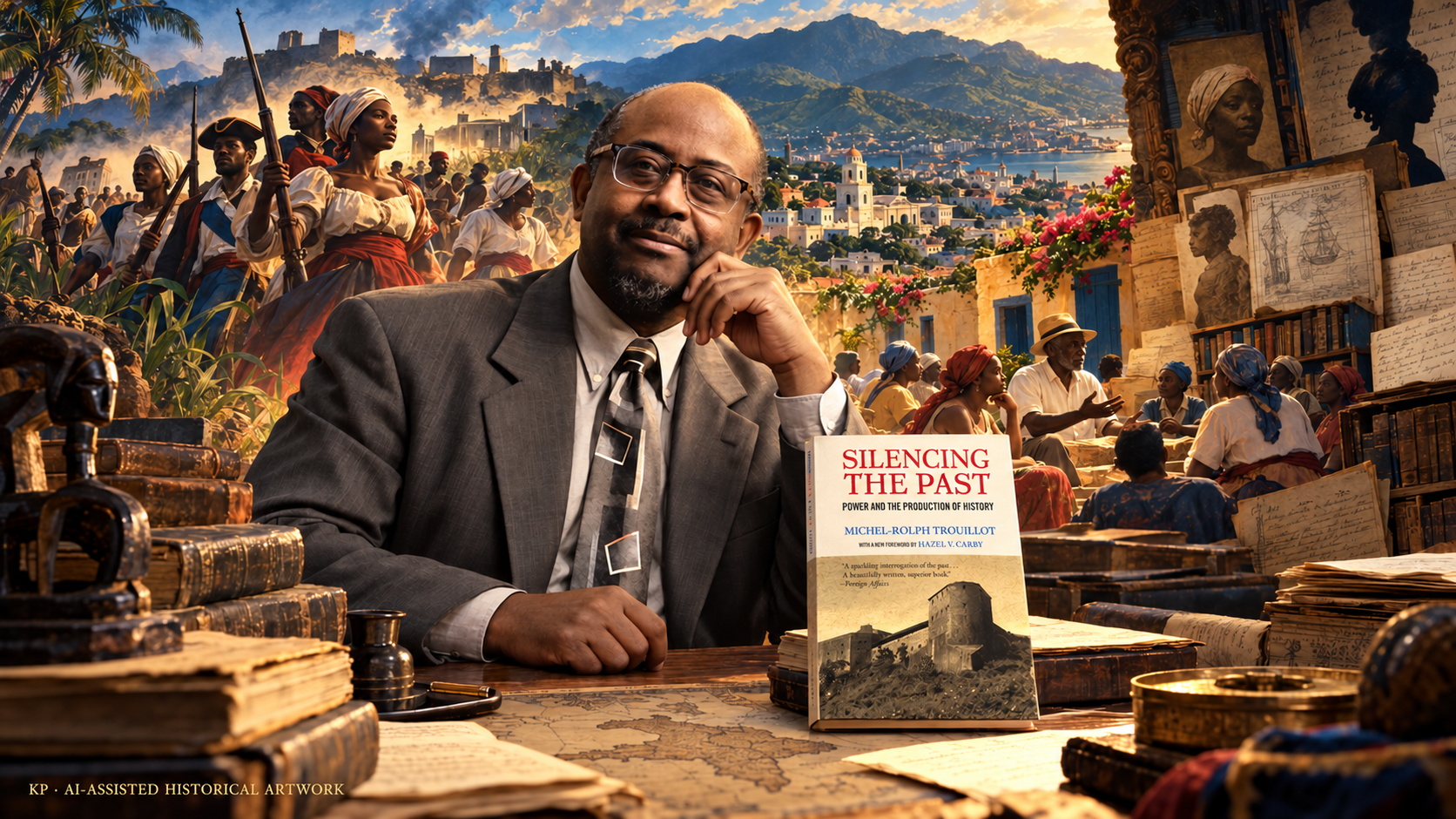
Committed to making history accessible to all, Trouillot published an early account of the Haitian Revolution in Haitian Kreyòl, broadening the reach of historical knowledge. He later earned his doctorate from Johns Hopkins University, launching an influential academic career that included faculty appointments at leading institutions such as the University of Chicago. Trouillot’s seminal book, Silencing the Past: Power and the Production of History (1995), revolutionized the field by exposing how power shapes what is remembered and what is forgotten. He challenged Eurocentric narratives that marginalized African and Caribbean peoples, insisting instead on their agency and centrality in the making of the modern world. His work interrogated the structures that determine whose voices are heard, whose experiences are recorded, and how historical memory is constructed.
Trouillot’s intellectual achievements garnered international recognition, including prestigious fellowships from the Guggenheim Foundation and the National Humanities Center, as well as the Frantz Fanon Lifetime Achievement Award in 2011. He also played a key role on the Gulbenkian Commission for the Restructuring of the Social Sciences, shaping conversations about the future of global scholarship. Trouillot passed away in Chicago in 2012, but his intellectual legacy endures. His scholarship continues to inspire new generations of historians and anthropologists to confront historical silences, question dominant narratives, and critically examine the relationship between power and knowledge.
A Childhood in Conversation with History
Trouillot was born in Port-au-Prince on 26 November 1949, and grew up in a family where literature, politics, and historical argument formed part of everyday life. His father, Ernst Trouillot, was a lawyer, teacher, journalist, and television presenter who hosted programs on Haitian history. His uncle, Hénock Trouillot, was a prolific historian and director of Haiti’s National Archives. His siblings—Jocelyne, Évelyne, and Lyonel—also became writers, educators, and intellectuals. Trouillot later recalled growing up in a household where “history sat at the dinner table.” These family discussions brought competing interpretations of Haiti’s past and its political possibilities into view. This relationship between lived experience and historical interpretation would remain central to his work.
Trouillot received his primary and secondary education at the Petit Séminaire Collège Saint-Martial in Port-au-Prince. He completed the Baccalaureate II examination in philosophy in 1968 and began coursework at the École Normale Supérieure. His education unfolded under François Duvalier’s dictatorship, whose repression threatened students and other political opponents. In 1968, Trouillot left Haiti amid the persecution of student activists. By 1971, he had settled in Brooklyn.
Exile, Work, and Cultural Resistance
New York became a place of intellectual formation and displacement. Initially staying with an aunt, Trouillot worked as a taxi driver and took other jobs while pursuing his education. Alongside those demands, he participated in the political and cultural life of the Haitian diaspora, opposing the Duvalier regime and challenging the treatment of undocumented Haitian migrants in the United States. He helped establish Tanbou Libète, or “Drum of Freedom,” a theatre and music collective associated with the kilti libète—“freedom culture”—movement. Its work brought performance, political education, and Haitian cultural traditions into conversation. Trouillot wrote poetry, plays, and songs, including lyrics for “Aliyen Kat,” or “Alien Card,” which addressed a central experience of migrant life. He also helped sustain intellectual exchange through diaspora publications, including Lakansièl, Lire Haiti, and Les Cahiers du Vendredi.
These activities were not preliminary diversions from a future scholarly career. They confronted questions that would animate his scholarship: who could speak with authority, how knowledge travelled, and how people understood and resisted domination. His commitment to music also endured. When his former student, Yarimar Bonilla, asked how he would introduce himself to a stranger, he answered, “I’d tell them I’m a songwriter.”
Writing Haitian History in Kreyòl
Trouillot’s first book, Ti difé boulé sou istoua Ayiti, appeared in 1977 while he was still an undergraduate. Written in Haitian Kreyòl and published through Kolèksion Lakansièl, it challenged both the language and the conventions through which Haitian history usually reached its readers. Rather than addressing the French-reading educated minority primarily, Trouillot wrote in the language spoken by the Haitian majority. His choice asserted that Kreyòl could carry complex historical analysis and political argument. Trouillot also drew on oral storytelling rather than simply translating conventional academic history into another language. His narrative centers on Grinn Prominnin, a traveling storyteller who recounts and discusses the past in a rural lakou, a shared household-and-courtyard setting.
Proverbs, dialogue, wordplay, and references to Vodou cosmology become part of the work’s intellectual structure, so history emerges through exchange rather than a single authoritative voice. The book invites its audience to consider how the Haitian Revolution’s struggle for emancipation coexisted with conflicts over labor, property, and political control. Its Marxist analysis questioned celebratory accounts centered on exceptional leaders, instead directing attention to the people who made the revolution and the inequalities that survived it.
Trouillot self-published the work with assistance from his siblings Évelyne and Lyonel. Copies circulated through Haitian diaspora networks and reached readers in Haiti, where teachers used it clandestinely. Later translated into English as Stirring the Pot of Haitian History, the book embodied a commitment that continued throughout his career: historical understanding should not remain the possession of a narrow intellectual class.
From Brooklyn to Caribbean Anthropology
In 1978, Trouillot graduated summa cum laude from Brooklyn College with a degree in Caribbean history and culture. That year, Sidney W. Mintz and Richard Price recruited him to the doctoral program at Johns Hopkins University. He completed his PhD in anthropology in 1985, developing an approach that joined ethnography, historical research, and political economy.
His doctoral fieldwork in Dominica became the basis of Peasants and Capital: Dominica in the World Economy (1988). Through the lives and labor of small-scale banana cultivators, he examined the relationship between rural production and international capitalism. The farmers were not remnants of an isolated, premodern economy. Their work connected to commercial networks and economic decisions that extended far beyond the island. This approach challenged treating an anthropological field site as a self-contained community. To understand local livelihoods, Trouillot followed relationships across different scales: household labor, agricultural production, trade, and the world economy. His earlier research on coffee cultivation in colonial Saint-Domingue similarly complicated accounts dominated by sugar plantations, drawing attention to other crops, producers, and social relationships within the economy of captivity.
Trouillot taught at Duke University from 1983 to 1988 and helped establish its Caribbean Studies Program. He returned to Johns Hopkins in 1988, becoming the Krieger/Eisenhower Distinguished Professor of Anthropology and directing the Institute for Global Studies in Culture, Power and History. In 1998, he joined the University of Chicago as Professor of Anthropology and Social Sciences.
The Haitian State and the Nation
Haiti remained central to Trouillot’s intellectual and political concerns. In Haiti: State Against Nation: The Origins and Legacy of Duvalierism (1990), developed from a French-language work published in 1986, he examined the historical relationships that made dictatorship possible. Rather than treating Duvalierism as the inexplicable product of a singularly brutal ruler, he investigated the structures through which the Haitian state had accumulated resources and exercised authority.
The distinction between state and nation was crucial. The state did not stand transparently for the people it governed. Its institutions could extract wealth from rural producers while denying them meaningful political influence. Trouillot therefore placed the peasantry, taxation, class formation, and political exclusion within the explanation of authoritarian rule.
His argument resisted two forms of simplification: reducing Haitian politics to individual personalities and representing repression as an expression of some timeless Haitian condition. Dictatorship had a history. Understanding that history required tracing institutions and social conflicts rather than substituting cultural stereotypes for analysis.
How History Acquires Its Silences
Published in 1995, Silencing the Past brought Trouillot’s questions about historical knowledge to a broad interdisciplinary readership. Its central concern was not simply that powerful people distorted an otherwise complete record. Inequality entered the making of history long before a historian began to write.
Trouillot distinguished between the processes through which people make history and the narratives through which those processes become known. Events happen, but their passage into historical knowledge is neither automatic nor equal. Some actions produce documents; others leave scattered traces. Some records are preserved and organized; others disappear or remain inaccessible. Later narratives select from this uneven inheritance, while commemorations and public institutions confer significance on particular accounts. He identified four moments at which silences enter historical production: the creation of sources, the assembly of archives, the retrieval of facts in narratives, and the retrospective attribution of historical significance. These moments connect, but each raises different questions about authority and exclusion. The implications extended beyond professional scholarship. Classrooms, museums, monuments, public ceremonies, and family stories all help produce understandings of the past. Recognizing the workings of power also did not require abandoning evidence or treating every account as equally persuasive. It required investigating how evidence came into existence, what it could establish, and what its absences might conceal.
Haiti and the Limits of European Thought
The Haitian Revolution occupied a decisive place in this argument. Trouillot described it as “unthinkable” within the dominant frameworks of its time: an event that prevailing categories could not adequately account for. Africans and their descendants challenged not only colonial oppression and captivity but the racial assumptions through which European societies understood humanity and political capacity. Those assumptions made it difficult for many observers to recognize African people as the organizers of a revolutionary struggle. When evidence of the uprising could no longer be dismissed, explanations often shifted authorship to foreign agents or other external forces. The problem was not the revolutionaries’ inaction. It was the inability—or refusal—of established political thought to recognize the full meaning of that action.
For Trouillot, the revolution demonstrated that political practice could exceed the limits of recognized theory. People asserted possibilities through struggle before dominant intellectual traditions could accommodate them. Haiti therefore unsettled accounts that traced freedom’s origin to European thought and its spread elsewhere through imitation. Historical writing could reproduce the original refusal through outright omission or through what Trouillot called banalisation: reducing the revolution to a derivative episode, minimizing its emancipatory significance, or explaining its outcome without adequately recognizing Haitian organization and military action. Recovering that significance demanded more than adding Haiti to an established narrative. It required reconsidering the narrative’s assumptions about who could make universal claims to freedom.
Anthropology and the Making of the West
Trouillot also turned his critical attention towards anthropology itself. In his 1991 essay “Anthropology and the Savage Slot,” later incorporated into Global Transformations: Anthropology and the Modern World (2003), he examined the intellectual space the discipline occupied. Anthropology had inherited a role within a larger Western imagination that represented other peoples as radically different and made that difference serve accounts of Western identity.
The “savage slot” named that inherited position; it was not Trouillot’s description of the people placed within it. His challenge was therefore deeper than a demand for more respectful representations. Anthropology needed to question the historical arrangement that made some societies appear to embody modernity while others became objects through which modernity defined itself.
He brought a similarly searching approach to “culture.” The concept had helped challenge biological explanations of human difference, yet its public uses could also portray communities as fixed, homogeneous, and fundamentally separate. Trouillot defended its capacity to oppose racial determinism while questioning language that turned historical relationships into supposedly timeless cultural characteristics. He also participated in the Gulbenkian Commission’s Open the Social Sciences (1996), contributing to a wider reconsideration of disciplinary boundaries.
Teaching, Illness, and an Enduring Intellectual Life
Students remembered Trouillot as a demanding, generous teacher who insisted scholarship begin with a consequential problem. His emphasis on “burning questions” encouraged researchers to identify the knowledge they wanted to produce, rather than simply select a topic or accumulate information. His graduate seminar, “Concept and Categories,” required students to examine the histories and political implications of the terms through which they worked.
Serious brain aneurysms in 2002 sharply curtailed his active research and writing. Among his unfinished projects was an ambitious study provisionally titled “The West,” intended to link a critique of colonialism and capitalism to the creativity and agency of peoples too often represented as passive recipients of world history.
His commitments also remained rooted in Haiti. In 2011, he and his siblings co-founded the Center Culturel Anne-Marie Morisset in Delmas, honoring their mother and supporting education and cultural life. That year, the Caribbean Philosophical Association awarded him its Frantz Fanon Lifetime Achievement Award.
Trouillot died in Chicago on 5 July 2012, aged sixty-two.
Trouillot’s intellectual legacy joins rigorous criticism to what he called “moral optimism”: a commitment to human possibility that need not ignore the force of domination. Across Kreyòl storytelling, political song, fieldwork, teaching, and historical analysis, he insisted on recognizing people as makers of worlds, not merely as subjects of systems imposed upon them. His work continues to demand an exacting form of historical attention—one that asks not only what the past contains, but how its surviving accounts became authoritative, and whose struggles those accounts have made difficult to see.
Sources:
https://en.wikipedia.org/wiki/Michel-Rolph_Trouillot
https://news.uchicago.edu/story/michel-rolph-trouillot-scholar-caribbean-history-1949-2012
https://www.amacad.org/person/michel-rolph-trouillot
https://thehaitianroundtable.org/portfolio/michel-rolph-trouillot/
https://nacla.org/2013-5-31-burning-questions-life-and-work-michel-rolph-trouillot-1949-2012/
https://ageofrevolutions.com/2022/08/22/before-silencing-the-past-michel-rolph-trouillots-stirring-the-pot-of-haitian-history/
https://www.bostonreview.net/articles/remembering-trouillot-colin-dayan/
https://iuuk.mff.cuni.cz/~andrew/EAP/Trouillot.pdf
https://www.youtube.com/watch?v=ZPDkx2_0vHs
https://www.livinganthropologically.com/anthro-lectures/idea-of-culture/
https://www.andrewmdavenport.com/writing/trouillot
https://brill.com/view/journals/nwig/96/3-4/article-p339_6.xml?language=en&srsltid=AYCX9vIqvZ4YdcFFkHliZZT14E7ccoxwHUzV33Y30T-RnbFH2ezC4rhf
https://www.redalyc.org/pdf/392/39225841008.pdf