
María Remedios del Valle was an Afro‑Argentine freedom fighter, nurse, and guerrilla who became a decorated officer in Argentina’s wars of independence and is now honored as “Madre de la Patria” (Mother of the Homeland). Del Valle accompanied the Army of the North into campaigns marked by exhausting journeys, battlefield victories, and devastating defeats. She cared for wounded soldiers, endured injury and captivity, and earned recognition from General Manuel Belgrano. Those who knew her service remembered her as “La Capitana,” the Captain.
Her military contributions did not secure a comfortable life. After the campaigns, she faced severe poverty before a prolonged effort by her former comrades to obtain military compensation. Her biography brings together two histories too often separated: the achievement of independence and the struggle of an African-descended woman to receive acknowledgment for helping make it possible.
A Life Only Partly Preserved
Del Valle was born in Buenos Aires in the second half of the eighteenth century. Her precise birth date remains uncertain, and little is known about her childhood or early adulthood. The most detailed surviving evidence concerns her military service and the later proceedings through which she sought compensation for her contributions to the independence struggle.
As a Black woman, she lived within a society shaped by the Maafa—the centuries-long catastrophe inflicted on African peoples through forced displacement, captivity, and exploitation. Her African ancestry appears in her military record, but the surviving biographical evidence offers few details about her family background or her life before she joined the army in 1810.
Joining the Independence Struggle
Following the May Revolution of 1810, del Valle accompanied the Army of the North with her husband and two sons. The army’s campaigns sought to end Spanish control in Upper Peru, a region corresponding largely to present-day Bolivia, and to advance the independence movement farther north.
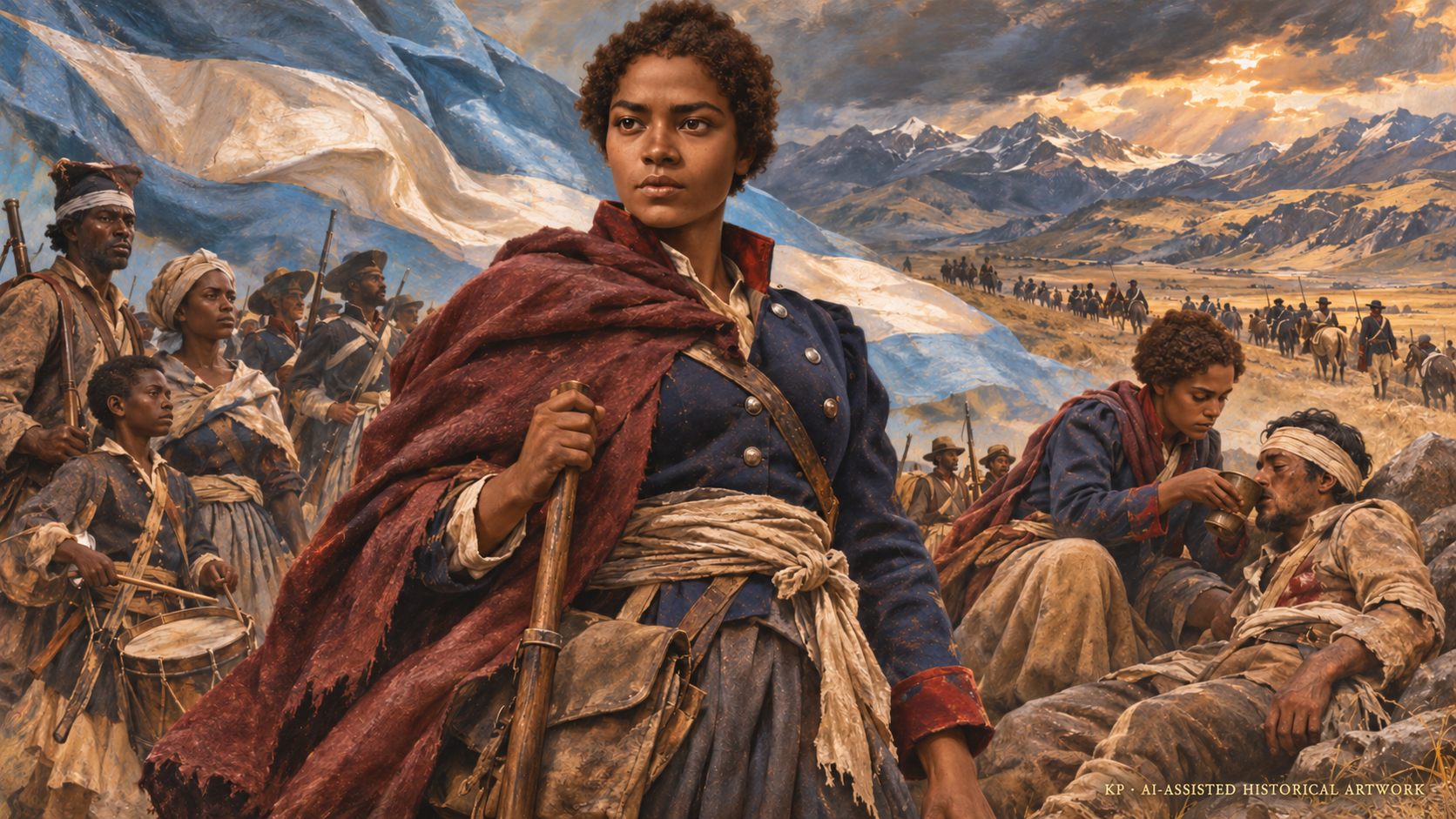
Del Valle initially served as an auxiliary, tending the wounded and supporting logistics, but repeatedly moved into active combat roles, especially in critical battles such as Huaqui, Tucumán, Salta, Vilcapugio, and Ayohuma. Accounts place her at Huaqui in 1811, during the retreat toward Jujuy, and in the Jujuy evacuation of 1812. They also connect her to the victories at Tucumán in September 1812 and Salta in February 1813, followed by the defeats at Vilcapugio and Ayohuma later that year. Her service extended across both celebrated successes and the difficult withdrawals that followed military disaster. She helped wounded men, supplied troops, and took part in combat. Later testimony described her not simply as someone who accompanied soldiers, but as a participant whose actions exposed her to the same dangers.
One of the best-known accounts of del Valle’s service concerns the Battle of Tucumán. Before the fighting, she asked Belgrano for permission to attend to soldiers wounded near the front. He initially refused, saying the battlefield was no place for a woman. Del Valle nevertheless proceeded with the work she believed necessary. Belgrano subsequently recognized her service by naming her a captain.
The episode captures an important feature of her career: recognition followed action. She did not wait for acceptance within the army before demonstrating what she could contribute. Her conduct challenged a restriction placed upon her because she was a woman, and her appointment acknowledged the value of work performed under fire.
Loss, Captivity, and Continued Resistance
The campaigns brought profound personal losses. Accounts of del Valle’s life record the deaths of her husband and sons during the independence struggle. She continued to participate despite the destruction of the family with whom she had entered the campaigns.
She was also wounded and taken prisoner by forces fighting to maintain Spain’s control. Testimony later presented in support of her claim for military compensation describes that she was publicly flogged and subjected to severe punishment while imprisoned. Scholarly accounts also describe her escape and subsequent activity as a guerrilla fighter.
Because of her courage in combat and her tireless work tending and supplying troops, soldiers and officers began to call her “La Capitana” and “La Madre de la Patria.”
Poverty in Buenos Aires
After her military service, del Valle returned to Buenos Aires and struggled to support herself. Age and poor health limited her ability to earn a living. Accounts describe her seeking food near churches and convents. General Juan José Viamonte recognized her in the street and took up her cause. Other officers supplied testimony confirming her service, wounds, and captivity. Their statements were crucial because they connected the impoverished woman in Buenos Aires to the veteran they had known during the campaigns. The resulting proceedings exposed the distance between battlefield recognition and material support. Del Valle had been known to soldiers and officers, but that knowledge did not automatically translate into income. She needed witnesses and advocates to help turn remembered service into an acknowledged claim.
The legislative debate recognized her position as a captain and the compensation associated with that service. Proposals also included a biography and a monument, although those commemorative plans did not move forward at the time. Her struggle was thus about more than remembrance: it concerned the practical means to live.
Recognition in Her Final Years
By 1829, del Valle had been recognized as sergeant major. Subsequent military arrangements provided a salary matching her rank. During Juan Manuel de Rosas’s governorship of Buenos Aires, she appeared in military records as Remedios Rosas. A scholarly biographical account traces that name in army documentation from 1836 until her death in 1847.
She died in Buenos Aires in 1847. November 8 became the date Argentina later used to honor both her life and the broader contributions of its African-descended communities.
A Place in Argentina’s Public Memory
María Remedios del Valle died in Buenos Aires on November 8, 1847. Argentina’s Law No. 26,852 established November 8 as the National Day of Afro-Argentines and Afro Culture in her honor.
In recent years, she has become a central figure in efforts to recover Afro‑Argentine history. Streets and schools bear her name, and scholars have examined her place in Argentine history and how she has been remembered as “La Capitana” and “Madre de la Patria.” These efforts challenge accounts of independence that have marginalized African-descended people, particularly Black women.
On November 8, 2022, a monument honoring del Valle was inaugurated in Buenos Aires’s Plaza Alfonso Castelao. Selected through a public competition, the sculpture connected the remembrance of Del Valle to contemporary African-descended participation in shaping Argentina’s public memory.
The sculpture’s subsequent history also exposed the vulnerability of that recognition. It was attacked and burned in September 2023, prompting condemnation from Argentina’s Ministry of Culture and a public gathering of organizations protesting its destruction.
Her recognition also extended to the country’s currency. In May 2022, the Central Bank of Argentina announced a proposed 500-peso banknote featuring del Valle alongside Manuel Belgrano. Its accompanying account described her as a heroine of independence who confronted prejudice as both a woman and a person of African descent. On May 7, 2024, the bank introduced a 10,000-peso note bearing their portraits, placing her image on currency used nationwide.
The title “Mother of the Homeland” places del Valle within Argentina’s founding story, but her actions give that title its substance. She joined the independence campaigns with her husband and sons, cared for wounded soldiers under fire, fought and endured captivity, and later sought the military compensation her service warranted. Her biography brings those experiences together, restoring the combatant, caregiver, and veteran behind the commemorative name.
Sources:
https://en.wikipedia.org/wiki/Mar%C3%ADa_Remedios_del_Valle
https://enslaved.org/fullStory/16-23-126856
https://cabildonacional.cultura.gob.ar/noticia/maria-remedios-del-valle-la-madre-de-la-patria
https://voluntarioglobal.org/de/voluntario-global-info-de/item/1646-did-you-know-maria-remedios-del-valle-the-mother-of-the-homeland.html
https://bicyt.conicet.gov.ar/fichas/produccion/en/12058115
https://journals.openedition.org/nuevomundo/69871?lang=en