
“Each of us has a singular purpose. If one is fortunate enough to self-analyze and discover that purpose, then run with it… Expect setbacks, learn from them, and get back up and keep running forward. Always invest in your dream”.
For more than five decades, Chester Higgins has photographed people of African descent, affirming their dignity, cultural richness, and spiritual presence. His work moves between the intimacy of family life and the expansive histories of Africa and its diaspora: an elder’s face in Alabama, a religious ceremony in Brazil, a monastic community in Ethiopia, a gathering of artists in Harlem. Across these settings, his concern remains remarkably consistent. He seeks the person beyond the stereotype, the inheritance beyond the rupture, and the spirit beyond the visible surface.
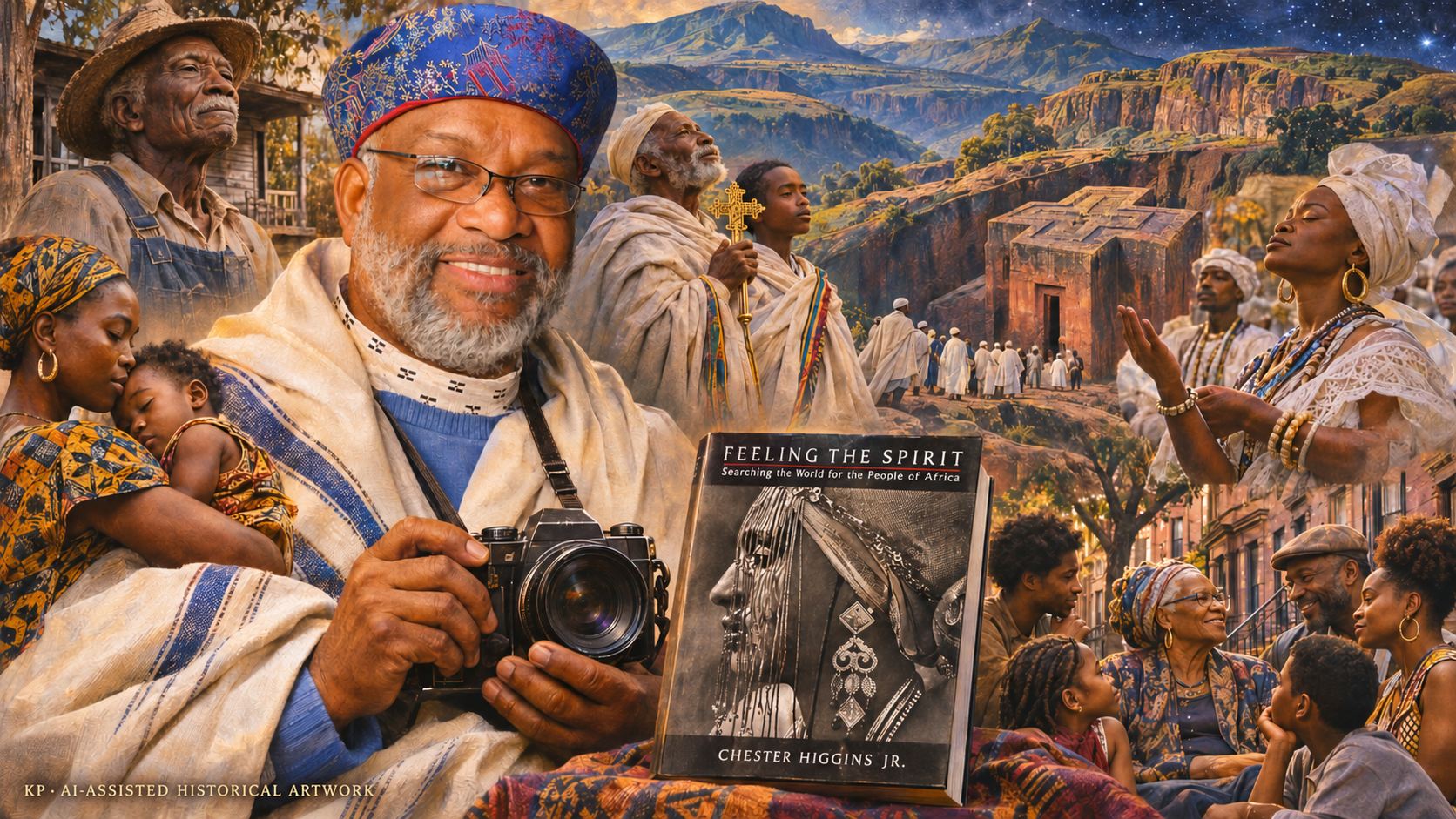
A photographer, author, and longtime photojournalist for The New York Times, Higgins has built a body of work around memory—its preservation, its recovery, and its power to shape how people understand themselves. His photographs challenge visual traditions that reduce Black life to deprivation, conflict, or spectacle. Instead, they offer a sustained encounter with people as bearers of knowledge, beauty, devotion, and historical agency. His books, particularly Feeling the Spirit: Searching the World for the People of Africa (1994), extend that encounter across continents, restoring relationships that the Maafa and colonial oppression sought to sever.
Alabama Beginnings and the Discovery of Photography
Chester Higgins Jr. was born in Fairhope, Alabama, in November 1946 and grew up in New Brockton. Family, church, and the authority of elders shaped his childhood in the segregated rural South. The people around him possessed a depth of experience and strength of character rarely seen in the dominant public image of Black Americans. Long before he developed a photographic practice, he belonged to a community whose worth he would later make visible.
He attended Tuskegee Institute, now Tuskegee University, where he studied business management with a minor in sociology and graduated in 1970. Photography entered his life through work on the student newspaper. While chasing overdue advertising photographs, he visited photographer P. H. Polk and saw portraits of rural Black men and women made during the Great Depression. Their presence unsettled an absence he had scarcely considered: people like his own relatives deserved portraits, yet their homes contained few images that celebrated their lives.
Among those he wanted to photograph were his great-aunt Shugg McGowan Lampley, a community midwife, and his great-uncle March Fourth McGowan. Making their portraits was an act of recognition, placing their likenesses on walls where commercial calendars and religious pictures had supplied much of the available imagery. His vocation began not with the pursuit of celebrity or distant subjects, but with the conviction that the people closest to him deserved to see themselves honored.
Student activism sharpened that conviction into a public purpose. During the unrest of the late 1960s, Higgins saw how mainstream reporting could depict Black students as threats rather than as citizens making political demands. The distance between what he witnessed and what newspapers presented revealed photography’s power to distort as well as illuminate. He wanted to make images from within the experience, rather than accept interpretations imposed from outside it. His early publication, Student Unrest at Tuskegee Institute: A Chronology (1968), coauthored while he was an undergraduate, was part of that effort to document events from the students’ perspective.
An Education in Seeing
Polk became Higgins’s first photographic mentor. He lent him a camera, examined his developing work, and demonstrated that technical competence depended on human relationships. A portrait required more than correct exposure: it required an encounter in which the person being photographed could appear with assurance and dignity.
Higgins extended that apprenticeship by seeking out established photographers and artists. At Look magazine, Arthur Rothstein taught him to recognize an image’s visual structure. Using pieces of paper to isolate portions of a print, Rothstein showed how cropping could remove distractions and concentrate meaning. He also directed Higgins toward museums, encouraging him to study why particular compositions worked.
Gordon Parks offered guidance about the politics of publication. Higgins wanted to counter racist imagery with photographs that conveyed decency, dignity, and character. Parks warned that this intention had to govern every exposure: an editor could select the single compromising frame from an otherwise thoughtful sequence. The lesson concerned not merely photographic consistency but control over how Black people entered the public record.
The artist Romare Bearden deepened Higgins’s understanding of light. During visits to Bearden’s studio in the 1970s, Higgins studied the ways painters organized illumination, space, and human presence. Light became more than a condition to accommodate. It became an active element of expression, capable of revealing a scene’s emotional and spiritual life. These mentors helped him unite social purpose with formal discipline.
New York and the Politics of Representation
Higgins’s early professional life placed him amid a flourishing Black cultural world. From 1970 to 1973, he worked as a photographer for SOUL!, the pioneering public television program produced and hosted by Ellis Haizlip. He photographed artists and political figures, documented the 1972 National Black Political Convention in Gary, Indiana, and developed a freelance career.
In 1975, he joined The New York Times and remained on staff until 2014. The position gave him access to a powerful national audience, but he understood that access as a responsibility. The newspaper reached people who helped shape public policy and cultural opinion. Its readers needed to encounter Black communities beyond the narrow circumstances in which mainstream journalism so often presented them. His work brought everyday life, cultural achievement, and communal traditions into that visual field. He helped sustain coverage of Kwanzaa and documented ceremonies at Coney Island remembering Africans who died during the Middle Passage. He also photographed major cultural and political figures, including Maya Angelou, Amiri Baraka, and Kofi Annan.
Newspaper deadlines demanded speed. Where a personal project might permit weeks of preparation, an assignment could leave only minutes to establish rapport and recognize a revealing moment. Higgins relied on what he called his “awareness radar”: an attentive combination of empathy, experience, and sensitivity to character. His newspaper work and independent projects developed together, joined by the same determination to represent people with complexity and care.
Africa and the Diaspora: Reconnecting a Dispersed World
Higgins’s first journey to Africa took him to Senegal in 1971. It began a sustained engagement that would encompass repeated visits and extended stays across the continent. He lived in Ghana during the summers of 1972 and 1973, studying Asante culture, and spent the summer of 1974 in Senegal, deepening his knowledge of Wolof life and Islamic traditions. His travels also took him to Ethiopia, Egypt, Sudan, Uganda, Tanzania, and Kenya.
These journeys answered an intellectual need as well as an artistic one. His education had exposed the limitations of American accounts of African history. Rather than remain dependent on inherited distortions, he built his own sources through observation, relationships, and photographic documentation. His guiding historical proposition was direct: “[The Maafa] is not the beginning of our history. [The Maafa] is an interruption of our history.” This distinction reorganized the narrative. African-descended people could not be understood adequately through the violence inflicted upon them alone; their histories also encompassed earlier civilizations, intellectual traditions, spiritual systems, and ongoing cultural invention.
Higgins carried this perspective into the Caribbean and South America, following the relationships between continental African practices and their diasporic transformations. In Brazil, he photographed Candomblé ceremonies, including rituals honoring Omolu. In New York, he documented communal remembrance and worship at places such as Coney Island and the African Burial Ground. His attention to continuity did not require every community to look or worship the same way. Rather, he searched for affinities across distinct histories: gestures, forms of reverence, relationships between generations, and the ways people sustained belonging. The diaspora emerged in his work not simply as the aftermath of displacement but as a world of active cultural creation.
This approach also changed the meaning of travel. Africa was not a distant stage for finding unusual subjects. It was a place of relationship, historical inquiry, and self-recognition. Photography became a way to restore connections between communities too often taught to see themselves as separate.
Ethiopia: A Place of Return
Ethiopia acquired a particularly important place in Higgins’s life. He first visited in 1973, drawn to Addis Ababa by a meeting of the Organization of African Unity, and photographed Emperor Haile Selassie. What remained with him, however, extended beyond the official occasion. He was struck by the assurance he observed in Ethiopian life—a sense of identity grounded in history, culture, and environment. He returned repeatedly, spending weeks at a time in the country and traveling beyond the capital into rural highlands, monastic communities, and sacred landscapes. These stays were not incidental excursions within a larger itinerary. They became a sustained education in inhabiting history and practicing faith.
Ethiopia also offered a release from the racial pressures that shaped his daily life in the United States. “When I travel to Ethiopia or Africa I’m not in search of something exotic, I’m in search of reflections of myself,” he explained. “In Ethiopia, I’m no longer in a society where I am a minority. I am the majority.” The experience expanded his creative freedom by loosening the American framework through which he had so often been required to understand himself.
An encounter with an Ethiopian priest gave him another language for diasporic identity: “western-born Africans.” Higgins embraced the phrase to assert a relationship that geography and historical dispossession had obscured. It connected his American experience to a longer African history without making the Maafa the defining point of origin.
The country’s physical environment also transformed his vision. Mountain heights, deep canyons, volcanic crater lakes, and brilliant night skies intensified his attention to light and to the relationship between landscape and spiritual practice. He photographed pilgrims, priests, religious communities, and places where devotion was embedded in daily routines. “Only in Ethiopia do you feel you can reach up and touch the floor of heaven,” he observed.
His 2015 exhibition Zéma, A Love Song brought these experiences together. Named for a Ge‘ez word for melody, it combined portraits, highland landscapes, and more abstract images in what Higgins described as a love song to Ethiopia. The title captured the relationship’s character: sustained, personal, and responsive to a country that had become central to his artistic imagination.
Feeling the Spirit: Introducing Cousins Across Continents
Published by Bantam Books in 1994, Feeling the Spirit: Searching the World for the People of Africa crystallized Higgins’s decades of travel and reflection. The book presented Africa and its diaspora as a field of relationship rather than a series of isolated national stories. Its organizing vision began before the Maafa. Higgins reached into the deeper histories of East Africa instead of treating the Transatlantic trafficking as the opening chapter of African-descended life. That decision established the book’s historical orientation: catastrophe mattered profoundly, but it could not contain the whole narrative.
The sequencing likewise challenged conventional boundaries. Higgins put people from different countries and continents in conversation rather than confining each image to a geographic category. A mother in Alabama could appear alongside a mother in Ghana; another photograph might lead the reader toward Nigeria, Brazil, or the Caribbean. The arrangement encouraged recognition before classification. He described the purpose as introducing “cousins” to one another. This was both an emotional proposition and a visual method. Expressions, gestures, family relationships, and sacred practices became ways to consider what dispersed communities shared, even as their circumstances differed.
The book also addressed people who might never undertake such journeys themselves. Higgins wanted readers to encounter a broader world than news coverage dominated by crisis offered. His photographs supplied an alternative visual nourishment: images through which African-descended people could recognize beauty, achievement, and belonging.
In this sense, Feeling the Spirit was not simply a record of where its photographer had traveled. It was an effort to repair the imagination. Higgins connected the nearer memory of African American life with the continent’s longer histories, creating a form in which readers could move between them.
The project subsequently reached museum audiences, including presentations at the International Center of Photography and the Smithsonian’s Anacostia Community Museum. Its movement from book to exhibition extended the central invitation: to encounter the African world through relationship rather than estrangement.
Books, Archives, and the Longer View
Higgins’s other publications reveal the breadth of this undertaking. Black Woman (1970) and Drums of Life (1974) established early directions. Some Time Ago: A Historical Portrait of Black Americans from 1850–1950 (1980) grew from a decade of archival research, including searches through institutional collections and family photographs preserved in homes. By copying and gathering these images, he helped safeguard a visual history that exceeded the familiar public archive.
Elder Grace: The Nobility of Aging (2000) honored older people as individuals of presence and experience. His memoir, Echo of the Spirit: A Photographer’s Journey (2004), reflected on how his vision formed.
With Sacred Nile (2021), Higgins brought decades of fieldwork into an exploration of sacred landscapes, monuments, and religious imagination along the Nile. Ethiopia, Sudan, and Egypt became interconnected sites of inquiry. The project extended his insistence that African civilizations belong at the center of discussions of antiquity, architecture, and spiritual history.
Making Pictures, Preserving Presence
Higgins insists on a distinction between “taking” and “making” photographs. Making requires preparation, intention, and a relationship with the person before the lens. For a portrait of a writer, he may read the work; for a musician, he may listen. Appearance begins the encounter, not its conclusion.
His photographs of celebrated figures belong to the same ethical world as his images of unnamed people. Fame does not confer greater human worth. The camera’s task is to attend—to recognize the inner presence that an unhurried gesture, a particular quality of light, or a moment of trust can disclose.
Higgins’s induction into the International Photography Hall of Fame in 2022 recognized a career whose significance spans journalism, portraiture, historical research, and art. His photographs have also entered major museum collections, including the Museum of Modern Art, the National Gallery of Art, and the Brooklyn Museum.
Yet institutional recognition is only one measure of his achievement. Higgins has created an archive through which future generations can encounter African-descended people as makers of history rather than as its incidental subjects. From the relatives whose portraits he first wanted to place on their walls to the communities he came to know across Africa and the diaspora, his work returns to an originating conviction: their lives deserve to be seen fully, and their presence deserves to endure.
Read also: Black History Month Spotlight: Chester Higgins — A Visual Artist Captures the Soul of the African Diaspora by DuEwa Frazier
To see some of his photography, visit Artnet
Exclusive Gallery Representation: Bruce Silverstein Gallery
Sources:
https://en.wikipedia.org/wiki/Chester_Higgins_Jr.
https://brucesilverstein.com/artists/222-chester-higgins/
https://www.zekemagazine.com/interview-chester-higgins?srsltid=AYCX9vIYDMnc4NisgX9P6ZvNgJ5u7w1wuf8_qe0xI2Oe7PVJSDYQrj30
https://nerdacitywithduewa.substack.com/p/black-history-month-spotlight-chester
https://dentonbff.com/legendary-photographer-chester-higgins-shares-recent-project/
https://www.youtube.com/watch?v=T5Cd467cCTg
https://www.pbs.org/brothermen/higgins.html
https://archive.nytimes.com/lens.blogs.nytimes.com/2015/05/19/chester-higgins-homage-to-ethiopia/
https://www.jcsu.edu/news/new-york-times-legendary-photojournalist-chester-higgins-jr-shines-light-africa