
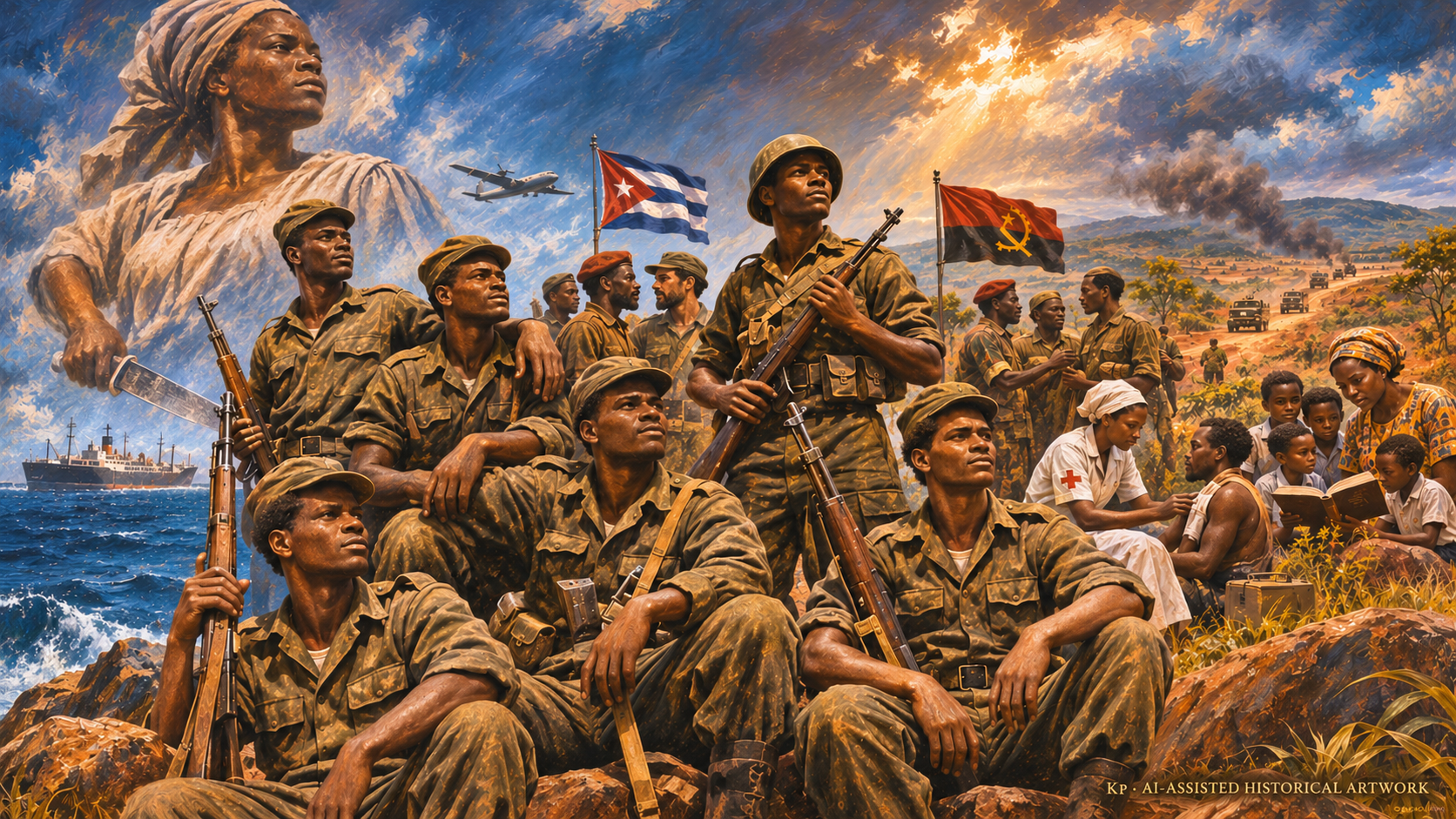
On 5 November 1975, Cuba launched Operation Carlota, a military mission to defend Angola’s independence and shift the balance of power in southern Africa. Responding to an urgent appeal from Agostinho Neto, leader of the Popular Movement for the Liberation of Angola (MPLA), the Cuban government began sending combat troops across the Atlantic as South African forces advanced from the south and another foreign-supported army threatened Luanda from the north. What began as an emergency deployment became a commitment lasting until 1991, involving hundreds of thousands of Cuban soldiers and civilian specialists.
The operation took its name from Carlota, an African woman who helped lead an uprising at the Triunvirato sugar estate in Matanzas, Cuba, on 5 November 1843. Naming the mission after her connected two struggles separated by an ocean and 132 years: the resistance of Africans held in bondage in nineteenth-century Cuba and the defense of African sovereignty against apartheid aggression.
Yet Operation Carlota was more than a military campaign or an expression of historical kinship. Its history encompasses Angolan political agency, Cuban internationalism, competing foreign interventions, women’s determination to serve, and the immense human costs of a prolonged war.
Angola’s Independence Under Attack
Angola approached independence after a long armed struggle against Portuguese oppression. The overthrow of Portugal’s dictatorship in April 1974 opened the way for a transfer of sovereignty, but the transition became entangled in conflict among three liberation movements: the MPLA, the National Front for the Liberation of Angola (FNLA), and the National Union for the Total Independence of Angola (UNITA). Their rivalry had Angolan roots, while outside support intensified the struggle and increased its destructive reach.
By late 1975, the MPLA controlled Luanda, where it would proclaim independence on 11 November. Its position was precarious. From the north, Holden Roberto’s FNLA advanced with support from Zaire and other foreign backers. From the south, the South African Defense Force pushed into Angola from occupied Namibia, cooperating with forces opposed to the MPLA. The United States also supported the MPLA’s opponents through covert assistance.
For Pretoria, events in Angola threatened a regional order sustained by apartheid and the denial of Namibian independence. For Neto and the MPLA, the immediate question was whether the approaching transfer of sovereignty would take place with Luanda still in their hands. The struggle was therefore simultaneously an internal contest for political authority and a defense against foreign military intervention.
An Alliance Built Before the Emergency
Cuba’s relationship with the MPLA predated the November 1975 crisis. During the 1960s, Cuban representatives established contacts with Angolan liberation leaders, provided training, and developed cooperation through African centers of revolutionary activity, particularly Brazzaville. Neto’s meetings with Cuban leaders helped establish the trust upon which the later military partnership depended.
In 1975, as Angola’s transition deteriorated, Neto renewed his requests for assistance. A Cuban delegation led by Raúl Díaz Argüelles assessed the situation, and Havana agreed to send approximately 480 military specialists to establish training centres for the MPLA’s armed forces, known as FAPLA. Doctors, vehicles and communications equipment accompanied this initial commitment.
The instructors arrived expecting to train Angolan recruits. Instead, the accelerating South African advance brought the war to their positions. At Benguela, Cuban personnel and their Angolan trainees had to move from instruction into combat. Neto’s emergency request for additional help transformed the scale of Cuba’s involvement.
Havana’s decision to send combat forces was its own, not an instruction from Moscow. Soviet weapons and subsequent logistical assistance were important to sustaining the campaign, but the distinction matters: Cuba acted as a government pursuing its own political commitments, just as the MPLA actively sought assistance to meet its immediate needs. Neither country’s role is adequately explained by treating it simply as an extension of a larger state’s strategy.
Carlota: A Name Carried Across the Atlantic
Carlota, remembered as a woman of Lucumí origin, belonged to a wider history of African resistance in Cuba. At Triunvirato in November 1843, she helped lead an armed uprising that challenged the plantation system and spread beyond a single estate. She was killed during the repression that followed. Her name gave the Angolan mission a historical language rooted in resistance rather than conquest. Cuba’s leadership presented the operation as solidarity with a continent whose peoples had profoundly shaped Cuban society.
Fidel Castro’s description of Cubans as a “Latin-African people” placed African ancestry and cultural inheritance at the center of the mission’s purpose. In the Cuban leadership’s account, Africa had helped make Cuba: Africans and their descendants had sustained its economy, shaped its culture and fought in its wars for independence. The language of a “debt to Africa” expressed a national obligation to honor those contributions through solidarity with African struggles for freedom. Internationalism gave that obligation a practical meaning: “to be an internationalist is to pay our own debt to humanity.” Defending Angola was presented as a continuation of the struggle through which Cuba itself had become free.
For some Afro-Cuban volunteers, this sense of solidarity was rooted directly in family history. Reverend Abbuno González expressed the connection in intimate terms: “My grandfather came from Angola. So, it is my duty to go and help Angola. I owe it to my ancestors.” His words brought the mission beyond the language of government policy. Angola was not simply a distant country in need of assistance; it was a place connected to his own origins, and service offered a way to honor those who had been taken from it.
The journey also acquired meaning through encounters with Angolans. General Rafael Moracén recalled an Angolan telling him that “our grandparents, whose children were taken away from Africa…, would be happy to see their grandchildren return to Africa to help free it.” In this view, the Atlantic crossing reversed its historical purpose: descendants of people forcibly removed from Africa returned of their own will to help defend its freedom.
Naming the operation after Carlota brought these convictions together. Her resistance connected Cuba’s own history of struggle with the defense of Angolan independence and the confrontation with apartheid. Volunteers did not all leave for the same reasons, but revolutionary commitment, ancestral memory and opposition to racial oppression could reinforce one another. For those who understood the mission as a debt, fulfilling it meant honoring Africa’s contribution to Cuba by standing beside Africans in their own struggle for sovereignty.
Defending Luanda
Cuba’s initial deployment demanded extraordinary improvisation. Civilian aircraft carried military personnel and equipment, while merchant vessels were adapted to transport troops, vehicles, fuel and ammunition. Long distances, limited refueling options, and the urgency of the fighting made the Atlantic crossing a high-risk operation.
The defense of Luanda reached a decisive moment at Quifangondo on 10 November 1975. There, Angolan defenders and Cuban military personnel defeated the FNLA-led advance from the north. The victory prevented that force from entering the capital immediately before independence. On 11 November, Neto proclaimed the People’s Republic of Angola.
The northern battle should not be confused with the separate struggle against South Africa’s main advancing columns in the south. Fighting on that front continued after independence, and the outcome remained uncertain. Cuban reinforcements helped FAPLA stabilize its positions and subsequently push southward. By late March 1976, South African troops had withdrawn across the border into Namibia.
Success came at a cost. On 11 December 1975, Díaz Argüelles, who had helped organize the initial Cuban mission, was killed when his vehicle struck a mine. His death exposed a danger that would persist throughout the conflict: roads and tracks could remain lethal even away from an immediate exchange of fire.
Esther Lilia Díaz Rodríguez: Determined to Serve
Among the people who challenged the boundaries of participation was Esther Lilia Díaz Rodríguez. Her story gives Operation Carlota a human dimension often obscured by accounts centered on presidents, generals and battlefield movements.
In García Márquez’s account, Esther was a twenty-three-year-old former teacher who had joined Cuba’s Revolutionary Armed Forces in 1969 and distinguished herself in shooting. She repeatedly sought permission to serve in Angola, only to be rejected on the grounds that conditions there would be harder for a woman. The obstacle was not a lack of determination or preparation, but the assumption that her gender made her unsuitable.
By early December 1975, she had decided to circumvent the selection process. With a photographer comrade’s assistance, she placed her clothes in a ship’s hold and prepared to travel as a stowaway. Before carrying out that plan, however, she learned that official permission had been granted for her to leave by aircraft. García Márquez described her as the first woman sent on the mission.
Three of her brothers—César, Rubén and Erineldo—also volunteered. According to the same account, each independently told their mother that they were going to military manoeuvres in Camagüey. All four returned safely. Their mother took pride in their service in Angola, but did not readily forgive the deception. The episode captures the tension between the public language of solidarity and the private anxieties of a family whose children had entered a distant war.
Another incident accompanied Esther’s return. After a compulsory forty-eight-hour medical examination at Havana’s Naval Hospital, she took a taxi home. The driver refused payment because she had served in Angola. When she asked how he knew, he explained that he had seen her on the hospital terrace and recognized it as a place receiving returning personnel. García Márquez used the encounter to illustrate how widely an officially discreet operation had become understood within Cuban society.
Esther’s experience also entered cultural memory. Margaret Randall wrote a poem about her, helping establish her as a celebrated figure of women’s participation in the mission.
She was not, however, the only woman participant. Women served as medical workers, journalists, technicians and military personnel; women’s anti-aircraft battalions later operated in southern Angola. Esther’s distinction lies in her early departure and her refusal to accept exclusion. Her story reveals a contradiction within revolutionary internationalism: a mission named after an African woman freedom fighter initially placed substantial obstacles in the way of women seeking to serve.
Beyond the Battlefield
Cuban involvement extended far beyond combat formations. Doctors, nurses, teachers, construction workers and technical specialists worked alongside Angolan colleagues as the country faced war, disrupted services and the departure of many Portuguese professionals. Medical assistance and education became important dimensions of the relationship.
Teachers worked in Angolan communities, while Angolan students traveled to Cuba, including to schools on the Isle of Youth. These exchanges created relationships that could not be reduced to military strategy. They involved classrooms, hospitals, language learning and the everyday work of sustaining institutions under difficult conditions.
The distinction between civilian and military service could nevertheless become dangerously thin. During UNITA’s March 1984 attack on Sumbe, Cuban civilian personnel joined the defense of the city. The attached account identifies women among those present. Such episodes demonstrate both the breadth of participation and the insecurity surrounding work far from the principal battlefronts.
Angolans remained central to these efforts. They were not simply recipients of assistance: they fought, taught, treated patients, organized communities and endured the greatest consequences of the conflict. A history of Cuban solidarity must retain the people of Angola as its principal historical actors.
A Long War and Difficult Entanglements
The withdrawal of South African forces in 1976 did not end the war. UNITA continued its armed campaign, South Africa mounted further interventions, and Cuban troops remained in support of the MPLA government. An emergency operation developed into a prolonged military presence.
That presence also drew Cuba into Angola’s internal political struggles. During the violent crisis of 27 May 1977, associated with Nito Alves and his supporters, Cuban forces helped protect Neto’s government. The extensive repression that followed remains a deeply painful part of Angolan history. The episode complicates any account that presents the mission solely as combat against an external aggressor: support for national independence also became support for a particular government confronting domestic opponents.
Across the following decade, soldiers and civilians faced bombardment, mines, illness, separation and bereavement. More than 2,000 Cubans died during the Angolan commitment, although the supplied material gives differing precise totals. Angola’s suffering extended far beyond those losses, encompassing devastated communities and years of insecurity.
Cuito Cuanavale and the Southern Front
The decisive final phase developed in 1987–1988. A FAPLA offensive against UNITA suffered severe reverses near the Lomba River after South African intervention. Angolan formations retreated towards Cuito Cuanavale, where their position became increasingly dangerous. Cuba responded with major reinforcements.
Angolan and Cuban forces strengthened defensive positions around the town and the Tumpo bridgehead. Repeated South African and UNITA attacks failed to eliminate those positions. At the same time, Cuba built up forces farther west and advanced towards the Namibian frontier, creating pressure beyond the immediate Cuito Cuanavale battlefield.
This wider geography is essential. The campaign’s importance did not rest on a single engagement. Holding the eastern positions, strengthening air operations and opening a substantial southwestern front together increased the risks facing South Africa. Cuban aircraft’s June 1988 strike at Calueque demonstrated the changing military situation near the border.
The outcome remains contested. Cuban and southern African liberation accounts emphasize a strategic victory that weakened apartheid’s regional reach. Other interpretations stress military stalemate and diplomacy. The clearest conclusion is narrower but substantial: South Africa did not eliminate the defended bridgehead, and the wider campaign contributed to conditions that made a negotiated regional settlement possible.
Withdrawal, Namibia and an Unfinished Peace
On 22 December 1988, Angola, Cuba, and South Africa signed agreements in New York that linked Cuban military withdrawal to the implementation of the United Nations settlement for Namibia. Namibia achieved independence on 21 March 1990. The last Cuban military contingents left Angola in May 1991.
The agreements did not resolve Angola’s internal conflict. Fighting between the MPLA government and UNITA continued after the Cubans left. Defending independence and reducing South African intervention had not, by themselves, established a durable Angolan peace.
For southern African liberation movements, however, the campaign carried profound significance. Speaking in Matanzas in July 1991, Nelson Mandela praised the Cuban contribution to African freedom and identified Cuito Cuanavale as a turning point in the struggle against apartheid. His assessment underscored the campaign’s importance to those who had confronted South Africa’s racial regime from within the region.
The Meaning of Carlota
Operation Carlota joined military action, political solidarity, and historical memory on an exceptional scale. It helped prevent the defeat of the MPLA, sustained Angola against repeated South African intervention, and contributed to the regional settlement through which Namibia secured sovereignty. Carlota’s name placed an African woman’s resistance at the center of that history. Esther Lilia Díaz Rodríguez’s determination brought another woman’s agency into its unfolding reality. Between them lies a connection more demanding than symbolism alone: freedom required people willing to challenge both armed aggression and the assumptions that restricted who could participate in resisting it.
Sources:
https://premiovladimirherzog.org/wp-content/uploads/2023/10/Operacion-Carlota-Gabriel-Garcia-Marquez.pdf
https://journals.iai.spk-berlin.de/index.php/iberoamericana/article/view/971/651
https://research-information.bris.ac.uk/ws/files/148474896/PETERS_CONTRAPUNTOS_LATINO_AFRICANOS.pdf
https://www.whyafrica.co.za/wp-content/uploads/2024/07/Cuba-in-Angola.pdf
https://history.columbian.gwu.edu/sites/g/files/zaxdzs4856/files/downloads/The%20George%20Washington%20Historical%20Review%202019-2020%20Edition.pdf
https://cuba-solidarity.org.uk/news/article/4671/operacioacuten-carlota-50-years-of-cuba-and-african-liberation-by-isaac-saney
https://thesis.unipd.it/retrieve/42f4e7fe-b128-49af-8793-0ff36ff89dcd/Migliacci_Sara.pdf
https://scispace.com/pdf/cuba-and-angola-fighting-for-africa-s-freedom-and-our-own-ed-3g700lqoq4.pdf
https://themilitant.com/2025/11/28/cubas-historic-role-in-defeat-of-south-africa-invasion-of-angola/
https://www.sa-soldier.com/data/09-SADF-links/UsedPDFs/From_a_Cuban_perspective.pdf