
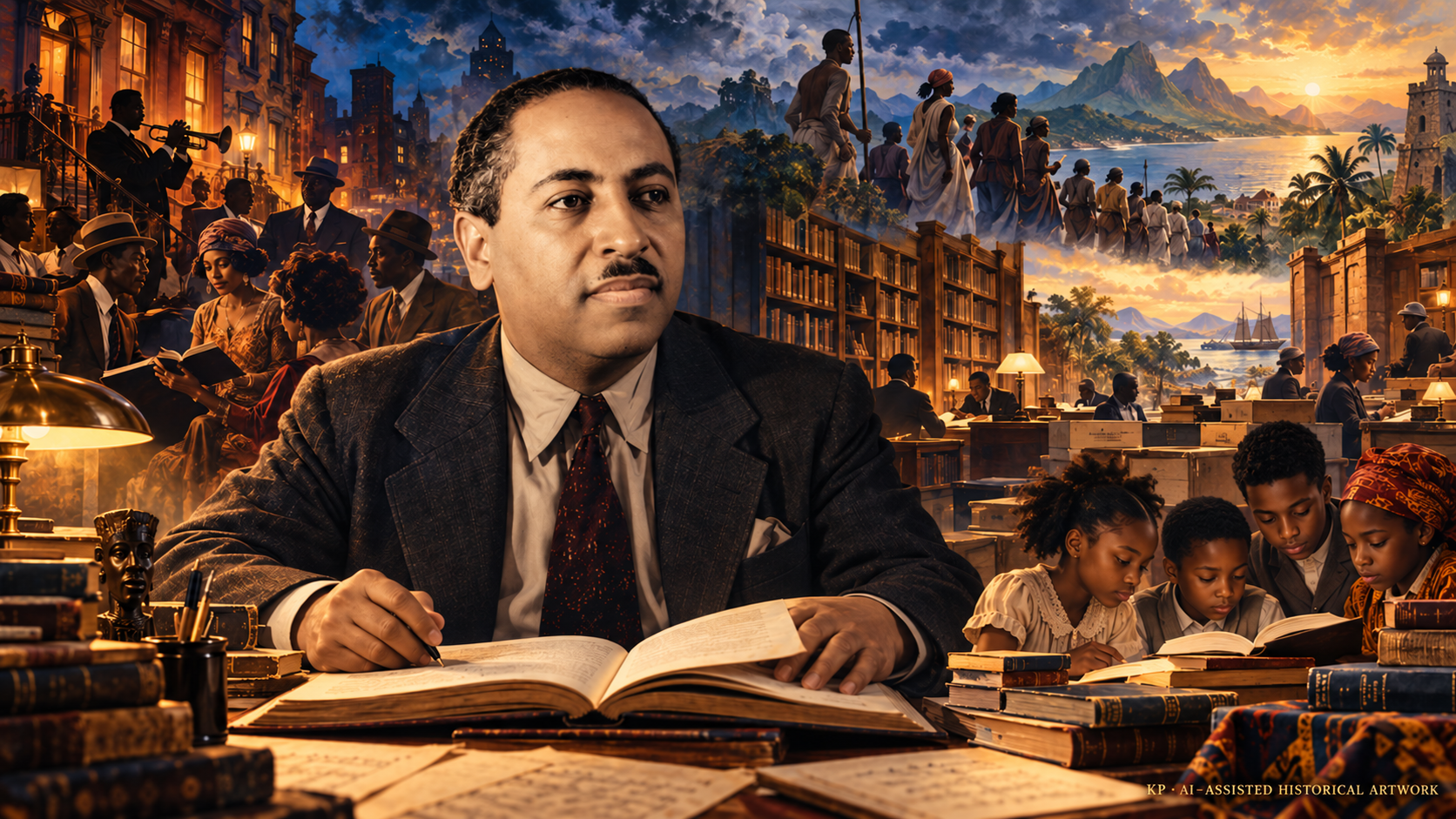
Arna Wendell Bontemps was a prominent American writer, poet, and librarian who played a key role during the Harlem Renaissance. Born in Louisiana and raised in California, he developed lasting collaborations with literary figures such as Langston Hughes. Bontemps published novels, poetry, and children’s books that illuminated African Americans’ experiences and struggles. He later earned a master’s degree in library science and became head librarian at Fisk University, where he preserved and promoted African American literature and culture. Bontemps connected Harlem’s creative energy in the 1920s with the institutions dedicated to preserving its legacy. He not only participated in the movement and chronicled its history, but also understood the importance of safeguarding cultural achievements. His unique legacy lies in merging literary creation with cultural preservation and documenting Black history.
Louisiana Roots and a California Childhood
Bontemps was born on October 13, 1902, in Alexandria, Louisiana, into a Creole family. His father, Paul Bismarck Bontemps, was a bricklayer and contractor; his mother, Maria Carolina Pembroke, was a schoolteacher. When he was three, racial threats against his father prompted the family to leave Louisiana for California. They settled in Los Angeles’s Watts district, where Bontemps spent his formative years. The move changed both their religious and geographic surroundings. Originally Catholic, the family became Seventh-day Adventists. His father sought security and advancement by conforming to Anglo-American expectations, an approach that increasingly troubled his son. When his father sent him to San Fernando Academy, an Adventist boarding school, he warned him not to “go up there acting colored.” Bontemps remembered the instruction as a painful demand to distance himself from his own heritage.
Reading offered Bontemps another way to understand his identity. As a boy, he visited the public library and became conscious of the absence of Black people’s contributions from the histories available to him. That exclusion shaped his later work: to recover experiences conventional accounts overlooked and make them accessible to readers. He attended Pacific Union College in Angwin, California, graduating in 1923 with a degree in English and a minor in history. Afterward, he worked at the Los Angeles Post Office, where he befriended the future novelist Wallace Thurman. In 1924, a teaching position at Harlem Academy took him to New York and into a remarkable community of Black writers and intellectuals.
Finding His Voice in Harlem
Bontemps arrived in Harlem as its literary and artistic movement was gathering momentum. His poem “Hope” appeared in The Crisis in August 1924, and his verse later appeared in both The Crisis and Opportunity, two influential journals supporting African American writers. Recognition came quickly. In 1926, “Nocturne at Bethesda” received a poetry prize from The Crisis, while “Golgotha Is a Mountain” won Opportunity’s Alexander Pushkin Prize. He received another Pushkin Prize in 1927 for “The Return.” These awards established him as one of the promising young poets of the Harlem Renaissance.
His poems often approached racial suffering through restrained language, religious imagery, and an awareness of historical endurance. Their quietness did not imply acquiescence. In “Southern Mansion,” the beauty of a Southern landscape is disturbed by the remembered sounds of captivity. “The Day-Breakers” imagines sacrifice as a way to open a path for those who follow. His poetry gave dignity and emotional depth to experiences that dominant accounts either diminished or ignored.
Harlem also connected him with Countee Cullen, Zora Neale Hurston, James Weldon Johnson, and other major cultural figures. His friendship with Langston Hughes became especially important. Their relationship became a sustained exchange of encouragement, ideas, and collaboration that continued until Hughes’s death in 1967. Their correspondence later provided a substantial record of Black literary life over four decades.
In 1926, Bontemps married Alberta Johnson. They raised six children, and the responsibility of supporting a growing family remained an important consideration throughout his writing and professional life.
Fiction, Family, and the Depression
Bontemps published his first novel, God Sends Sunday, in 1931. Drawing on stories about his Uncle Buddy, he created Little Augie, an African American jockey whose fortunes rise and fall. The novel explored a Black social world shaped by ambition, pleasure, instability, and disappointment. It later supplied the basis for St. Louis Woman, the Broadway musical for which Bontemps and Countee Cullen collaborated on the book, produced in 1946.
The Depression made it difficult to translate literary success into financial security. In 1931, Bontemps moved his family to Huntsville, Alabama, to teach at Oakwood Junior College, a Seventh-day Adventist institution. His years there were productive but increasingly contentious. His interest in race-conscious literature and his connections with visitors concerned about the Scottsboro trials unsettled the administration.
Accounts of the dispute describe pressure on Bontemps to burn books from his personal library as a public rejection of radical politics. He refused and left the college in 1934, returning to California. Although some details of the episode have been disputed, it reveals the conflict between his commitment to Black cultural and intellectual freedom and institutional demands for accommodation.
During this period, he also produced “A Summer Tragedy,” one of his best-known short stories. Its elderly sharecropping couple faces poverty, physical decline, and the prospect of dependency. The story’s unsentimental treatment of their desperation demonstrated his ability to expose the human consequences of an oppressive social order without reducing his characters to abstractions.
Reimagining the History of Resistance
Bontemps’s historical fiction centered Black resistance in the narrative. His most celebrated novel, Black Thunder (1936), drew on Gabriel’s planned uprising in Virginia in 1800. Rather than presenting enslaved people merely as sufferers awaiting emancipation, the novel portrayed them as people capable of imagining freedom and organizing to achieve it.
The book brought historical struggle into conversation with the racial and economic tensions of Bontemps’s own era. Its importance lay not simply in recovering an episode of resistance but in treating the captive people’s aspirations as a serious subject for American literature.
In Drums at Dusk (1939), he extended his interest in revolutionary history beyond the United States. Set at the outbreak of the Haitian Revolution in 1791, the novel explored the violence and instability beneath the wealth of the French colony of Saint-Domingue. Where Black Thunder examined an attempted uprising, Drums at Dusk entered a colonial society on the cusp of revolutionary transformation.
Together, these novels challenged narratives that denied Black people historical agency. They also demonstrated the breadth of Bontemps’s imagination: African American history belonged within a larger history of the Black Atlantic, colonial oppression, and struggles for liberation.
Writing for Children
Children’s literature also became a major part of Bontemps’s career. He recognized that young readers needed books in which Black people appeared as central characters and historical actors. Writing for children let him address the omissions he encountered in his own schooling while reaching audiences whose understanding of the world was still taking shape.
He wrote his first children’s book, Popo and Fifina: Children of Haiti (1932), with Langston Hughes. Through the everyday experiences of two siblings, it introduced readers to Haitian life. Later books included You Can’t Pet a Possum (1934), Sad-Faced Boy (1937), and Lonesome Boy (1955). These works gave space to Black childhood, family life, humor, music, and adventure.
With Jack Conroy, Bontemps also explored American tall tales. Their collaborations included The Fast Sooner Hound (1942), Slappy Hooper, the Wonderful Sign Painter (1946), and Sam Patch (1951). Such books reflected his interest in oral traditions and in storytelling that could entertain without sacrificing cultural substance.
His historical writing for younger readers earned particular distinction. Story of the Negro, published in 1948, received a Newbery Honor in 1949 and the Jane Addams Children’s Book Award in 1956. The book presented Black history to an audience too often offered little meaningful account of it.
In Chariot in the Sky: A Story of the Jubilee Singers (1951), he turned to the history of the Fisk Jubilee Singers. He also wrote biographies of figures including George Washington Carver, Frederick Douglass, and Booker T. Washington, while Golden Slippers (1941) introduced young readers to African American poetry. His books connected literary pleasure with historical knowledge and a fuller understanding of Black achievement.
Chicago and Collaborative Scholarship
After moving to Chicago in the mid-1930s, Bontemps worked with the Illinois Writers’ Project, part of the Works Progress Administration. The project supported writers during the Depression and created opportunities for historical research and collective literary work. Bontemps helped document Black life and history in a community that included writers such as Richard Wright and Margaret Walker.
His association with Jack Conroy became a lasting partnership that extended beyond children’s books. Together they wrote They Seek a City (1945), a study of Black migration later revised as Anyplace But Here (1966). Migration was both a historical subject and an experience rooted in Bontemps’s own family story. Their work examined the search for opportunity alongside the racial barriers that followed Black Americans into new places.
Building an Archive at Fisk
In 1943, Bontemps earned a master’s degree in library science from the University of Chicago and became head librarian at Fisk University in Nashville. He held the position for twenty-two years and retired in 1965. Librarianship gave institutional form to the purpose that had long animated his writing: ensuring that Black cultural life would remain available for study.
At Fisk, he helped build major collections of African American literature, history, and music. His friendships became invaluable resources. Through relationships with Hughes, Carl Van Vechten, and other cultural figures, he secured manuscripts, correspondence, and materials that might otherwise have remained scattered or vulnerable to loss. The Langston Hughes Renaissance Collection became an important part of this work.
Bontemps understood the value of the unpublished record as well as the finished book. Letters and manuscripts could reveal how writers worked, how relationships sustained them, and how a cultural movement developed. Preserving those materials let later researchers examine the Harlem Renaissance through the participants’ own words.
He also encouraged the professional development of Jessie Carney Smith, who succeeded him as Fisk’s head librarian in 1965. His institutional legacy therefore included not only collections but the people who would continue caring for them.
Anthologies, Later Years, and Legacy
Throughout his library career, Bontemps remained an active writer and editor. With Hughes, he compiled The Poetry of the Negro (1949) and The Book of Negro Folklore (1958). His own editorial projects included American Negro Poetry (1963), Great Slave Narratives (1969), and The Harlem Renaissance Remembered (1972). These volumes brought dispersed voices together and made Black literary traditions accessible to new generations.
His poetry was collected in Personals (1963). After serving as head librarian at Fisk, he held academic and curatorial positions at the University of Illinois at Chicago Circle and Yale University, where he worked with the James Weldon Johnson Collection. He returned to Fisk as writer-in-residence in 1971.
Bontemps died of a heart attack in Nashville on June 4, 1973, aged seventy. He had been working on his autobiography and the short-fiction collection The Old South, which was published in the year of his death.
Bontemps’ achievement cannot be contained within a single literary category. He wrote imaginative accounts of resistance, gave children a richer historical inheritance, gathered fellow writers’ work, and helped create the archives through which future scholars could recover their lives. For Bontemps, writing history and preserving its evidence were closely related responsibilities. His life’s work ensured that Black experience would not merely enter the literary record, but remain there.
Sources:
https://en.wikipedia.org/wiki/Arna_Bontemps
https://poets.org/poet/arna-bontemps
https://www.youtube.com/watch?v=aLp88xHDbQc
https://www.harlemworldmagazine.com/jules-bledsoe-harlem-new-york-1897-1943/