
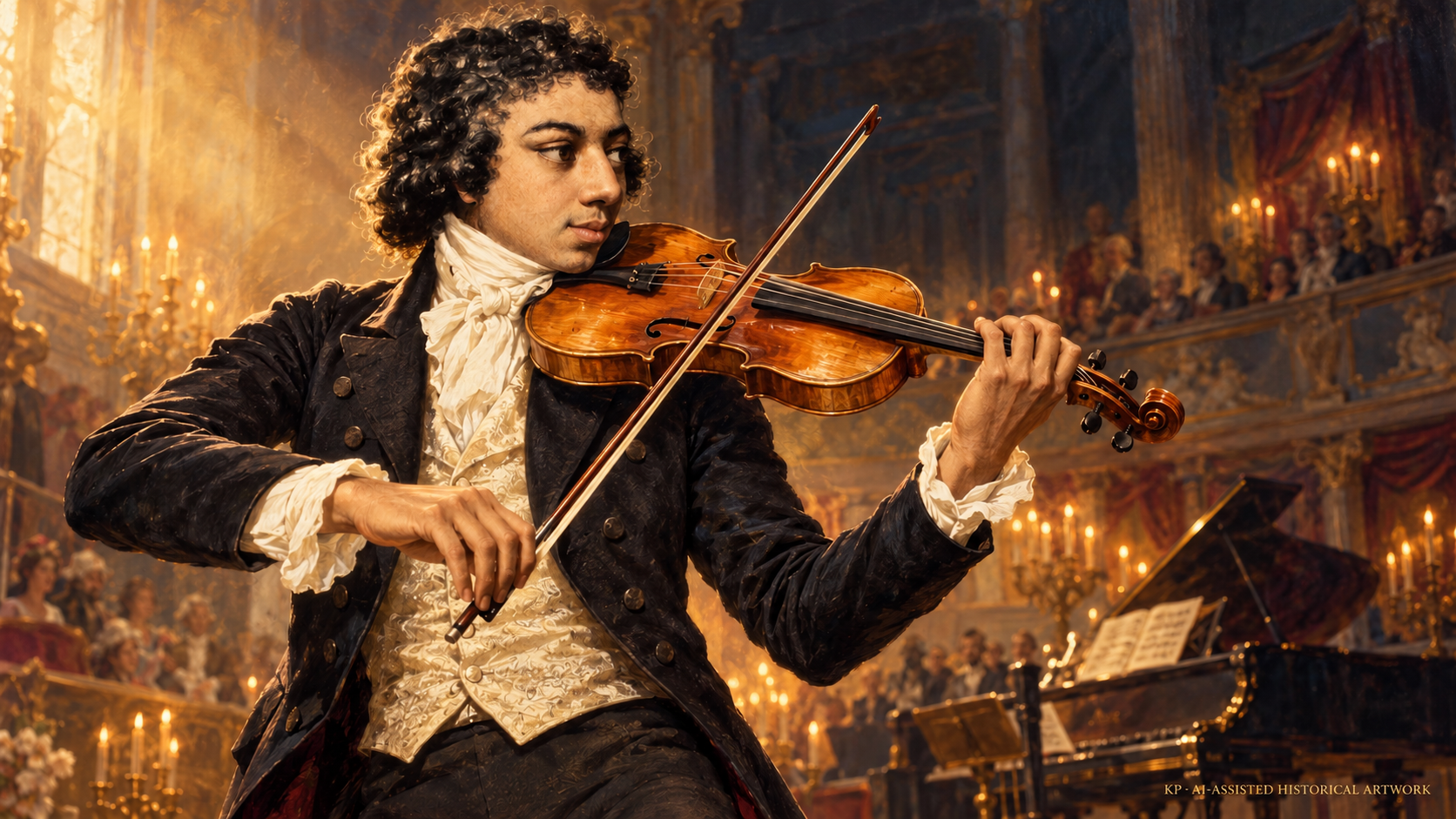
George Augustus Polgreen Bridgetower (1778–1860) was a violinist, composer, and teacher whose musical career took him from the aristocratic courts of Central Europe to the concert halls of Paris, London, and Vienna. Celebrated as a child prodigy, he became a musician for the Prince of Wales, earned a Bachelor of Music degree at Cambridge, and worked within some of the most distinguished musical circles of his age. His most famous collaboration was with Ludwig van Beethoven: in May 1803, the two musicians gave the first performance of the violin sonata now known as the Kreutzer Sonata, a work originally associated with Bridgetower and his exceptional playing. Yet Bridgetower’s importance extends beyond that encounter. His life illuminates the presence of musicians of African descent within European classical culture, the opportunities and constraints of aristocratic patronage, and the racial assumptions surrounding artistic achievement in the late eighteenth and early nineteenth centuries. Recovering his biography restores not merely the original performer of a celebrated sonata, but an accomplished artist with a substantial career of his own.
Birth, Family and a Musical Childhood
Bridgetower was born on 13 August 1778 in Biała Podlaska, then within the Polish–Lithuanian Commonwealth. His father, John Frederick Bridgetower, was of African descent and is generally associated with the Caribbean, probably Barbados, although his origins remain uncertain. His mother, Maria Ursula Schmid, was of German-Polish background. Later publicity around the family’s ancestry would feature elaborate stories of African royalty, enslavement, and liberation, but those narratives cannot be treated as established genealogy. Parish records distinguish Bridgetower’s birth from his formal baptism on 11 October 1778, a date older accounts sometimes give as his birthday. Apparently considered dangerously ill at birth, he had already received an emergency baptism. At the subsequent church ceremony, he was recorded under the Latin baptismal name Hieronymus Hyppolitus de Augustus. Members of the powerful Radziwiłł family appeared among his sponsors, including Prince Hieronim Wincenty Radziwiłł. Their involvement placed the infant within an aristocratic network that would shape his earliest opportunities.
During his childhood, the family entered the orbit of Prince Nikolaus Esterházy’s court, where his father worked in household service. Joseph Haydn directed the prince’s musical establishment, and Bridgetower grew up near one of Europe’s leading centers of musical activity. Later advertisements described him as Haydn’s pupil. Direct evidence of sustained private instruction is limited, however, and the distinction matters: proximity to Haydn’s musical world is better established than a formal teacher–pupil relationship.His younger brother, Frederick, also became a professional musician, specializing in the cello. The brothers’ careers eventually diverged, but their later joint appearances suggest a family in which musical training was neither incidental nor confined to the more famous son.
A Prodigy on the European Concert Circuit
Bridgetower’s public career began unusually early. Newspaper evidence places a performance at Frankfurt’s Red House concert room on 5 April 1786, when he was seven years old. Before this, he had reportedly played in private before aristocratic audiences, including Emperor Joseph II. In Mainz, he studied with Ernst Schick, a leading court violinist whose instruction helped develop his technique. His father managed his appearances and fashioned a public identity designed to attract attention. George was advertised as a remarkable young violinist, a pupil of Haydn and the son of an “African Prince”. John Frederick’s elaborate dress and theatrical presentation made ancestry part of the spectacle surrounding his son’s performances. Such promotion could open doors in fashionable society, but it also encouraged audiences to view the child through an exoticizing frame. By late 1788, father and son were traveling through the Rhineland and the Low Countries. Bridgetower performed in Kleve, Liège, Brussels and The Hague, including an appearance before William V of Orange. These journeys resembled the childhood tours through which other prodigies, most famously Mozart, established European reputations: the young performer moved between courts, private gatherings, and public concerts, turning astonishment into professional opportunity.
In April 1789, Bridgetower appeared at the Concert Spirituel in Paris. He also performed at the Abbaye de Penthemont before an audience that included Thomas Jefferson. French commentary praised his abilities and explicitly connected them to the question of racial equality, presenting his talent as an answer to those who denied people of African descent the capacity to distinguish themselves in the arts. His playing was thus received both as a musical achievement and as evidence within a wider argument about human ability.
Britain, Public Acclaim and Racial Scrutiny
Later in 1789, as revolutionary upheaval transformed France, Bridgetower and his father traveled to Britain. The young violinist soon appeared before audiences whose approval could determine the course of a career. He performed in Brighton during celebrations of the Prince of Wales’s birthday and, on 25 September, played before King George III and Queen Charlotte at Windsor Lodge. His program included a Viotti concerto and music by Haydn.
Bath proved particularly receptive. On 5 December 1789, more than 550 people attended his appearance at the Upper Assembly Rooms. The Bath Chronicle described an audience “enraptured with the astonishing abilities of this wonderful child” and judged his taste and execution comparable to those of the finest established performers. The diarist Hester Piozzi offered a more economical assessment: he played “like a 1st rate performer” and, as practical confirmation of his standing, was paid like one.
The language of his reception nevertheless exposed the racial categories through which British society understood him. Newspapers variously called him a “Moor”, a “person of colour” or used the now-outdated term “mulatto”. Some praised his brilliance while retaining imagery that marked him as an exotic exception. Others directly argued against racial hierarchy. In August 1789, the Chester Chronicle concluded that “genius does not solely belong to the tincture of a skin”. These responses came from a society whose wealth remained deeply connected to captivity, even as abolitionist campaigning gained strength. Bridgetower’s acclaim did not place him outside that world. Rather, his performances became occasions when its assumptions were challenged. Admirers recognized him as an extraordinary musician, but their repeated emphasis on his ancestry shows how often Black accomplishment was expected to disprove prejudice.
Royal Patronage and Professional Formation
Bridgetower made his public London debut at Drury Lane Theatre on 19 February 1790, playing a violin concerto during a performance of Handel’s Messiah. His success helped secure the protection of the Prince of Wales, the future George IV. The prince supported his education and brought him into his private musical establishment. This intervention also changed the conditions under which Bridgetower worked. Accounts distinguish the young musician’s modest conduct from his father’s increasingly troublesome dealings with concert organizers, including disputes over money. Royal patronage offered a more stable framework for his training and career, reducing his dependence on the promotional methods that had carried him through childhood. His teachers in Britain included the violinists François-Hippolyte Barthélémon and Giovanni Giornovichi, also known as Ivan Jarnović, and the composer Thomas Attwood, a former pupil of Mozart. Bridgetower subsequently served for approximately fourteen years as first violinist in the prince’s private orchestra, working between Carlton House in London and the Royal Pavilion in Brighton.
He also developed a substantial public career. His appearances took him to Drury Lane, Covent Garden, the Haymarket Theatre, and Hanover Square Rooms. In April 1791, he performed a concerto in the Haydn–Salomon concert series with Haydn presiding at the keyboard. During that year’s Handel Commemoration at Westminster Abbey, he and the young Johann Nepomuk Hummel assisted the organist Joah Bates. Benefit performances, chamber music and charitable engagements further embedded him in British musical life.
Bridgetower’s development therefore cannot be understood simply as the continuation of a prodigy’s fame. He received advanced instruction, built institutional connections, and gained experience across several forms of performance. By early adulthood, he had become a working professional within Britain’s musical establishment.
Vienna and Beethoven
In 1802, Bridgetower obtained leave from royal service to visit his mother and brother in Dresden. He performed there successfully, and Frederick appeared as a cellist in a concert in March 1803. George then continued to Vienna, arriving in April and entering the city’s aristocratic and musical networks.
An introduction to Beethoven, through the composer’s patron, Prince Lichnowsky, quickly produced mutual artistic interest. Beethoven described Bridgetower as a highly capable virtuoso with complete command of his instrument. Surviving communications show him recommending the violinist to patrons and arranging social meetings. Their acquaintance was not merely a formal connection between composer and performer; for a short period, it combined professional admiration with personal warmth.
Beethoven prepared his Violin Sonata No. 9 in A major, Op. 47, for their joint appearance. The work demanded a violinist able to meet its scale, intensity, and technical challenges, and Bridgetower’s abilities were central to its first performance. That premiere took place at eight in the morning on 24 May 1803 at Vienna’s Augarten. Preparation was hurried. Parts of the music had not been fully copied, and Bridgetower had to read the second movement from Beethoven’s manuscript rather than from a completed separate violin part. Beethoven himself performed from material that was still incompletely written out.
Bridgetower’s later recollection gives the occasion its most vivid episode. During the first movement, he introduced an alteration that echoed a passage in the piano part. Beethoven was delighted and called out, “Noch einmal, mein lieber Bursch!”—“Once more, my dear fellow!” The story presents Bridgetower not as a passive executor of the composer’s instructions but as a musician confident enough to contribute his own interpretive gesture. Although the dramatic details come through retrospective testimony, the account preserves a striking image of creative exchange between the two performers.
The Lost Dedication
Beethoven’s original inscription associated the sonata explicitly with Bridgetower:
“Sonata mulattica composta per il mulatto Brischdauer, gran pazzo e compositore mulattico.”
The wording is commonly translated as a “mulatto sonata” composed for Bridgetower, a “great fool” and “mulatto composer”. Playful in tone, it also records the racial language Beethoven used to identify his collaborator. Bridgetower’s surname appears in a phonetic form, “Brischdauer”.The friendship did not last. According to Bridgetower’s later account, they had a “silly quarrel about a girl”. The woman’s identity and the precise circumstances remain uncertain. Beethoven subsequently dedicated the published sonata to the French violinist Rodolphe Kreutzer, whose name became inseparable from the work. Kreutzer reportedly disliked the piece and never performed it publicly.
The rededication had a lasting effect on musical memory. The performer whose virtuosity helped bring the sonata into being largely disappeared from its familiar title, while a musician who had not given its premiere acquired the enduring association. Yet the quarrel did not end Bridgetower’s engagement with Beethoven’s music. Back in Britain, he continued to program and perform it, maintaining an artistic commitment beyond the rupture of their personal relationship. A further tangible connection survived in Beethoven’s tuning fork, which passed to Bridgetower and is now preserved in the British Library. Like the original inscription, it connects the famous composer’s history to a musician whose place in that history has too often been reduced to an anecdote.
London, Cambridge and Composition
Bridgetower resumed his British career after returning from the Continent. On 23 May 1805, he organized a benefit concert at Hanover Square’s New Rooms that included his own violin concerto. Frederick performed a cello concerto by Bernhard Romberg, and the brothers participated in Beethoven’s Septet. The program brought together Bridgetower’s roles as soloist, composer, organizer and advocate for contemporary music.
Professional recognition followed. He was elected to the Royal Society of Musicians on 4 October 1807. In 1813, he appeared during the inaugural season of the Philharmonic Society of London, leading Beethoven’s String Quintet and playing second violin in a Mozart quartet. He became a permanent member of the society in 1819.
His connection with Cambridge had developed over many years through Charles Hague, the university’s Professor of Music. Bridgetower participated in numerous Cambridge concerts between 1795 and 1811 and pursued the professional Bachelor of Music qualification associated with Trinity Hall. Awarded the degree in June 1811, he submitted a substantial composition for chorus and orchestra setting a text by F. A. Rawdon, beginning “By Faith Sublime Fair Passiflora Steers her Pilgrimage Along This Vale of Tears”. The university performed the work at Great St Mary’s Church on 30 June before the university’s Chancellor, the Duke of Gloucester. The Times described it as “elaborate and rich”, drawing particular attention to the beauty of its trio section.
The degree recognized a dimension of Bridgetower’s musicianship that later accounts have frequently overshadowed. He was not only a virtuoso performer but also a composer capable of undertaking large choral and orchestral works. As an early Black Cambridge graduate, he also occupies a significant place in the history of the university.
A Composer, Teacher and Advocate of Bach
Much of Bridgetower’s music has been lost, including his Cambridge exercise and the violin concerto performed in the first decade of the nineteenth century. The surviving works nevertheless reveal a musician active across several genres. They include Diatonica Armonica, a collection of piano studies published in 1812; the song Henry; and music for flute and strings. His chamber works include Jubilee, associated with the celebration of George III’s fiftieth year on the throne in 1809, and an arrangement of the overture to Cherubini’s Lodoïska. These compositions and arrangements place him within the practical musical culture of his period, in which teaching, domestic performance, public celebration and adaptation were closely connected.
Bridgetower also belonged to the circle of musicians promoting Johann Sebastian Bach’s music in Britain. A friend and collaborator of Samuel Wesley, he subscribed to the early British edition of The Well-Tempered Clavier. Wesley praised his ability to perform Bach’s solo violin music from memory with “the utmost precision”. That testimony adds depth to the familiar image of a brilliant showman: Bridgetower’s artistry also rested on exacting study and command of demanding repertoire.
Marriage, Children and Estrangement
On 9 March 1816, Bridgetower married Mary Leech Leake at St George’s, Hanover Square. Mary, the daughter of the prosperous cotton manufacturer Edward Leech, had inherited considerable wealth. The couple lived at Upper Seymour Street, Portman Square, where records described Bridgetower as a gentleman. They had two daughters, Julia, who died in infancy, and Felicia, who survived into adulthood.
The marriage had broken down by the mid-1820s. Mary moved to Rome with Felicia, while Bridgetower spent periods elsewhere in Europe, including Paris. The family formalized their separation through arrangements in 1828. In Italy, Mary formed a relationship with Carlo Ignazio Busca Arconati Visconti, Marchese di Lomagna, and had a son, Lodovico Paolo. She died in July 1835. Contemporary rumors attributed her death to poisoning, but those rumors do not establish its cause.
Felicia subsequently attempted to live with her father in London, but their relationship deteriorated. In October 1836, she left his residence and later described his treatment in legal proceedings as “cruel, unnatural and unfeeling”. Disputes over guardianship and her mother’s estate brought father and daughter into the Court of Chancery. In 1839, Felicia married Luigi Mazzara and returned to Italy. She later claimed that her paternal grandfather belonged to Ethiopia’s imperial dynasty. The Mazzara family published a genealogical pamphlet in 1864, and descendants pressed claims to the Ethiopian throne. The British did not accept these assertions.
Later Travels and Final Years
As his public appearances became less frequent, Bridgetower continued to move within European artistic circles. He spent time in Rome during the 1820s and returned to Vienna and Paris in later decades. Correspondence connected him with the pianist and composer Johann Baptist Cramer, while accounts of his later life associate him with the young Camille Saint-Saëns. He remained a living link to the musical world of Haydn and Beethoven long after that world had passed into history. His brother Frederick had died much earlier, in Newry, County Down, in August 1813. After performing in London with George, Frederick had established himself in Dublin as a cellist, composer and teacher. His premature death left a widow and two young children, whose descendants continued the Bridgetower name in Britain.
George eventually settled at 8 Victory Cottages in Peckham, South London. He died there on 29 February 1860, aged eighty-one, and was buried at Kensal Green Cemetery on 7 March. His gravestone gave his age as seventy-eight, another reminder of the inconsistencies that accumulated around his birth and early biography.
Later accounts sometimes portrayed him as having died in destitution or placed his death years before it occurred. The surviving estate evidence complicates that picture. His property was valued at nearly £1,000, and an auction of his musical possessions included valuable violins attributed to Stradivari and Amati, alongside other instruments and music.
Recovering Bridgetower’s Place in Musical History
Bridgetower’s modern reputation has been reshaped by scholarship, performance and creative work. Rita Dove’s Sonata Mulattica (2009) explored his life through poetry. Julian Joseph and Mike Phillips brought his story to the stage in the jazz opera Bridgetower—A Fable of 1807. Violinist Nicole Cherry’s Forge with George initiative has connected the recovery of his surviving music with new works engaging Black musical histories.
Public commemoration has also restored his name to places where he lived and studied. In October 2022, a blue plaque was unveiled at Jack Jones House in Peckham, on the site associated with his final home. Trinity Hall commemorates him through a named room and an essay competition for Black Cambridge students. Such recognition places his achievements within institutional and local histories that long marginalized them. Some musicians and scholars now use the name Bridgetower Sonata for Beethoven’s Op. 47. The gesture draws attention to the work’s first violinist and the collaboration obscured by its published dedication. More importantly, it invites a broader reassessment of Bridgetower himself: a European-born musician of African descent whose achievements encompassed performance, composition, teaching, and scholarship. Bridgetower was not an incidental visitor to European classical music, but one of the musicians who helped make it.
Sources:
https://en.wikipedia.org/wiki/George_Bridgetower
https://www.trinhall.cam.ac.uk/about/people/notable-alumni/george-bridgetower-1778-1860/
https://www.montesbradley.com/post/georgebridgetoweratcambridge
https://www.southwark.gov.uk/news/2022/afro-european-violinist-and-favourite-beethoven-remembered-southwark
https://georgianera.wordpress.com/2020/09/16/ggeorge-bridgetower-violin-virtuoso-part-1/
https://kresgeartsindetroit.org/wp-content/uploads/2015/09/George-Augustus-Polgreen-Bridgetower.pdf
https://www.musicandpractice.org/wp-content/uploads/2025/12/Cherry_Final_MP.pdf
https://www.cambridge.org/core/services/aop-cambridge-core/content/view/4C64739A53DBDCD29D2C28C355494E93/S1479409826101141a.pdf/george_bridgetower_two_quintets_for_flute_and_strings_edited_by_mark_ferraguto_and_nicole_cherry_ar_special_publications_56_middleton_ar_editions_2025_xi_34pp_5_partbooks_7500_issn_9781987209266.pdf
https://www.musicalamerica.com/mablogs/wp-content/uploads/2022/02/8-20B-1921_p5.pdf
https://beethoven.ru/img/bridgetower.pdf
https://www.researchgate.net/publication/319710845_New_Light_on_George_Bridgtower
https://brightonmuseums.org.uk/wp-content/uploads/2026/07/BH-Schools-Resource-Black-History.pdf
https://www.peckhamsociety.org.uk/?p=2602