
Lejja, located in the Nsukka cultural region of present-day Enugu State, Nigeria, is recognized as the oldest known site of iron-making in the world. Long before iron reached many regions now regarded as centers of world civilization, the people of Lejja mastered the art of transforming ore, clay, charcoal, air, and fire into iron.
Lejja is an expansive, inhabited metallurgical landscape featuring furnaces, tuyeres, iron ore, blooms, slag pits, vast quantities of slag, habitation areas, agricultural evidence, shrines, graves, terracing, defensive works, and active political institutions. The archaeological record reveals large-scale, specialized iron production and technological innovation across an extensive period. Lejja is not merely a singular ruin or abandoned furnace; it is a living landscape marked by enormous blocks of slag. This slag—the stony material remaining after iron is separated from ore—endures in great numbers, preserving the legacy of generations who mastered the challenging art of smelting.
At Otobo Ugwu Dunuoka, one of Lejja’s prominent public squares, over 800 cylindrical slag blocks have been documented. Some are as large as heavy stools or small tables, each weighing approximately 34 to 57 kilograms. Collectively, these blocks demonstrate a long-standing tradition of organized iron production, highlighting the depth of African scientific achievement and skilled labor.
The people of Lejja did not merely discover iron—they created it.
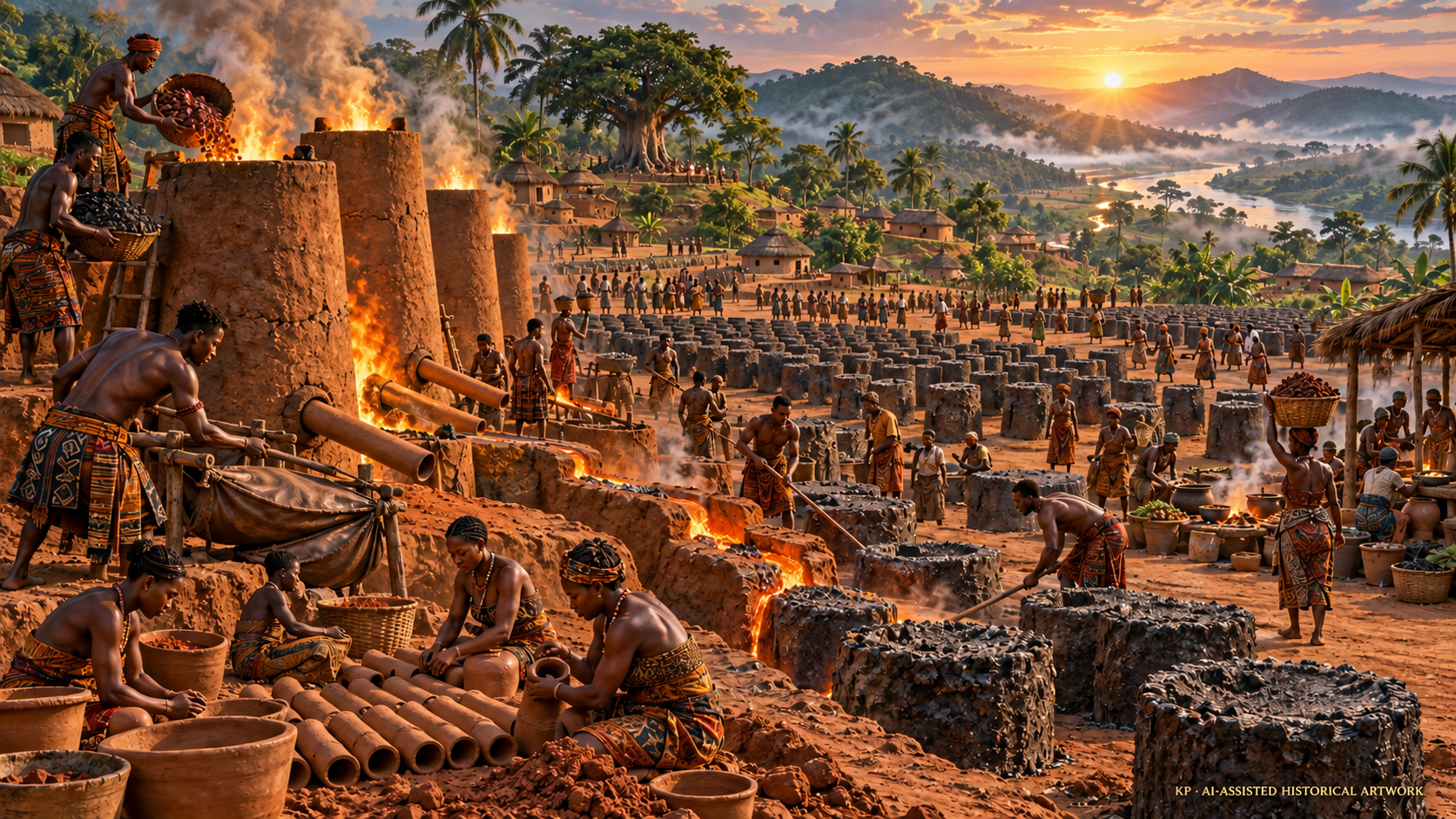
They gathered iron-rich ore from the land, produced charcoal from wood, and constructed clay furnaces. They shaped ceramic pipes called tuyeres to channel air into the furnaces. Bellows forced air into the fire, raising the temperature high enough to turn ore into a bloom of iron. This expertise was passed down through generations—carried in the hands, eyes, memories, and practices of the people.
A very early date
Lejja holds a significant place in world history because its iron-working tradition may predate what most textbooks suggest. Archaeological excavations yielded a radiocarbon date of 4005 ± 40 BP, calibrating to roughly 2631–2458 BCE. Another early result, 3445 ± 40 BP, corresponds to about 1885–1625 BCE.
This evidence suggests that people may have been smelting iron in Lejja over 4,000 years ago. If future research confirms the earliest date, Lejja would rank among the very first iron-smelting sites on Earth.
Even without focusing on a single date, the broader archaeological evidence is compelling. Research shows that iron-smelting in Lejja persisted for over 2,000 years. Furnace designs evolved, slag management improved, and the community’s knowledge expanded across generations. The people mastered heat, minerals, airflow, clay, fuel, timing, and chemical processes long before modern laboratories assigned European terminology to these skills.
The furnaces
The earliest furnace systems in the Nsukka region featured tall shaft furnaces powered by forced air. Bellows directed air through tuyeres into burning charcoal, generating the intense heat necessary for smelting. These furnaces measured approximately 0.85 to 1.25 meters in width, with expertly constructed walls built to endure extreme temperatures.
As iron formed, workers drew molten slag from the furnace through channels into specially prepared pits in the ground. There, it cooled into the large cylindrical blocks that remain at Lejja today. These are far from ordinary stones; they are the enduring remnants of ancient chemical expertise.
Over time, Lejja’s ironworkers and others in the Nsukka region devised new techniques. In one period, slag was allowed to flow onto the ground, forming flat, ropy cakes. Later, smelters adopted natural-draught furnaces that relied more on wind and architectural design, lessening the need for constant bellows operation. The evolving shapes and chemistry of the slag reveal a culture rooted in experimentation, improvement, and innovation.
More than a furnace site
Iron working was a communal enterprise. People searched for and prepared ore, cut wood and transformed it into charcoal, and gathered clay to mold into furnaces and tuyeres. Others grew and cooked food to sustain those engaged in this demanding labor. Potters, farmers, charcoal makers, ore collectors, furnace builders, smelters, smiths, traders, ritual specialists, and families—all contributed to the intricate world that made iron production possible.
Researchers have discovered pottery, terracing, stone walls, abandoned settlements, grinding and pounding tools, shrines, graves, and evidence of farming throughout the Lejja landscape. Archaeobotanical studies—the analysis of ancient plant remains—have revealed crops such as oil palm and Vigna, a group that includes cowpea. Lejja was a center of productivity, nourishment, spirituality, and vibrant community life.
Metalworkers were deeply embedded within their society. Their furnaces stood amid a world of kinship, cultivation, ceremony, trade, and shared responsibility.
Iron and community memory
At Otobo Ugwu Dunuoka, the slag blocks were not discarded as mere waste. Over generations, they became integral to the public square. Arranged in rows, they help shape the space where people from Lejja’s thirty-three villages gather for judgment, ritual, and community discussions.
This reflects a powerful idea: the remnants of iron production became woven into the very place where communal decisions were made. The earth, transformed by fire, remained a living presence in public life.
Lejja’s landscape also holds shrines and sites associated with Adada, a revered female water deity. Iron ore, slag, and pottery appear in certain ritual spaces, underscoring that iron-making was inseparable from the spiritual and communal fabric of life.
African research at Lejja
African and Nigerian scholars have shown Lejja’s importance through archaeological investigation, interdisciplinary research and engagement with local knowledge-holders. Their work reveals not merely an ancient furnace site, but a long-lived landscape of technical knowledge, farming, ritual, public memory and community life.
F. N. Anozie’s 1979 study, Early Iron Technology in Igboland: Lejja and Umundu, was foundational to the archaeological interpretation of Lejja’s iron technology. He understood the evidence as including pit- or bowl-furnace forms and drew upon both material discoveries and oral traditions to reconstruct local iron-working practices. Later archaeometallurgical study clarified that some features first understood as bowl furnaces were instead pits into which slag had been tapped from shaft furnaces.
Edwin Eme Okafor studied metallurgical residues from Lejja and other Nsukka-area sites, establishing a technological sequence that extends from roughly 765 BCE to 1950 CE. His research traced systematic changes in furnace design, slag handling and iron-extraction efficiency. Okafor’s earliest secure dates—2305 ± 90, 2170 ± 80 and 2080 ± 90 BP—belong to the wider Nsukka sequence, especially Opi; Lejja’s residues nevertheless resembled material from this early phase. His work established an early regional metallurgical tradition, against which the later, much earlier Lejja dates must be understood.
Pamela Eze-Uzomaka’s excavations from 2007 onward significantly reshaped discussion of Lejja’s chronology. Her team investigated furnace structures, tuyere placement and the scale of production, uncovering furnace forms not previously reported and recovering charcoal dated to 4005 ± 40 BP. The excavation reports connect archaeological material from iron-smelting contexts with an age of more than 4,000 years. At Amaovoko, Eze-Uzomaka and collaborators extended archaeological work in order to clarify Lejja’s cultural sequence and investigate the apparent chronological space between proposed early iron-smelting horizons and later activity. This work strengthened the case for Lejja as a landscape used and remade across many generations.
Christian Chukwuma Opata has explored Lejja’s iron technology through questions of community, gender, ritual and political authority. With Eze-Uzomaka, he examined gender-specific roles and divisions of labour in iron smelting, including women’s part in the transfer and legitimisation of political authority between village heads. Opata’s work also helps readers understand Otobo Ugwu Dunuoka as more than an archaeological location. The slag blocks sit within a public square shaped by rules of seating, ethical conduct, ritual and collective decision-making. In this sense, the remains of iron production became monuments through which Lejja remembers technical achievement, community authority and social relationships.
Chioma Vivian Ngonadi expanded the research by examining how Lejja’s metal-producing communities sustained themselves and organized their landscape. At Amaebo-Attamah and Amaovoko, her research brought together archaeobotany, radiocarbon dating, ceramic analysis, landscape survey, oral tradition and GIS mapping. Ngonadi recovered plant remains including oil palm and Vigna, connecting food production with iron working across a long period, approximately 840–2100 BP in the dated research sequence. Her work moves us beyond the image of a solitary smelter: Lejja’s metallurgy depended upon farming, food processing, fuel, pottery, labour coordination and the knowledge held across the community.
Landscape archaeology
In 2017–2018, Eze-Uzomaka, Ngonadi and their collaborators surveyed thirteen key villages in Lejja. They identified sixteen archaeological sites, including iron-smelting, domestic and ancestral locations, demonstrating a varied and densely inhabited cultural landscape.
Together, these Nigerian and African researchers show that Lejja is a vital part of Nigeria’s intellectual inheritance and Africa’s technological legacy. Its furnaces and slag blocks are evidence of sophisticated iron production, but also of a people’s accumulated knowledge of land, fire, cultivation, ritual and collective life.
Lejja in world history
For a long time, many accounts of iron technology began elsewhere and treated Africa as a place that received knowledge from outside. That story was shaped by old European assumptions, not by the full weight of African evidence. African iron-working traditions are varied, deep, and technically sophisticated; they can never be reduced to a simple tale of borrowed knowledge.
Lejja stands alongside other early African iron-production sites, including Oboui in the Central African Republic, Tchire Ouma in Niger, and sites in the Bassar region of Togo. Yet the earliest published Lejja date—approximately 2631–2458 BCE—places it at the forefront of this history.
Its importance is not only that it may be among the earliest. Its importance is also that it shows African people as makers: people who studied their land, managed fire, developed furnaces, transformed ore, organized labor, and passed technical wisdom through generations.
Lejja reminds us that world history is not a road that begins in Europe and travels outward. It is a gathering of many human centers of thought, invention, and creation. In Lejja, the earth still holds the evidence: iron ore, furnace clay, blackened charcoal, heavy slag, and the quiet memory of fire.
Sources:
https://www.nature.com/articles/s40494-024-01383-2
https://link.springer.com/article/10.1007/s10437-023-09545-6
https://therai.org.uk/awards/past-awards/emslie-horniman-award-chioma-vivian-ngonadi/
https://journals.udsm.ac.tz/index.php/sap/article/view/2710
https://journals.udsm.ac.tz/index.php/sap/article/view/2723/2762
https://journals.udsm.ac.tz/index.php/sap/article/view/2728/2766
https://etheses.whiterose.ac.uk/id/eprint/21859
https://siris-libraries.si.edu/ipac20/ipac.jsp?uri=full=3100001~!596502!0
https://www.ijih.org/volumes/article/612
https://www.navarchivo.com/en/node/168028
https://unesdoc.unesco.org/ark:/48223/pf0000133908
https://www.repository.cam.ac.uk/items/af2139c9-2f0d-4eb2-bafc-14f9e69c256e
https://www.unn.edu.ng/2010-journal-publications-vii/
https://www.unn.edu.ng/2012-journal-publications-vii-2/
https://ng.usembassy.gov/u-s-launches-125000-project-to-preserve-4000-year-old-lejja-iron-smelting-site-in-enugu-state
https://lissin.org/about-lissin/our-story/
https://britishmuseum.iro.bl.uk/downloads/bd730f69-41f0-444a-b4ce-fea985dffc11