
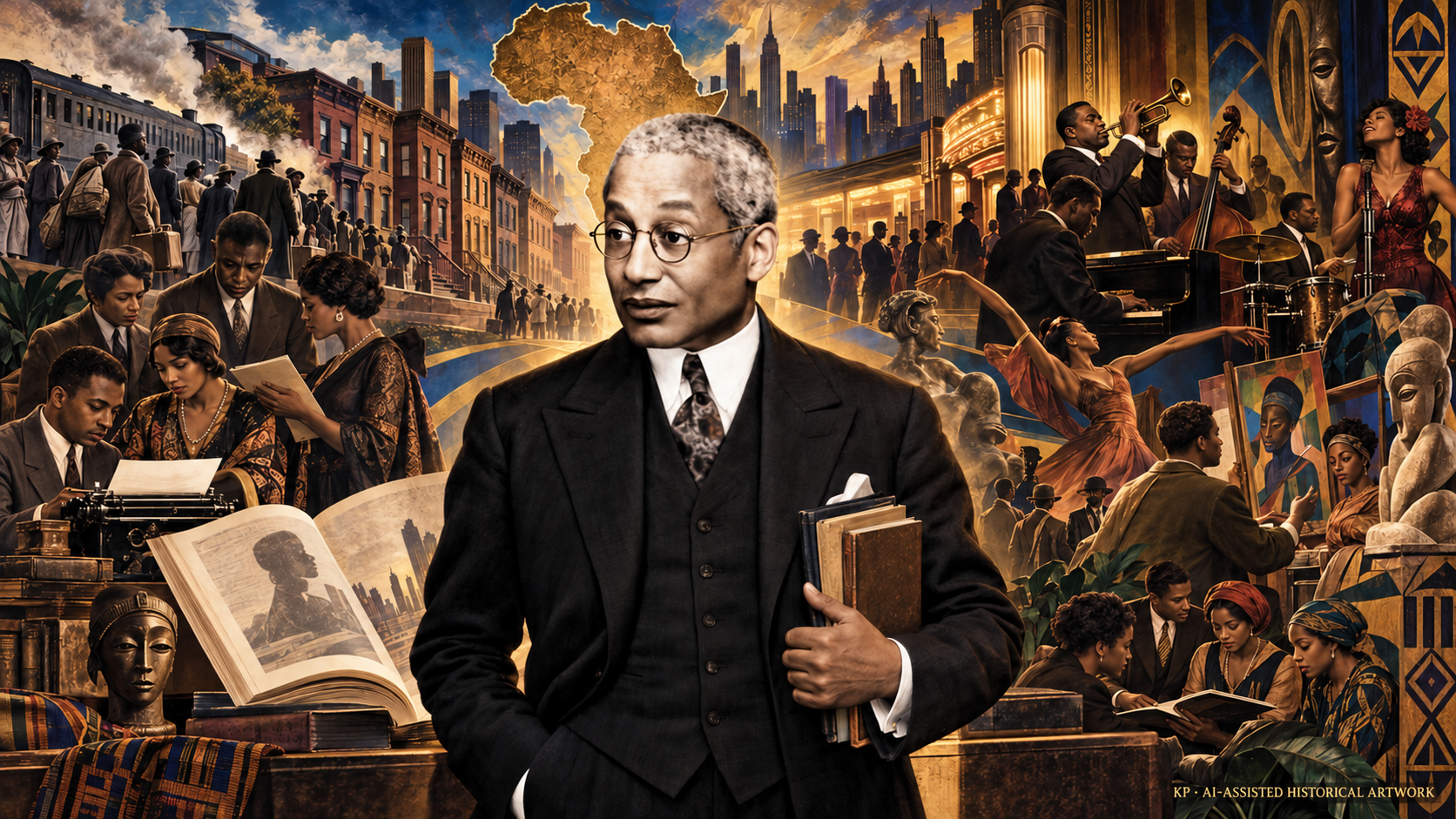
Alain LeRoy Locke was one of the most consequential intellectual figures in twentieth-century American cultural life: a philosopher of value, teacher, editor, critic, patron, and advocate for Black artistic achievement. Often called the “Dean” or “Father” of the Harlem Renaissance, he did not simply observe that extraordinary cultural flowering; he helped give it a language, a public platform, a network of support, and an enduring philosophical rationale. For Locke, art was an instrument through which a people long defined by degradation, exclusion, and caricature might claim self-knowledge, dignity, and historical agency.
His life joined remarkable intellectual accomplishment with institutional work and aesthetic conviction. The first African American Rhodes Scholar, a Harvard-trained philosopher, and a professor at Howard University for nearly four decades, Locke moved between elite academic settings and the practical work of cultivating a generation of writers and artists. He believed that political rights mattered profoundly, but he also insisted that the struggle for freedom required a transformation in cultural consciousness. Black Americans had to see themselves—and be seen by others—not as a social “problem” or a fixed biological category, but as makers of modern culture. His celebrated idea of the “New Negro” was therefore both a diagnosis of historical change and a summons to creative self-realization.
Philadelphia Beginnings
Locke was born Arthur Leroy Locke in Philadelphia on 13 September 1885, although he sometimes gave his birth year as 1886. His early life was shaped by the contradictions of race, class, aspiration, and social classification in post-Reconstruction America. A Quaker physician who recorded his birth registered him as “white,” apparently avoiding the racial designation altogether. This seemingly small bureaucratic act embodied a larger social reality: racial identity in the United States was constantly policed, distorted, and imposed, even as it remained unstable and historically constructed. Locke’s later philosophical challenge to biological ideas of race may be understood, in part, as a sustained intellectual response to such contradictions.
He grew up within Philadelphia’s educated Black middle class, a world he later described as “fanatically middle class.” This was not merely a matter of material standing. It was a social milieu invested in discipline, learning, cultivated manners, professional advancement, and racial uplift. Locke inherited a family tradition of educational and civic distinction. His grandfather, Ishmael Locke, was the first principal of the Institute for Colored Youth, an important institution for the classical education of Black students. His father, Pliny Ishmael Locke, was a notable pioneer in federal employment: he became the first African American to pass the federal civil-service examination and then the first Black employee of the United States Postal Service.
Pliny Locke sought to give his son a stringent intellectual formation. He reportedly required the boy to study mathematics in the morning before turning to Virgil and Homer, an education that joined modern discipline to the classical tradition. Yet Pliny died when Locke was only six years old. Locke’s mother, Mary Hawkins Locke, thereafter played a decisive role in his upbringing. Where his father had stressed intellectual rigor and what might be called masculine self-command, his mother fostered his aesthetic sensibility. Under her influence, Locke developed the refined personal style for which he became known: elegant dress, fastidious taste, literary sophistication, and a highly cultivated social manner. In a society determined to deny Black intellectual authority, Locke’s poise became a kind of armor. His self-presentation expressed a demand to be judged by standards of learning, taste, and achievement that racial prejudice sought to withhold from Black Americans. At the same time, it revealed an important tension in his life: he belonged to a class accustomed to respectability and cultural polish, yet he would devote his career to expanding the grounds on which Black art and Black life could be recognized.
Scholar Across Borders
Locke distinguished himself early in school. He graduated second in his class from Philadelphia’s Central High School in 1902 and ranked first at the Philadelphia School of Pedagogy in 1904. He later attended Harvard University, where he studied English and philosophy. In 1907, he received his A.B. degree magna cum laude, was elected to Phi Beta Kappa, and won the Bowdoin Prize. These achievements placed him within one of the nation’s premier intellectual institutions at a time when opportunities for Black students remained sharply restricted.
That same year, Locke became the first African American Rhodes Scholar. The distinction was historic, but it did not free him from racial hostility. At Oxford, where he attended Hertford College from 1907 to 1910, he encountered the social exclusions of an Anglo-American group. Several colleges refused him admission, and Anglo-Southern American scholars would not associate with him. The Rhodes Scholarship offered prestige, but it also exposed the limits of the liberal ideals that such institutions professed.
Locke nevertheless made the most of his time abroad. At Oxford, he joined the Cosmopolitan Club, where he met students, colonial subjects, and anti-imperialist thinkers from a wider world. These exchanges expanded his sense that race could not be understood solely within the terms of American segregation. His intellectual horizons became international and comparative. In his developing thought, the colonial world, European modernism, African heritage, and the racial order of the United States belonged to a single field of cultural and political inquiry.
From 1910 to 1911, Locke studied philosophy at the University of Berlin. Germany offered him a social and sexual atmosphere more open than the one he had known in the United States and Britain. The experience mattered personally, but it also sharpened his understanding of culture as something historically made rather than naturally fixed. Europe did not provide an uncomplicated refuge from racism or hierarchy; rather, it gave him another perspective from which to assess the particular rigidity of American racial categories.
Locke eventually returned to Harvard and earned a doctorate in philosophy in 1918. His dissertation, The Problem of Classification in the Theory of Value, addressed questions that might initially appear remote from the later cultural politics of the Harlem Renaissance. Yet its concern with classification, judgment, and the contextual nature of values formed the foundation for his mature thought. Locke understood that systems of value are never innocent. They arise within social worlds, carry inherited assumptions, and can become instruments of exclusion. This insight would enable him to challenge the supposedly objective racial hierarchies of his age.
Philosophy, Race, and Culture
Locke’s philosophical work centered on value theory, or axiology: the study of how people decide what is valuable, beautiful, worthy, or true. He argued that social classifications and values were not eternal facts. Historical conditions, communal traditions, and practical human needs shaped them. This philosophical position led Locke toward cultural pluralism. He rejected the idea that democracy required people to disappear into a single dominant national culture. A genuinely democratic society, he believed, should enable different cultural traditions to contribute to a shared public life without surrendering their particularity. In this sense, diversity was one condition of a fuller humanism.
His treatment of race was especially important. At a time when biological theories of racial hierarchy retained enormous influence, Locke argued that race was not a fixed hereditary essence. He developed the idea of “ethnic race,” emphasizing that what people took to be racial identity was substantially social and cultural: a matter of historical experience, communal practice, memory, tradition, and creative expression. In debates with the philosopher Horace Kallen, Locke insisted that culture was “suppler stuff” than biology. It could be remade.
That conviction explains why art stood at the center of his politics. If Black identity had been fashioned under conditions of captivity, segregation, and racist representation, then it could also be reconstructed through new forms of collective expression. Literature, painting, music, folklore, and criticism could become forms of “race-building.” They could make visible a Black modernity that neither depended on white approval nor reduced Black life to protest alone.
Locke did not advocate a narrow or essentialist cultural nationalism. He wanted Black artists to draw upon African forms, folk traditions, spirituals, southern vernacular culture, and urban life, but not to reproduce any of these mechanically. The task was transformation: to create new, sophisticated modern forms from the materials of Black experience. Art could be rooted in particular histories while speaking to universal human concerns.
The Making of the New Negro
Locke’s most famous intervention came in 1925 with The New Negro: An Interpretation. The anthology developed from a special issue of Survey Graphic published in March of that year under the title “Harlem: Mecca of the New Negro.” Expanded into book form, it brought together essays, poetry, fiction, criticism, and visual art by a wide range of Black writers, thinkers, and artists. It became the central anthology of the Harlem Renaissance and has often been described as the first national book of African America.
The title was itself a declaration. The “New Negro” did not mean that Black people had suddenly appeared, nor that the past should be discarded. It named an emerging consciousness shaped by migration, urbanization, education, international awareness, and a refusal of inherited racial subordination. Locke observed that Black Americans were moving, psychologically as well as geographically, from what he called “medieval America” into the modern world. The Great Migration from the South to northern cities had helped create new communities, institutions, markets, audiences, and possibilities for collective expression. Harlem became, in his formulation, a “race capital”: a site where Black Americans could encounter one another as citizens of a modern cultural world.
In the anthology’s foreword, Locke declared an intention to allow Black Americans to “speak for themselves.” That phrase was fundamental. Black life had long been narrated by white observers, reformers, anthropologists, novelists, politicians, and social scientists. The New Negro movement, by contrast, would assert the right to self-representation. It would replace the racial stereotype with a complex and internally diverse cultural reality.
Locke’s own essays supplied the volume’s philosophical scaffolding. “The New Negro” articulated the new racial psychology he believed was taking shape. “Negro Youth Speaks” celebrated the energy and originality of the younger generation. “The Negro Spirituals” treated spirituals not as sentimental relics but as profound artistic and folk traditions. “The Legacy of Ancestral Arts” urged Black artists to see African artistic traditions as resources for modern creativity rather than as evidence of primitivism.
The anthology included figures who would become indispensable to American letters and art: Langston Hughes, Zora Neale Hurston, Countee Cullen, Claude McKay, Jean Toomer, and Aaron Douglas, among others. Its importance lay not only in the individual achievements it displayed, but in the framework it offered for reading them. Locke argued for Black culture as a field of modern artistic experimentation, intellectual seriousness, and national significance.
He was not a dictator imposing a single style. The Harlem Renaissance was heterogeneous, marked by disagreements over class, sexuality, religion, politics, artistic form, Africa, the folk, the city, and the meaning of racial authenticity. Locke’s achievement was to give these energies a provisional coherence. He acted, in his own phrase, as a “philosophical midwife”: one who helped bring into public life a cultural movement that had already begun to form.
Mentor, Critic, and Advocate
Locke’s influence depended on a remarkable capacity for mentorship and connection. He identified talent, encouraged younger artists, introduced writers to publishers and patrons, and promoted their work in journals, exhibitions, lectures, and anthologies. He helped establish careers while also pressing artists to think critically about the cultural significance of their work.
He urged Black writers and visual artists to look beyond white aesthetic expectations. They need not produce sentimental images designed to reassure white audiences, nor should they make art that functioned only as racial propaganda. Instead, Locke wanted art that was technically rigorous, emotionally truthful, formally innovative, and rooted in the varied textures of Black life. African sculpture, Black folk traditions, spiritual music, jazz, southern speech, urban aspiration, working-class experience, and intellectual experimentation could all serve as sources of creative renewal.
His engagement with visual art was especially important. Locke organized traveling exhibitions of Black artists and wrote extensively on Black artistic production. His books Negro Art: Past and Present (1936) and The Negro in Art (1940) helped establish a critical vocabulary for taking African and African American art seriously. He also worked toward creating a Harlem Museum of African Art, although the project was disrupted by the Great Depression.
In 1941, he organized American Negro Art at Edith Halpert’s Downtown Gallery in New York, a landmark commercial exhibition of African American art. The exhibition represented an important step toward securing recognition for Black artists within the broader art world. Locke’s advocacy was not only theoretical: he understood that artists needed institutions, markets, archives, exhibitions, and patrons for their work to survive and circulate.
Yet his role as mediator was not free of contradiction. He sought support from wealthy Anglo-American patrons, including Charlotte Mason, whose financial assistance helped sustain several Harlem Renaissance artists. Mason’s patronage came with controlling and racialized expectations about “primitive” authenticity. Locke found himself caught between a practical desire to secure resources for Black artists and his own conviction that Black modernism must not be confined within exoticizing fantasies. His relationship with Mason illustrates a central dilemma of the Harlem Renaissance: the movement sought cultural self-determination while operating within unequal structures of money, publishing, and institutional authority.
Locke also clashed with Albert C. Barnes, another prominent supporter of African art. Their disagreement concerned what that art meant. Barnes emphasized spiritual feeling and collective suffering, while Locke stressed formal achievement, craft, and the ways African visual traditions could inspire modern artistic practice. Behind the dispute lay a larger question: whether African art should be treated as an exotic emotional resource for Western modernism or as the work of artists whose formal intelligence and cultural histories demanded serious critical attention. Locke’s position helped clear the way for a more rigorous appreciation of African and diasporic art.
Howard University and Public Education
Howard University was the institutional center of Locke’s adult life. He joined its faculty in 1912 and remained associated with the university until 1953, teaching for nearly forty years. There he helped build one of the earliest philosophy departments at a historically Black college or university and served as department chair. Howard gave him a base from which to teach, write, mentor, organize, and intervene in national debates about race and culture.
His commitment to education extended beyond the classroom. He believed that intellectual life had to reach a broad public, not remain confined to university specialists. Through the Associates in Negro Folk Education, he helped produce the “Bronze Booklet” series, which offered accessible material on African American history, culture, and social life. These publications translated scholarly and aesthetic concerns into resources for schools, civic organizations, and ordinary readers.
Locke’s institutional life also involved direct confrontation with inequality. In 1925, Howard dismissed him after he advocated equal pay for Black faculty. He was reinstated in 1928 under university president Mordecai Johnson. The episode revealed that Locke’s cultural politics did not substitute art for material justice. He understood that intellectual and artistic liberation required institutions willing to treat Black scholars and workers fairly.
At Howard, he accumulated an important collection of African art and papers, ensuring that future students and researchers would have access to materials that dominant museums and universities often neglected. His pedagogy, like his criticism, aimed to create continuity: to make cultural memory available to those who would extend it.
Private Life and Lasting Legacy
Locke’s public life was marked by discretion, yet his personal identity shaped his thought and relationships. He was a Black gay man in an era of pervasive homophobia and social surveillance. Among trusted peers, he identified as gay and supported younger LGBTQ+ artists connected to the Harlem Renaissance. His sexual life could not be safely acknowledged in public, and that concealment brought loneliness as well as caution. Nonetheless, his experience as what might be called a “triple minority”—Black, gay, and Baháʼí—deepened his commitment to a humanism grounded in difference rather than conformity.
He converted to the Baháʼí Faith in 1918. The religion’s emphasis on the unity of humankind and the spiritual value of diversity resonated with his philosophy of cultural pluralism. Locke did not regard unity as sameness; rather, he sought forms of social relation in which distinct peoples and traditions could participate in a shared moral world.
He died on 9 June 1954, leaving unfinished materials for what became The Negro in American Culture, completed and published in 1956 by his protégée Margaret Just Butcher. For decades, the material remains of his life were treated with a neglect that contrasted painfully with his historical importance. His ashes were kept at Howard University in a plain paper bag until 2014, when African American Rhodes Scholars helped secure his interment at Congressional Cemetery in Washington, D.C.
His memorial reflects the range of identities and commitments that composed his life: a nine-pointed Baháʼí star, the Zimbabwe Bird associated with the Rhodes Scholarship, the lambda associated with gay liberation, the Phi Beta Sigma emblem, and an Aaron Douglas bookplate bearing the phrase Teneo te, Africa—“I hold you, my Africa.” The symbols make visible the affiliations that his public career often had to hold in tension.
Locke’s reputation has continued to grow. Martin Luther King Jr. named him, alongside W. E. B. Du Bois, as one of the essential modern American philosophers. Howard University memorialized him in Locke Hall, while schools in several American cities bear his name. Jeffrey C. Stewart’s 2019 Pulitzer Prize-winning biography, The New Negro: The Life of Alain Locke, renewed attention to the complexity of his life, including his intellectual achievement, aesthetic discipline, private vulnerability, and centrality to Black modernism.
Alain Locke’s lasting achievement was to make culture a site of freedom. He insisted that African Americans were not merely the subjects of a racial crisis created by others; they were creators of values, forms, institutions, and futures. The Harlem Renaissance was never simply an episode of artistic exuberance. In Locke’s hands, it became an argument about democracy, identity, memory, and the power of beauty to alter the terms on which human beings meet one another. His “New Negro” was not a historical type confined to the 1920s. It was an enduring ideal: self-aware, culturally grounded, intellectually rigorous, and unwilling to let a society’s inherited prejudices measure a people.
Sources:
https://en.wikipedia.org/wiki/Alain_LeRoy_Locke
https://www.metmuseum.org/research-centers/leonard-a-lauder-research-center/research-resources/modern-art-index-project/locke
https://www.newyorker.com/magazine/2018/05/21/alain-locke-harlem-renaissance
https://hiddencityphila.org/2021/06/alain-leroy-locke-father-of-the-harlem-renaissance-and-philly-lgbtq-hero/