
“I have strong sympathy for all women who have struggled and suffered.”
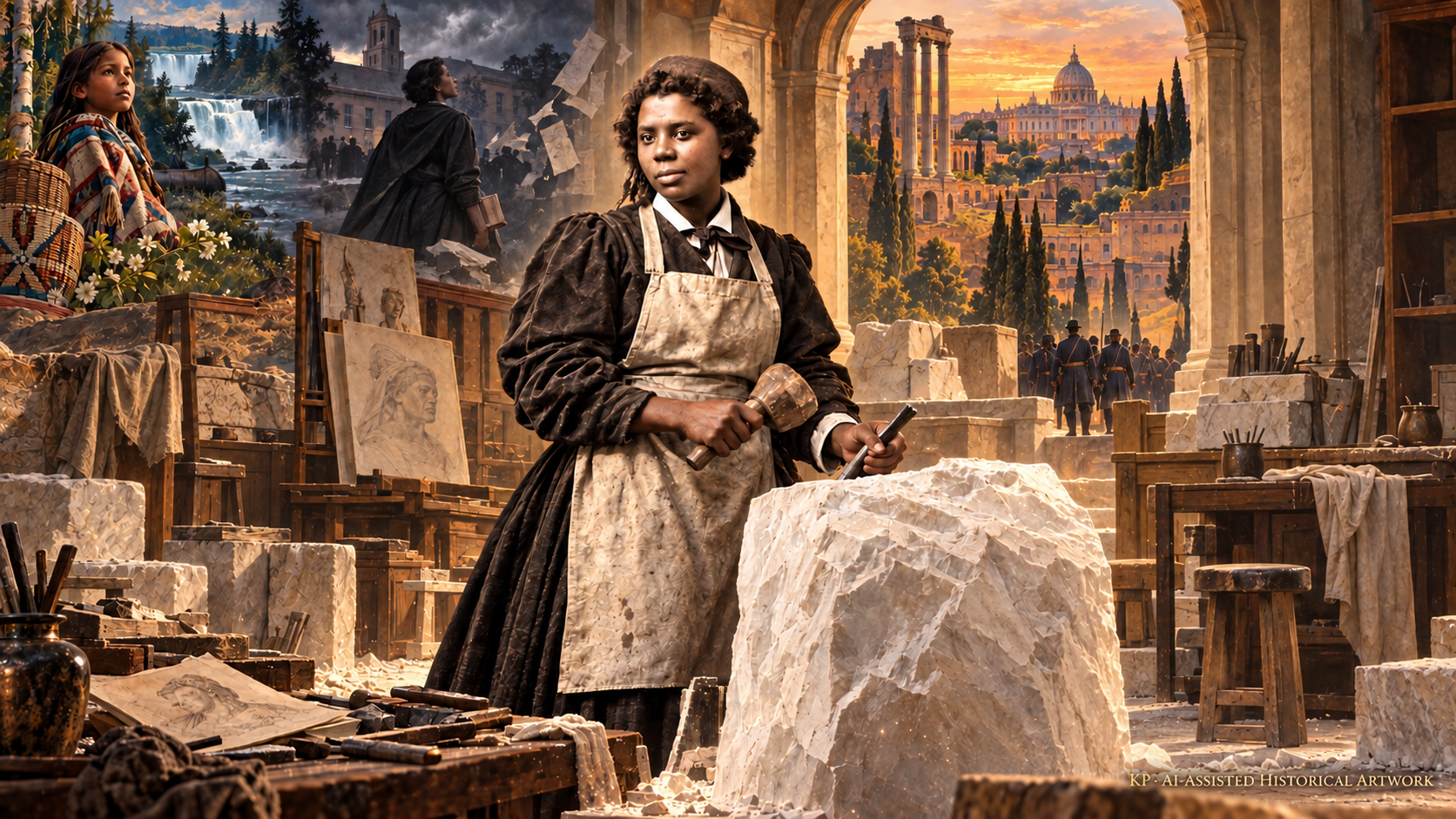
Mary Edmonia Lewis, known in childhood as “Wildfire,” was one of the most extraordinary artists of the nineteenth century: a sculptor of African American, Afro-Caribbean, and Mississauga Ojibwe ancestry who achieved international recognition in a field almost wholly closed to women and to people of African or Indigenous descent. Born around 1844 near Greenbush, New York, and dying in London in 1907, Lewis transformed marble into a language of freedom, racial dignity, Indigenous presence, female endurance, and self-possession. Her career was shaped by the violence and exclusions of the United States, yet it was also made possible by abolitionist networks, Black political struggle, transatlantic travel, and her own formidable will.
The exact facts of Lewis’s birth and early years remain uncertain, partly because records were sparse and partly because Lewis herself gave varying accounts of her life. She was probably born in or near Greenbush, now part of the East Greenbush area of New York State, around 1844. Her mother, Catherine Mike Lewis, was of Mississauga Ojibwe and African American descent. Her father is variously described as a Black or Afro-Caribbean man, perhaps of Haitian or West Indian French origin. This complex inheritance mattered. It formed the background to an artistic life in which Lewis repeatedly turned to Black liberation, Indigenous identity, biblical exile, and African womanhood as subjects worthy of monumental art.
Orphaned while still a child, Lewis was raised for a time by maternal relatives near Niagara Falls. She later recalled a childhood shaped by movement, craft, fishing, swimming, and the sale of Ojibwe-made goods — baskets, embroidered items, and moccasins — to tourists traveling through the region. During this period she was known as “Wildfire,” a name that would later become part of the legend surrounding her. This early experience gave her an intimate knowledge of artistic labor as both cultural practice and livelihood. Long before she entered a studio or touched a block of Italian marble, she had watched women make objects, circulate them through markets, and sustain themselves through skill.
Her older half-brother Samuel Lewis, who had made money during the California Gold Rush, financed her education. She attended New York Central College, an abolitionist institution in McGrawville, before entering Oberlin College in Ohio in 1859. Oberlin had a radical reputation because it admitted women and Black students, but it was not free of racism. Lewis was one of very few students of melanin in a predominantly Anglo-American institution, and the liberal ideals publicly associated with the college did not protect her from the racial hostility of campus and town life.
In 1862, Lewis was accused of poisoning two Anglo-American classmates after they became ill from drinking spiced wine she had served. She was arrested and tried. John Mercer Langston, an Oberlin alumnus and Ohio’s first Black lawyer, represented her. Lewis was acquitted because there was no convincing evidence that she had caused the women’s illness. Yet the legal acquittal did not save her from racial terror. Before the case reached court, she was seized by a mob of Anglo-American men, beaten brutally, and left in a field. The violence was a reminder that a Black and Indigenous woman could be punished socially and physically even when the law failed to convict her.
Lewis remained at Oberlin for a time but faced further hostility, including an accusation of theft. She was eventually prevented from completing her final term and left without a degree. More than a century and a half later, in 2022, Oberlin College awarded her a posthumous diploma. That gesture of institutional repair cannot undo what she endured, but it acknowledges the injustice of a college that had presented itself as progressive while failing to protect one of its most gifted students.
Lewis arrived in Boston in 1864, during the Civil War, at a moment when abolitionist activism, Black political organizing, and public debate over emancipation were transforming Northern cultural life. She entered a network of anti-Maafa figures who recognized her promise. William Lloyd Garrison, Lydia Maria Child, Henry Highland Garnet, and other abolitionists became part of the world in which her career developed. Their support mattered, but Lewis never became merely an ornamental symbol of abolitionist benevolence. She was alert to the possibility that Anglo-American patrons might admire her chiefly as a “Black sculptor” rather than as an artist of serious intellectual and technical power.
In Boston, Lewis studied with the sculptor Edward Augustus Brackett. Her early work included medallions and portrait busts of abolitionist figures such as John Brown, William Lloyd Garrison, Charles Sumner, and Wendell Phillips. One of her most commercially astute projects was a bust of Colonel Robert Gould Shaw, commander of the 54th Massachusetts Infantry Regiment, one of the first major Black regiments in the Union Army. After the Shaw family bought an original bust, Lewis sold reproductions. The income helped finance her journey to Europe.
Her decision to leave the United States was an act of survival and ambition. Lewis later explained that she had been “practically driven to Rome” because the United States — the supposed “land of liberty” — offered little room for a Black sculptor. Rome was then a center of neoclassical art and a major destination for American artists, collectors, and tourists. It offered access to marble, studios, skilled labor, artistic models, and a cosmopolitan clientele. It also provided a measure of distance from the daily racism that had shaped Lewis’s life in America.
Lewis arrived in Rome in late 1865. There she entered a community of expatriate women artists, including Harriet Hosmer, Anne Whitney, Emma Stebbins, and others associated with the actress Charlotte Cushman. These women had also sought in Rome a freedom unavailable to them in the United States, where serious artistic training, professional authority, and independent lives remained difficult for women to claim. Lewis established a studio in the former workspace of the celebrated Italian sculptor Antonio Canova, close to the Spanish Steps. Within a few years, her studio became a regular stop for Americans undertaking the Grand Tour.
What distinguished Lewis was not only the novelty of her identity in the art world but the seriousness of her technical practice. Many sculptors in Rome produced clay or plaster models that professional Italian carvers then translated into marble. Lewis insisted on carving her own work. This was both a practical necessity and an artistic principle. White male critics often questioned whether women sculptors genuinely made their own marble statues; for a Black and Indigenous woman artist, any perceived reliance on assistants could be used to deny her authorship entirely. Her determination to work directly in marble was therefore a declaration of creative sovereignty.
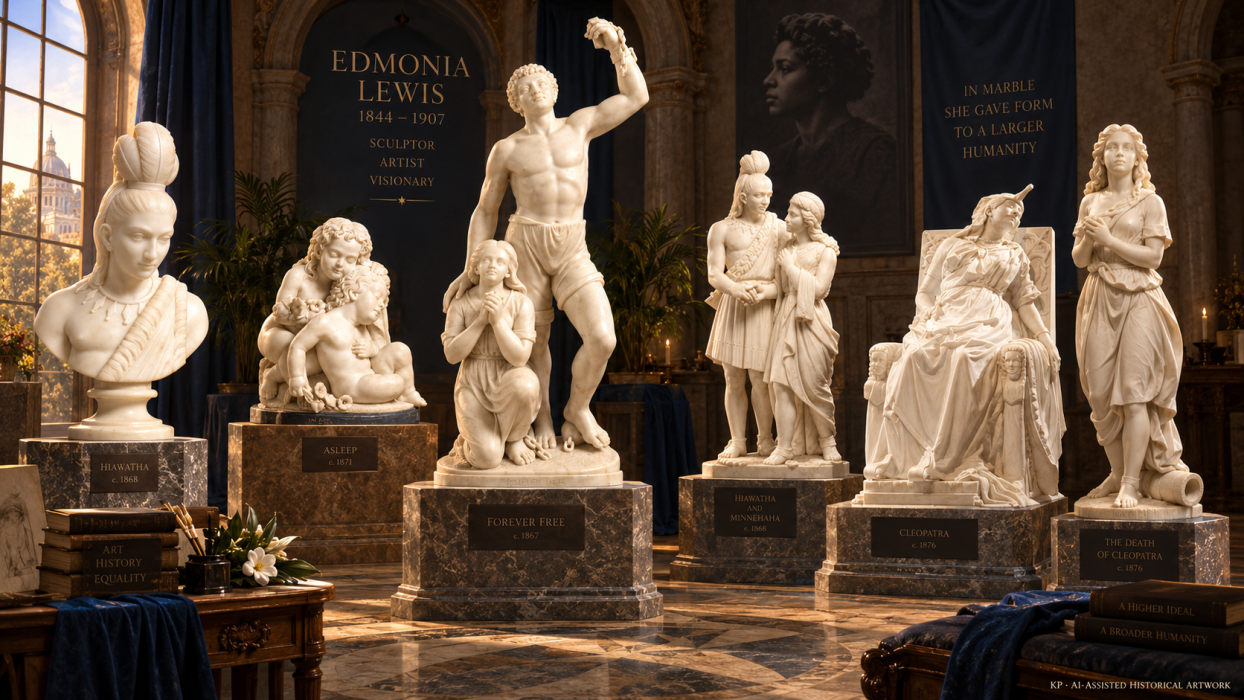
She made her most important works in the years after the Civil War, when emancipation, Reconstruction, Black citizenship, and the future of the United States were fiercely contested. Forever Free, completed in 1867, is among the clearest artistic responses to the abolition of the Maafa. The sculpture shows a Black man standing upright with broken chains at his wrist while a woman kneels beside him in prayer or relief. Although it is frequently associated with the Emancipation Proclamation, it was created after the ratification of the Thirteenth Amendment in 1865 and should be understood primarily as a commemoration of legal abolition. Its most radical feature is its rejection of the familiar abolitionist image of the passive, kneeling Black person pleading for mercy. Lewis’s male figure is already free. He stands erect, breaks his bonds, and becomes an active participant in liberation rather than a recipient of white benevolence.
The sculpture is also shaped by the gender politics of its age. The man appears as a heroic emancipated figure, while the woman’s kneeling posture may initially seem more conventional. Yet her presence makes a vital claim: emancipation must include Black women, family, intimacy, faith, and collective survival. The work does not portray freedom as an abstract legal change alone. It presents it as a transformation in human relationships — the right to stand together, to mourn, to love, to worship, and to exist outside the ownership of another person.
Lewis’s biblical sculpture Hagar is equally important. Hagar, a captive Egyptian woman in the Book of Genesis, is expelled into the wilderness with her son Ishmael after conflict with Sarah and Abraham. The subject allowed Lewis to address captivity, motherhood, abandonment, faith, and female suffering through a biblical narrative that her Christian audiences could recognize. Lewis once said, “I have strong sympathy for all women who have struggled and suffered.” That statement is essential to understanding the work. Her Hagar is neither merely a victim nor a decorative classical figure. She faces exile and danger, yet is sustained by spiritual endurance.
For Black viewers in the post-emancipation era, Hagar’s story could evoke the forced separation of families in bondage, the sexual and reproductive exploitation of Black women, and the insecurity of life after formal emancipation. For Lewis, whose Catholic faith deepened in Rome, the work could also be read as a meditation on divine presence in the wilderness. The power of Hagar lies in this doubleness: it is a sculpture of political vulnerability and sacred survival.
Lewis also created a body of work connected to Indigenous themes, most notably The Old Arrow-Maker and His Daughter and her sculptures of Hiawatha and Minnehaha, inspired by Henry Wadsworth Longfellow’s The Song of Hiawatha. These works are complex. Longfellow’s poem was not an Indigenous text; it was an Anglo-American literary adaptation of Ojibwe traditions and other Native sources. Lewis’s use of it therefore cannot simply be called cultural recovery. Yet she entered a popular American narrative about Indigenous life and made it materially hers. As an artist of Mississauga Ojibwe descent, she brought embodied knowledge and personal inheritance to subjects that white artists commonly treated as picturesque relics of a supposedly “vanishing” people.
Her Indigenous works have sometimes been criticized for their neoclassical forms and for their participation in Victorian expectations of Indigenous representation. Lewis worked within a market that often wanted Indigenous people rendered as romantic, historical, and disappearing. But her work also complicates that market. Her Indigenous figures have domestic presence, emotional interiority, craft knowledge, and familial bonds. Rather than treating Native people as scenery for national expansion, she grants them physical weight and intimate humanity in marble.
Her greatest achievement was The Death of Cleopatra, created for the 1876 Centennial Exposition in Philadelphia. The monumental sculpture depicts Cleopatra immediately after death, slumped on her throne with the asp still in her hand. The work was startling because Lewis rejected the idealized, graceful death that Victorian audiences expected from classical sculpture. Cleopatra is not serenely beautiful in death. Her body appears heavy, exhausted, and physically collapsed. Her face is slack. The sculpture insists on the material reality of a dead woman’s body.
This was a daring artistic choice, but it was also politically resonant. Cleopatra was an African queen facing Roman conquest. Lewis represented her not as an exotic fantasy or a submissive captive, but as a sovereign figure who chose her own fate. In a century when African-descended people were routinely denied authority over their bodies, their labor, their children, and their political futures, Lewis’s Cleopatra could be read as a monument to self-determination. The work’s setting at the Centennial Exposition sharpened this meaning. While the United States celebrated one hundred years of independence, Lewis presented a Black-associated African queen whose sovereignty was threatened and whose death refused humiliation.
The later history of The Death of Cleopatra is almost as dramatic as the sculpture itself. After the exhibition, the work disappeared from the art world. It ended up in the Chicago area, where it was reportedly used as a grave marker for a racehorse named Cleopatra. It later stood neglected in a construction yard, exposed to weather and graffiti. Its recovery and identification in the late twentieth century, aided by the scholarship of Dr Marilyn Richardson and bibliographer Dorothy Porter Wesley, became a powerful symbol of the neglect endured by Lewis’s legacy. The Smithsonian American Art Museum acquired and restored the sculpture in the 1990s, returning it to public view.
At the height of her success, Lewis was not an obscure artist. Visitors to Rome sought out her studio. Frederick Douglass, Henry Wadsworth Longfellow, Pope Pius IX, and former President Ulysses S. Grant were among those connected to her professional world. She received portrait commissions and produced smaller works tourists and middle-class collectors could buy. She was, in effect, both a fine artist and an entrepreneur: a Black woman running a studio business in an international art market.
Yet the conditions that made her success possible also contained its limits. Her career depended partly on the popularity of neoclassicism, American tourists’ continued interest in Rome, and a market for sentimental, religious, abolitionist, and Indigenous subjects. By the late nineteenth century, neoclassicism fell out of fashion. Impressionism, realism, and newer avant-garde movements displaced the polished marble ideal that had defined Lewis’s work. Her commissions diminished, and by the early 1890s she appears to have stopped sculpting.
Lewis eventually left Rome, lived in Paris for a period, and then moved to London. She died at Hammersmith Borough Infirmary on September 17, 1907, from chronic kidney disease, then known as Bright’s disease. She was buried in St Mary’s Roman Catholic Cemetery in Kensal Green. For more than a century, her grave’s location was uncertain. Archival research rediscovered it, and a new memorial stone was later installed. Like the recovery of The Death of Cleopatra, the restoration of her grave forms part of a broader effort to return Edmonia Lewis to the historical record.
Today, Edmonia Lewis is increasingly recognized as a central figure in Black art history, Indigenous art history, women’s art history, and the wider history of the African diaspora. Curators, archivists, Black feminist scholars, Indigenous scholars, and researchers have advanced her restoration to prominence by pursuing the fragments of a life that official institutions allowed to fade. The major 2026 retrospective, Edmonia Lewis: Said in Stone, at the Peabody Essex Museum marked an important stage in that recovery, bringing together sculptures, archives, and new research to illuminate a career long dispersed across collections and obscured by silence.
Lewis’s life was one of artistic discipline and defiance. She survived a racist mob attack, exclusion from a supposedly progressive college, the patronizing gaze of abolitionist culture, and the exclusionary structures of the art world. She then carved a place for herself in marble. Her sculptures remain not simply monuments to a remarkable individual, but records of a larger struggle: the struggle to make Black and Indigenous humanity visible, sovereign, and enduring in a world determined to deny it.
Sources:
https://americanart.si.edu/artist/edmonia-lewis-2914
https://www.nps.gov/people/edmonia-lewis.htm
https://americanart.si.edu/blog/artist-edmonia-lewis
https://americanart.si.edu/blog/edmonia_lewis_3D
https://artmuseum.williams.edu/collection/featured-acquisitions/edmonia-lewis
https://americanart.si.edu/artwork/hagar-14627
https://www.metmuseum.org/art/collection/search/687670
https://smarthistory.org/edmonia-lewis-forever-free
https://www.womenshistory.org/education-resources/biographies/edmonia-lewis
https://www.pem.org/blog/artist-edmonia-lewis-visited-boston-women-sculptors-in-rome-in-december-1865