
On the morning of 9 September 1739, a group of African captives in South Carolina began an uprising that would become known as the Stono Rebellion, or Cato’s Rebellion. Beginning near the Stono River in St. Paul’s Parish, roughly twenty miles from Charleston, it became the largest armed Rising by African captives on the North American mainland during the colonial period. It was not an isolated eruption of violence. Rather, it emerged from a world of coercive plantation labor, European warfare, African military experience, religious memory, and a determined pursuit of liberty.
The Rising was led by Jemmy, sometimes identified in later accounts as Cato, a literate man whose origins likely lay in West Central Africa, and more specifically in the Kingdom of Kongo. Colonial records described him and a core group of about twenty men as “Angolans,” a broad designation that obscured more specific cultural and political histories. Kongo had long-standing relations with Portugal and had incorporated Catholicism into its political and social life from the late fifteenth century. Portuguese circulated as a language of trade, diplomacy, and education, while schools in provincial centers supported a measure of literacy. Some of the men involved in the revolt may also have experienced the civil wars that had convulsed Kongo and its surrounding regions. Such backgrounds mattered. They brought to South Carolina memories of political organization, military discipline, Catholic practice, linguistic skill, and collective life beyond captivity.
A Colony Built on Captivity
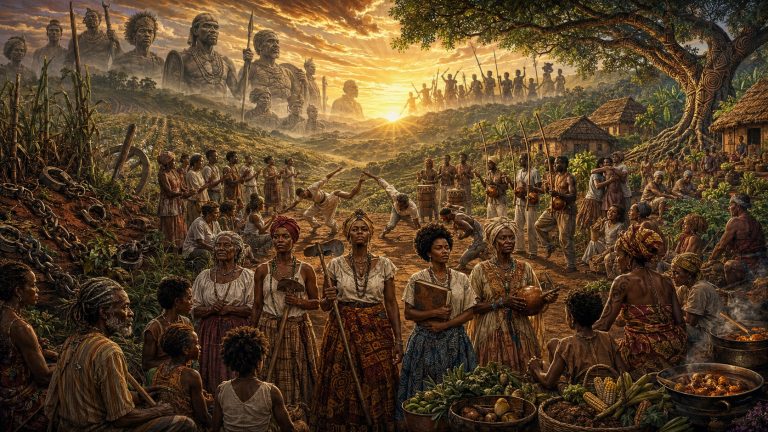
By 1739, South Carolina was a colony in which people of African descent formed a substantial majority. The expansion of rice and indigo cultivation had tied the Lowcountry to a brutal Atlantic economy, dependent upon the forced labor, agricultural knowledge, and technical skill of Africans and their descendants. The colony’s prosperity rested particularly on rice cultivation, for which the buckra (planters) exploited the expertise of people brought from regions where rice had long been grown. This labor took place in a hazardous environment of swamps, marshes, heat, mosquitoes, yellow fever, and malaria. Colonials developed racial theories to justify their dependence upon African labor in disease-ridden landscapes. Yet the practical structure of the colony also revealed the anxieties of its Anglo-American tyrannical-affluent class: captives vastly outnumbered their captors, and plantation society could be preserved only through surveillance, legal restriction, physical punishment, and public terror. Many people labored under the task system, in which they were assigned a set amount of work to complete under supervision. Though this system sometimes left limited time beyond the day’s imposed task, that space was never secure. Captive communities used what opportunities they could find to sustain kinship, religious life, language, food-growing, exchange, and forms of cultural continuity. Sundays could hold particular importance as a period of relative respite and gathering.
In the weeks before the Stono uprising, even this fragile breathing space had been threatened. The colonial authorities had requisitioned labor crews for demanding public works, including the expansion of drainage ditches and roadways. Workers were compelled to labor from sunrise to sunset, while customary Sunday breaks were suspended. For men already subjected to plantation discipline and public conscription, the disruption of this small interval of rest may have intensified the conditions from which rebellion emerged.
The Road Toward St Augustine
The Angolans’ destination was not arbitrary. They moved southward toward Spanish Florida, where the Spanish had offered freedom, land, and protection to people who escaped British jurisdiction, converted to Catholicism, and agreed to serve in the Spanish colonial militia. St. Augustine thus stood in the Angolans‘ imagination as a possible place of refuge and political transformation.
This prospect was heightened by the wider conflict between Britain and Spain. News of impending war raised the possibility that the Spanish might welcome men escaping from British South Carolina as allies. Their Kongolese and Portuguese-speaking background may have made Spanish proclamations especially intelligible, given the proximity of Portuguese and Spanish and Kongo’s longstanding Iberian connections. The Rising therefore belonged not only to South Carolina’s history but also to the wider Atlantic world, in which African political histories, Catholic networks, European rivalry, and military conflict shaped the horizons of action.
Its timing was equally strategic. South Carolina’s recently announced Security Act required Anglo-American men to carry firearms to church on Sundays from 29 September 1739. Jemmy and his companions acted twenty days before the measure was to take effect. They chose a Sunday morning, when many local men would ordinarily gather for worship and be less likely to be armed. Some historians have also noted the date’s possible spiritual resonance, as it fell immediately after the Feast of the Nativity of Mary. Whether understood chiefly as military calculation, religious symbolism, or both, the timing demonstrated foresight rather than spontaneity.
“Liberty!”
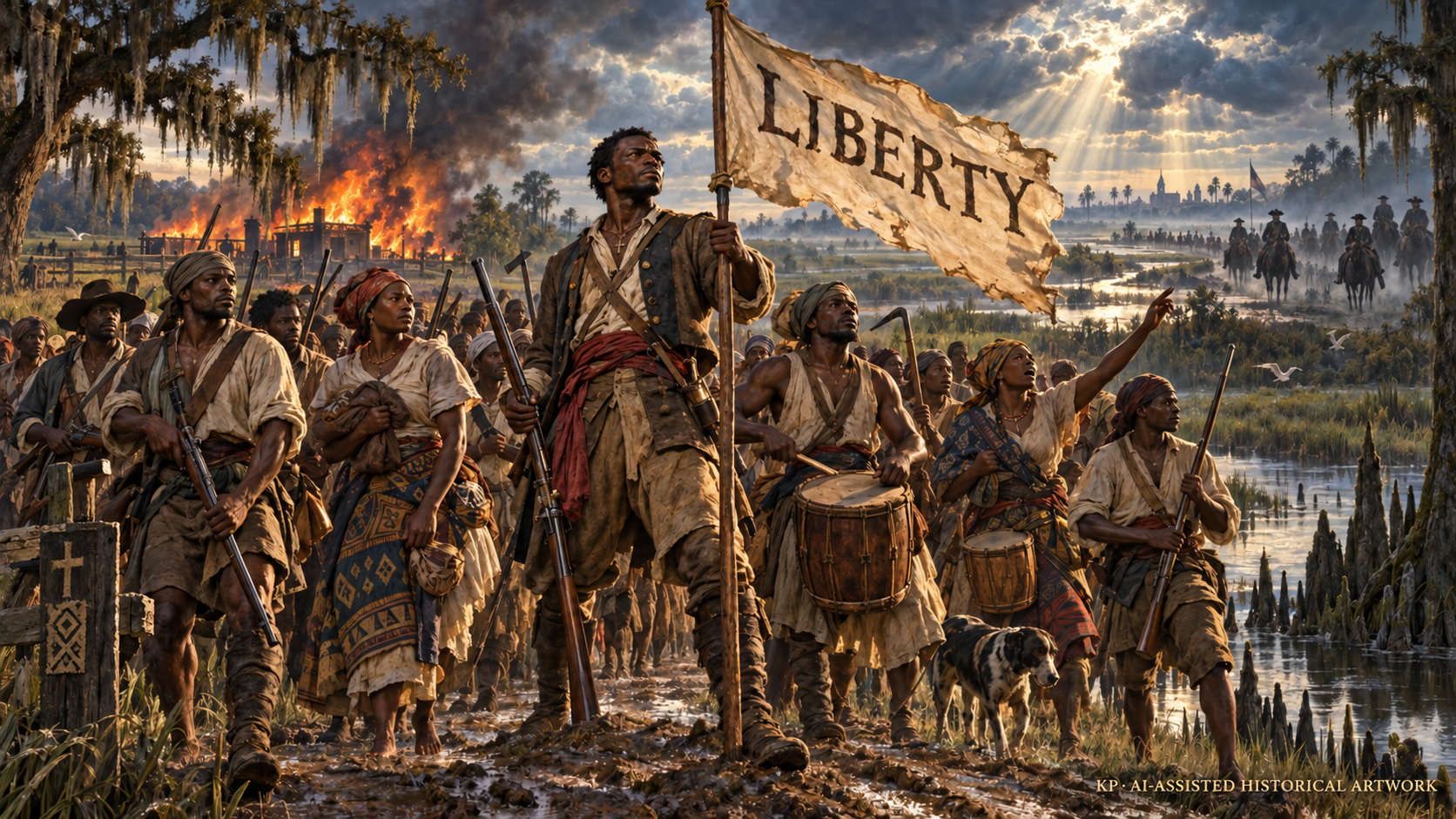
Sometime after midnight or early on the morning of 9 September, the initial group assembled near the Stono River Bridge. They entered Hutchinson’s store and ammunition warehouse, killed the two men there, and seized firearms, powder, and ammunition. Armed now with weapons that could challenge local forces, they set the store ablaze and moved onward.
Their first attacks included the home of Mr Godfrey, where members of the household were killed, and the dwelling was burned. The Angolans then proceeded south along the Pon Pon Road, part of the King’s Highway, in the direction of Florida. They carried banners, beat drums, and cried “Liberty!” As they advanced, they drew additional people into the movement. The number involved rose to perhaps seventy-six and, in some accounts, nearly one hundred participants. Some joined voluntarily; others may have been pressed into the column amid the march’s urgency and danger.
The procession was both an armed campaign and a public declaration. Drumming, banners, songs, firearms, and the repeated cry for liberty turned the road into a stage upon which captives rejected the terms imposed upon them. The uprising directly confronted a society that claimed the right to reduce human beings to marketable property and to enforce what colonial oppressors termed “absolute subjection.” The Angolans were not interested in seeking relief from a particular captor or workplace. They sought to leave the British colony altogether and reach a territory where another political future appeared imaginable.
The Angolans destroyed several plantation properties and killed between twenty and twenty-five Anglo-American colonists. One tavern owner, Thomas Wallace, was reportedly spared because he had a reputation for treating those held under his oppression less harshly than others. Such details, while necessarily filtered through colonial narration, suggest that the Angolans distinguished between particular local figures even amid a struggle directed against the wider system of captivity.
Battle, Repression, and Legacy
The Rising’s progress was interrupted by chance. Lieutenant Governor William Bull encountered the marching group while traveling with companions. He escaped and raised the alarm. A member of his party rode to Willtown Presbyterian Church, where the congregation was summoned into action. Armed Anglo-American buckra and other local men formed a mounted militia and pursued the rebels.
Late that afternoon, the militia intercepted the group near the Edisto River. The Angolans did not immediately surrender. They fired organized volleys, which has encouraged historians to consider the military experience some central participants may have brought from West Central Africa. When the militia’s fire inflicted heavy losses, many members of the larger group scattered. Yet a smaller core reportedly carried out a fighting retreat across the river with considerable order. By nightfall, around thirty were dead, and others had sought refuge into the surrounding countryside and swamplands.
The colonial response continued for weeks and, in some cases, months. They enlisted Chickasaw and Catawba men in the pursuit. Those captured were interrogated, killed, or expelled from the colony; severed heads were displayed along roads as instruments of intimidation. A further confrontation about a week later resulted in the killing of another group of participants. A number of survivors were transported and trafficked into the sugar-producing colonies of the West Indies. The violence of repression was designed not only to eliminate the immediate movement but also to send an unmistakable message to the colony’s African majority.
South Carolina’s legislature answered Stono with the 1740 Act. The measure intensified an already oppressive order. It restricted literacy, assembly, movement, independent economic activity, food cultivation, and drum use. It strengthened the written-pass system and widened the violence of Anglo-American people to stop, question, and punish Black travelers. The law also placed greater obligations on plantation proprietors to uphold the regime of oppression, making the preservation of racial captivity a collective responsibility of the colonial tyrannical class.
The Rising also affected the colony’s Atlantic trafficking. Believing that the uprising reflected the military capacity and shared cultural identity of recently imported West Central Africans, South Carolina’s legislators imposed a ten-year moratorium on further African importations through Charleston. When the trafficking resumed, the buckra sought to redirect their trafficking away from the Congo-Angola coast, revealing both their fear of people they considered politically and militarily formidable and their continuing commitment to an economy founded on human captivity.
The Stono Rebellion endures because it exposes the instability beneath colonial South Carolina’s surface. It reveals that the people held in bondage were never passive recipients of violence or merely units of plantation labor. Jemmy and his companions acted from knowledge, memory, calculation, faith, and an insistence upon self-determination. Their march toward St Augustine was an attempt to cross not simply a colonial border, but the boundary between imposed captivity and freedom. Their defeat brought ferocious retaliation and harsher law, yet the Rising also left an enduring record of organized African resistance in the early Black Atlantic world.
Sources:
William Stanley, Fear and Rebellion in South Carolina: The 1739 Stono Rebellion and Colonial Slave Society (MA thesis, James Madison University, 2020), https://commons.lib.jmu.edu/masters202029/55/.
https://en.wikipedia.org/wiki/Stono_Rebellion
https://www.pbs.org/wgbh/aia/part1/1p284.html
https://billofrightsinstitute.org/essays/the-stono-rebellion/
https://www.ccpl.org/charleston-time-machine/stono-rebellion-1739-where-did-it-begin
https://www.americanhistorycentral.com/entries/stono-rebellion-1739/
https://thehistorybandits.com/2016/04/01/kongo-in-the-carolinas-the-african-roots-of-the-stono-rebellion/