
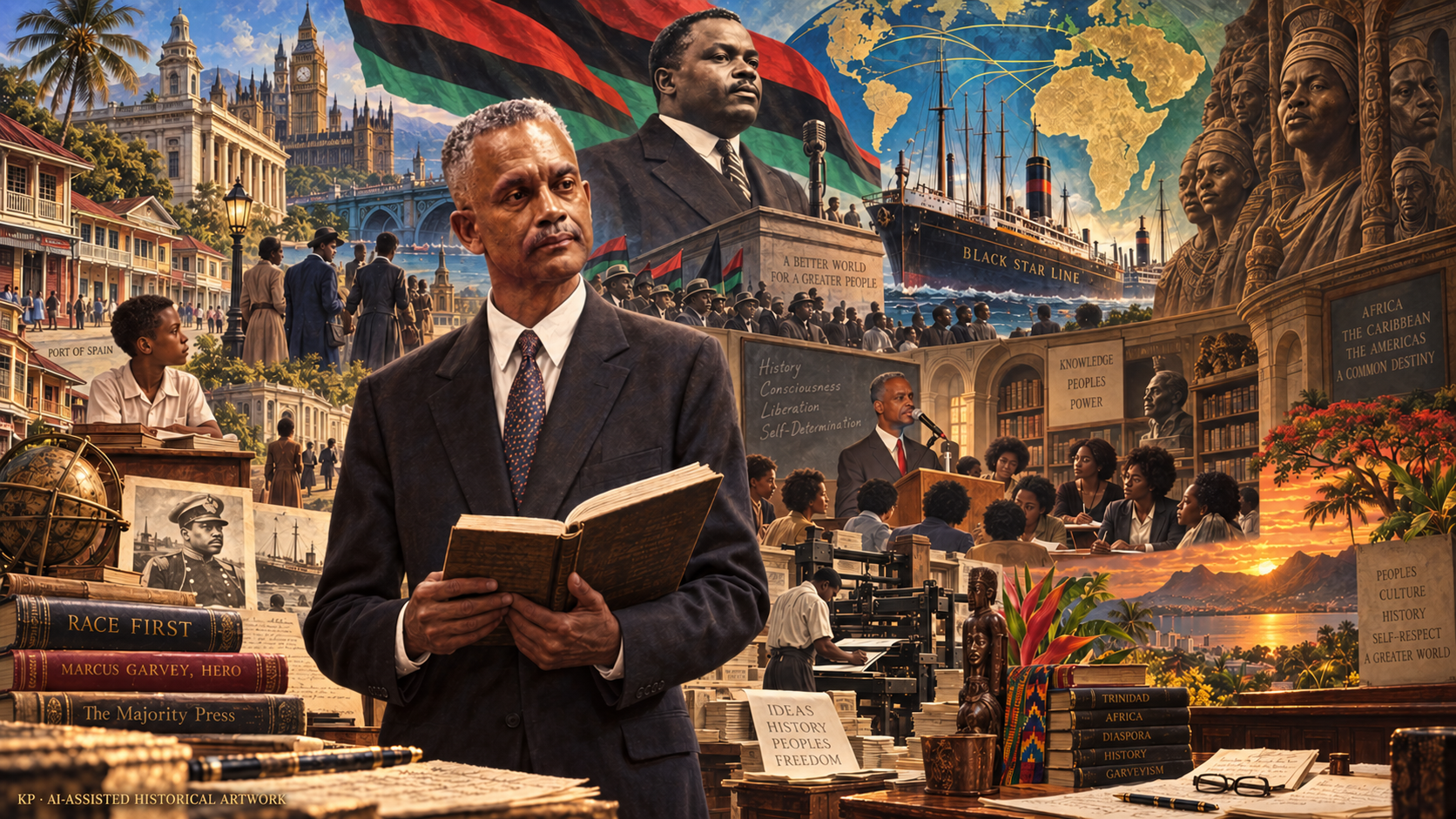
Tony Martin was a Trinidad and Tobago-born historian, author, educator, publisher, and Pan-African activist whose scholarly life was devoted above all to restoring Marcus Garvey and Garveyism to their proper place in African and diasporic history. A formidable and independent-minded intellectual, he wrote, edited, or compiled fourteen books, taught generations of students across the Caribbean and United States, and became one of the most influential modern interpreters of Garvey’s political thought, organizational achievement, and enduring international legacy. His career was marked by deep archival commitment, institutional service, intellectual controversy, and an unyielding belief that African people’s history should be studied from the standpoint of their own struggles, ideas, and aspirations.
Born in Port of Spain, Trinidad, on 21 February 1942, Martin grew up in Woodbrook, a district whose social and political life formed part of the wider ferment of twentieth-century Caribbean nationalism. He attended Tranquillity School, where one of his contemporaries was the future Black Power activist Stokely Carmichael. His early education and later moves between Trinidad, Britain, and the United States placed him within the broader postwar Caribbean diaspora: a generation shaped by colonial education, migration, anticolonial change, and the search for intellectual and political self-definition. He traveled to England to read law at Gray’s Inn in London and was called to the Bar in 1966. Yet the law did not become the central field of his life’s work. He later earned an honors degree in economics from the University of Hull in 1968, gaining a disciplinary grounding that would later complement his interest in the material, organizational, and ideological dimensions of Black political movements.
After completing his studies in Britain, Martin returned to Trinidad, where he taught at Cipriani Labour College and St Mary’s College. These early appointments placed him within educational institutions connected to the island’s labor, political, and civic traditions. In 1969, however, he moved to the United States to undertake graduate study in African history at Michigan State University. There he earned his master’s degree and, in 1973, completed a doctoral dissertation on Marcus Garvey. That research became the foundation of his most important scholarly work, Race First: The Ideological and Organizational Struggles of Marcus Garvey and the Universal Negro Improvement Association, published in 1976. In a field long shaped by dismissive or racially condescending readings of Garvey, Martin’s work treated the Jamaican leader and the Universal Negro Improvement Association as serious historical subjects: complex, disciplined, international in reach, and central to the development of modern Pan-African consciousness.
Race First established Martin as a major authority on Garvey and the UNIA. Rather than reducing Garveyism to charisma, spectacle, or failure, he examined the political ideas, organizational struggles, cultural expression, and transnational networks through which the movement reached millions of people of African descent. The book helped shift attention toward the intellectual seriousness of the Garvey movement and its profound influence on Black self-determination, anticolonial nationalism, religious life, cultural politics, and later Pan-African thought. Martin’s scholarship was part of a broader effort to free African diasporic history from frameworks that had too often treated Black political movements as marginal, irrational, or derivative. For him, Garvey was not merely an episode in American or Jamaican history, but a world-historical figure whose ideas connected Africa, the Caribbean, North America, Europe, and Latin America.
In 1973, the same year in which he completed his doctorate, Martin joined the faculty of Wellesley College in Massachusetts. He received tenure in 1975 and became a full professor in 1979. Over the course of thirty-four years at Wellesley, he helped establish and shape Africana Studies as an academic field within the college, serving as a founding member and long-standing chair of its Africana Studies Department. His teaching career was expansive both in subject and geography. Beyond Wellesley, he taught at the University of Michigan–Flint, Cipriani Labour College, and St Mary’s College, and served as a visiting professor at the University of Minnesota, Brandeis University, Brown University, and Colorado College. He also spent a year as an honorary research fellow at the University of the West Indies in Trinidad. Through these appointments, and through lectures delivered in the Caribbean, North America, South America, Africa, Europe, and Australia, he became a widely recognised public intellectual as well as a university scholar.
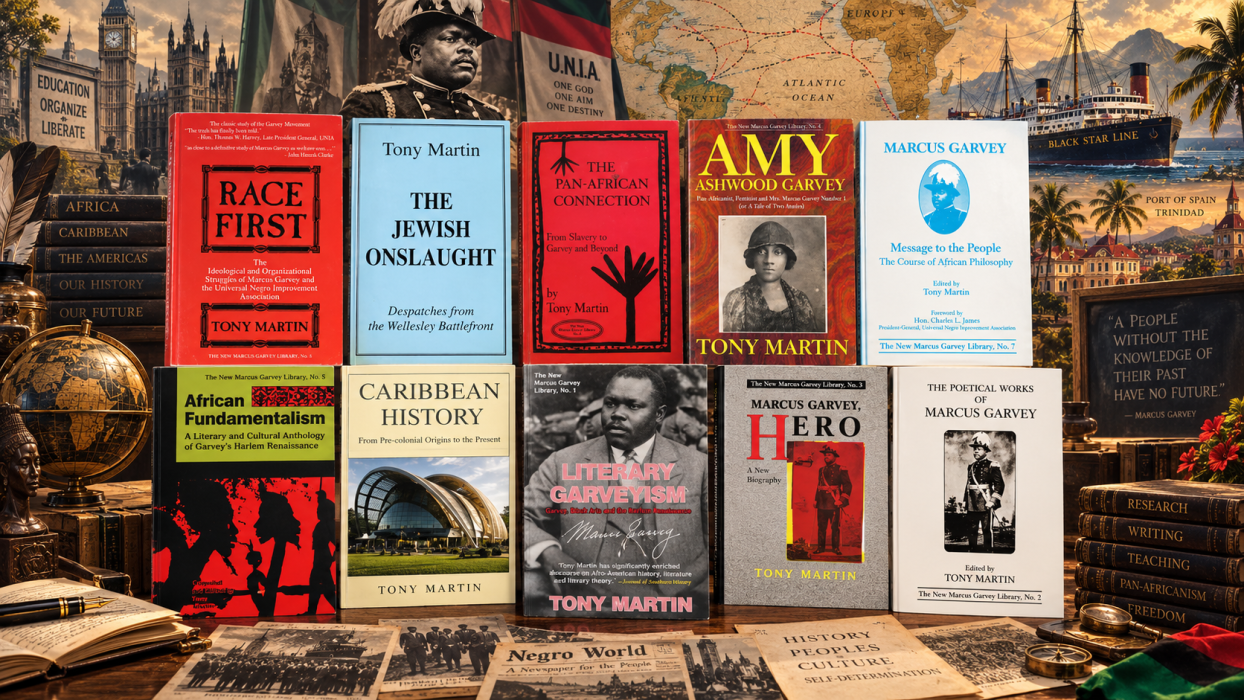
Martin’s written work reflected the breadth of his Garvey-centred intellectual project. In 1983 he founded The Majority Press, an independent publishing house that enabled him to publish his own work and support related scholarship beyond the constraints of conventional academic publishing. That year alone saw the appearance of several important titles: Marcus Garvey, Hero: A First Biography; Literary Garveyism: Garvey, Black Arts and the Harlem Renaissance; The Poetical Works of Marcus Garvey, which he compiled and edited; and The Pan-African Connection: From Slavery to Garvey and Beyond. His work moved beyond political biography into literature, cultural history, publishing, and historical recovery. By attending to Garvey’s poetry, prose, organisations, and cultural afterlife, Martin demonstrated that Garveyism was not simply a political programme but an intellectual and artistic current that helped shape the Harlem Renaissance and the wider cultural life of the African diaspora.
His other publications included Rare Afro-Americana: A Reconstruction of the Adger Library, co-authored with Wendy Ball; the two-volume In Nobody’s Backyard: The Grenada Revolution in Its Own Words, edited with Dessima Williams; and African Fundamentalism: A Literary and Cultural Anthology of Garvey’s Harlem Renaissance. These works reveal a scholar committed to preserving texts, recovering overlooked archives, and tracing the relationships between history, literature, political struggle, and collective memory. His 2007 study of Amy Ashwood Garvey, Amy Ashwood Garvey: Pan-Africanist, Feminist and Mrs. Marcus Garvey No. 1, Or, A Tale of Two Amies, also reflected his attention to figures whose importance had often been subordinated within male-centered accounts of political movements. By placing Amy Ashwood Garvey’s activism and Pan-Africanist thought at the center of the narrative, Martin contributed to a fuller understanding of the women who sustained and shaped Garveyism.
Martin’s intellectual independence also brought him into sharp conflict with colleagues, students, and public institutions, especially during the 1990s. At Wellesley, disputes surrounding his teaching, the assignment of The Secret Relationship Between Blacks and Jews, and his responses to criticism became the focus of intense public controversy. The book, published by the Nation of Islam, advanced claims about Jewish involvement in the transatlantic slave trade that were rejected by mainstream historians. Martin’s use of the text in an African American history course provoked opposition from Jewish organizations, campus groups, and members of the Wellesley faculty. He later set out his own account of the conflict in The Jewish Onslaught: Dispatches from the Wellesley Battlefront (1993), a work that was widely condemned as antisemitic by the Wellesley administration, faculty bodies, and other scholars. The controversy intensified further through a protracted libel suit involving classicist Mary Lefkowitz and others, which was ultimately dismissed after years of litigation and appeals.
These episodes became inseparable from Martin’s public reputation, though they should not obscure the scale and influence of his earlier and continuing historical scholarship. They reveal the contentious atmosphere surrounding questions of Afrocentrism, race, academic freedom, historical evidence, and institutional power in late twentieth-century American higher education. Martin saw himself as resisting an academic establishment that, in his view, was hostile to independent African-centered scholarship. His critics, however, objected strongly to his arguments, language, and associations, particularly after his 2002 address, “Tactics of Organized Jewry in Suppressing Free Speech,” at a conference organized by the Institute for Historical Review, an organization widely identified with Holocaust denial. Any full account of Martin’s career must recognize both the importance of his contribution to Garvey studies and the serious criticism attached to aspects of his later public interventions.
After retiring from Wellesley as professor emeritus in June 2007, Martin returned to Trinidad and Tobago, where he continued to research and write. His final major book, Caribbean History: From Pre-Colonial Origins to the Present (2012), extended his scholarly range across the region’s wider history. At the time of his death, he was working on biographies of two notable Trinidadian women: his aunt, the activist Audrey Jeffers, and the broadcaster Kathleen Davis, widely known as “Aunty Kay.” These unfinished projects suggest the continuing direction of his work: toward recovering Caribbean lives, institutions, and political traditions too often neglected in standard accounts.
Martin died unexpectedly on 17 January 2013 at West Shore Medical Hospital in Trinidad, aged seventy. He was survived by his son, Shabaka Martin, and his brother, Henry. His death brought to a close a career of remarkable persistence and productivity, one in which research, teaching, publishing, and Pan-African advocacy were closely joined. His most durable legacy remains his work on Marcus Garvey and the Universal Negro Improvement Association. Through Race First and his many subsequent books, editions, lectures, and public interventions, Tony Martin insisted that Garveyism be understood not as a historical curiosity, but as one of the great movements of African diasporic self-assertion in the modern world.
Sources:
https://en.wikipedia.org/wiki/Tony_Martin_(professor)
https://community-languages.org.uk/cls/tony-martin.html
https://amsterdamnews.com/news/2013/01/24/look-for-me-in-the-whirlwind-controversial/
https://www.triniview.com/blog/?p=543