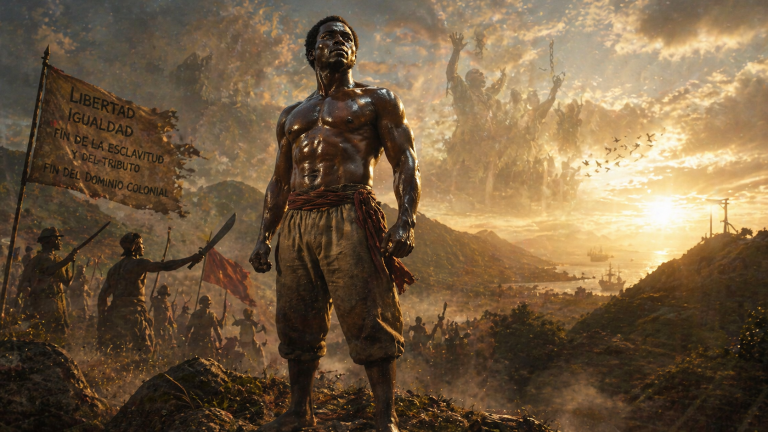

Born during the Maafa around 1775 or 1776, Gabriel became a skilled blacksmith, a literate artisan, and a revolutionary organizer who sought to transform Virginia. In the summer of 1800, he became the principal military leader of an ambitious movement to seize Richmond, capture its weapons, and compel the state’s authorities to recognize the freedom of African-descended Virginians. His struggle brought the promises of the American Revolution into direct confrontation with the racial order that its leaders continued to defend.
Remembered in African American cultural memory as General Gabriel, he was about twenty-four when Virginia authorities executed him on 10 October 1800. The planned uprising never became the battle he anticipated: disclosure and torrential rain prevented the mobilization, and the state responded with arrests, trials and public executions. Yet Gabriel’s importance extends beyond the collapse of his military plans. His life reveals the political intelligence, technical skill and collective ambition of Black communities determined to make freedom a lived reality rather than a privilege reserved for others.
In Before the Mayflower, Lerone Bennett offers a vivid portrait of the young leader. He describes a deeply religious man who wore his hair long in imitation of the biblical Samson, was fascinated by the Old Testament’s passages of judgment, and dreamed of a Black state in Virginia rather than in the Caribbean. According to Bennett, Gabriel laid his plans through the spring and summer of 1800. For four or five months he spoke at fish fries and barbecues, and every Sunday he slipped into Richmond to study the town, noting its strategic points and the locations of arms and ammunition. His brothers, Martin and Solomon, and his wife, Nanny, were among his associates.
Bennett describes the plan as simple. Three columns would attack Richmond: the right wing would seize the arsenal and its guns, the left would take the powder house, and the central force would enter the town at both ends at once. Gabriel then envisaged rapid attacks on other cities in the state. If the plan succeeded, he was to be named king of Virginia; if it failed, they would flee to the mountains and wage a guerrilla war. Bennett also reports that several thousand men and women had enlisted by August 1800.
A Life at Brookfield
Gabriel was born at Brookfield, a tobacco plantation in Henrico County, approximately six miles north of Richmond. Thomas Prosser owned the estate, and his son, Thomas Henry Prosser, later controlled it. Gabriel grew up with his brothers, Solomon and Martin. Although he is often called Gabriel Prosser, his family name is unknown. Contemporary records identify him simply as Gabriel, and the later attachment of Prosser’s surname should not be mistaken for evidence that he adopted it.
Gabriel married a woman named Nanny, also recorded as Nan. The surviving material offers little secure information about their marriage or any children. Later traditions elaborate his family history, but they cannot supply the certainty that contemporary documentation lacks. Nanny nevertheless belongs in his biography: Gabriel’s life included intimate relationships and community responsibilities, as well as the revolutionary project through which he became known.
By early adulthood, Gabriel stood six feet two or three inches tall. Descriptions noted his long, bony face, missing front teeth and head scars. Such details survive largely because officials wanted to identify and capture him. Read beyond their original purpose, they offer a rare physical outline of a man whose own account of his life has not survived. His exceptional stature attracted attention, but his more consequential attributes were practical knowledge, literacy, confidence and the ability to build relationships across the countryside and the city.
The Blacksmith and His World
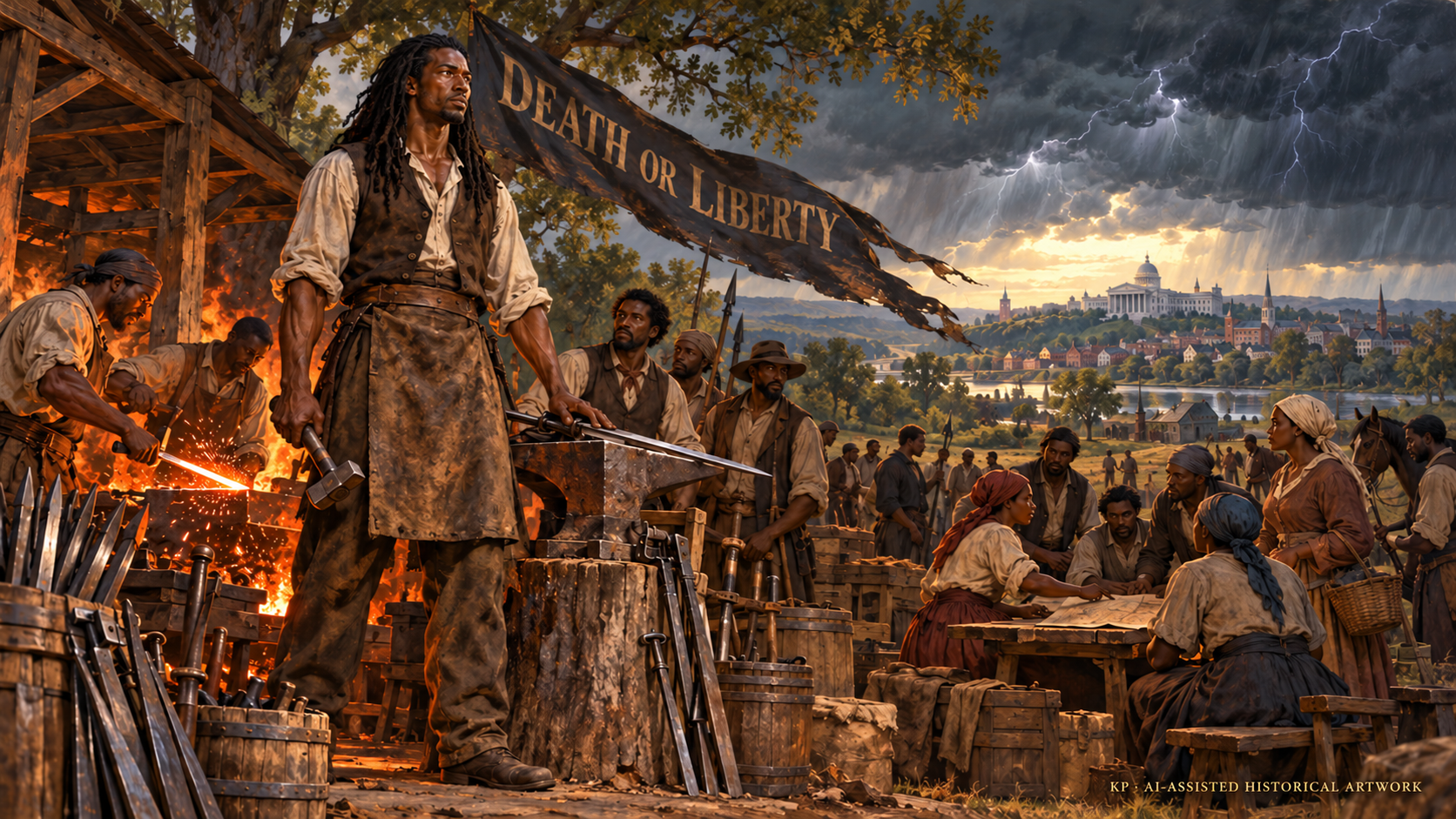
Gabriel’s craft placed him at the intersection of agricultural production, urban commerce and skilled labor. Blacksmithing demanded strength, precision and an understanding of materials. It also gave him a capacity that would prove indispensable to the uprising: he could turn the implements of plantation agriculture into weapons.
Through arrangements commonly described as “hiring out”, Gabriel worked beyond Brookfield, including in Richmond’s workshops and foundries. This did not amount to freedom, but it widened his experience and his circle of acquaintances. Like other mobile artisans, he could encounter free Black people, African-descended workers, European-descended laborers and travelers carrying news from elsewhere. The relationships connecting rural neighborhoods with Richmond became an infrastructure for political organization.
Gabriel could also read and write. Literacy offered another route into the political world around him, although the surviving evidence does not identify every newspaper, pamphlet or book he encountered. His importance as an organizer rested not simply on access to written information but on his ability to interpret the society in which he lived and to persuade others that it could be changed.
Religious life formed part of that society. Biblical narratives of deliverance and judgment offered a language through which Black communities could understand oppression and imagine liberation. Historians have differed over how much weight to give religion, artisan consciousness and neighborhood relationships in explaining the movement. These interpretations illuminate overlapping dimensions of Gabriel’s world rather than reducing him to a single influence.
The Confrontation of 1799
In September 1799, Gabriel, Solomon and a man named Jupiter became involved in a confrontation over a stolen pig. Absalom Johnson, a European-descended overseer associated with a neighboring plantation, challenged them. Gabriel fought Johnson and bit off part of his ear. The incident exposed the unequal consequences of physical conflict in Virginia’s racial regime.
Gabriel faced a capital prosecution for maiming Johnson. He avoided execution through the legal provision known as “benefit of clergy”, but the court ordered him branded on his left hand, and he spent approximately a month in jail. The episode has often been treated as the decisive turning point in his political development. It certainly demonstrated how little protection his skill, literacy or standing could provide against the American courts.
Nevertheless, no surviving personal testimony establishes exactly how Gabriel understood the experience. The branding and imprisonment belong to the documented sequence leading toward the uprising; the claim that they alone created his revolutionary commitment goes beyond what the evidence can securely show. His later organizing addressed something larger than a private grievance. The movement aimed to overturn the system that made such punishment possible.
Revolution Across the Atlantic
Gabriel came of age in an Atlantic world transformed by revolution. The American struggle for independence had made resistance to tyranny a celebrated political principle, while the French Revolution had intensified arguments about liberty, equality and legitimate government. In Saint-Domingue, the revolution that began in 1791 demonstrated that African-descended people could organize armed resistance on a scale capable of transforming a colonial society.
News of Saint-Domingue reached Virginia through newspapers, travelers and refugees. From 1793, arrivals from the colony brought accounts of upheaval into Virginia’s ports and towns. For European-descended authorities, these developments provoked anxiety. For Black communities, they opened another horizon of possibility. Haiti had not yet declared independence when Gabriel organized in 1800, so the example available to him was a revolution still unfolding, not an established independent republic. Its significance lay in the visible power of collective resistance and in the challenge it posed to assumptions about who could claim freedom.
Virginia’s own political divisions also mattered. The presidential contest of 1800 sharpened hostility between Federalists and supporters of Thomas Jefferson, and disputes over France, federal power and the meaning of republican government made the ruling order appear less united. The organizers noticed the withdrawal of federal troops stationed near Richmond in June, which suggests that their preparations included a practical assessment of military opportunity.
Gabriel and his associates did not merely absorb revolutionary language. They claimed its implications for themselves.
Building a Movement
The uprising emerged from collective discussion and neighborhood relationships during the spring and summer of 1800. Although Gabriel became its most prominent leader, he was not its sole originator. Historical research identifies Sam Byrd Jr. as an early proposer of the plan, alongside organizers including George Smith, Gilbert, Ben Woolfolk and Jack Bowler, also known as Jack Ditcher.
Its core lay in the Brook neighborhood north of Richmond. Recruitment extended through Henrico and Hanover into Caroline County and south toward Petersburg, with efforts reaching other localities. Organizers relied on relatives, friends, fellow workers and trusted acquaintances. Meetings took place near springs, beneath bridges, at religious gatherings and after a funeral: places where ordinary community life could shelter extraordinary political intentions.
Gabriel’s brothers participated in the preparations. Solomon worked with metal, while Gabriel and Martin helped produce musket balls. Jack Bowler contributed leadership, recruitment and weapons. The movement’s strength came from this distribution of labor and responsibility, not simply from the commanding presence of one man.
Its actual size remains uncertain. Testimony included claims of hundreds, thousands and even ten thousand recruits, but such figures cannot be treated as a reliable muster roll. Recruiters needed to convince prospective participants that enough others had committed to make the venture possible, and promises of overwhelming support could serve that purpose.
The uncertainty does not diminish the achievement. Across distances that authorities sought to regulate, Black organizers created a network capable of discussing strategy, producing arms and preparing a coordinated assault on the state capital.
The Plan for Richmond
The attack was scheduled for the night of 30 August 1800. Its organizers intended to overcome a central weakness: they possessed relatively few firearms. Rather than wait until every participant had a musket, they planned to use improvised weapons to seize government stores and arm the larger force.
Gabriel, Solomon and other blacksmiths refashioned scythe blades into swords, and one witness claimed they made twelve dozen. Jack Bowler reported making fifty pikes by attaching bayonets to poles. The conspirators also collected gunpowder and prepared ammunition. These measures show the practical relationship between skilled work and revolutionary strategy.
A diversionary fire in lower Richmond would draw residents away from the principal objectives. The main force would advance into the upper town and capture weapons held at the Capitol, the penitentiary and the public magazine. Governor James Monroe was a central target: taking him hostage could force negotiations over freedom.
Gabriel also undertook reconnaissance. In early August, he and two associates entered the Capitol to inspect its weapons. They obtained access through Robert Cowley, a free Black man who served as keeper of the building and doorman to the Council of State. A subsequent investigation cleared Cowley of complicity, and his assistance with entry should not be turned into evidence that he knowingly joined the movement.
According to Ben Woolfolk’s testimony, Gabriel intended to obtain silk for a banner bearing the words “Death or Liberty”. The motto expressed a determination to claim the freedom that Virginia’s revolutionary leaders celebrated but denied to Black people. The planned Rising described attacks on local European-descended residents and potentially extensive killing in Richmond. Other accounts identified exceptions for Quakers, Methodists, French people, and some poor residents considered sympathetic to freedom. These differences reveal their efforts to identify allies and distinguish among potential adversaries.
Disclosure and the Storm
On 30 August, Tom and Pharaoh disclosed the intended uprising to Mosby Sheppard, who passed the warning to Monroe. That evening, an extraordinary storm struck central Virginia. Heavy rain swelled waterways and made the planned gathering impossible.
The leaders postponed the attack until the following night, unaware that their adversaries had already been alerted. Patrols began detaining suspects, and the window for coordinated action closed. Accounts differ over the precise relationship between disclosure and the weather, but together they prevented the Rising from assembling its force.
No attack on Richmond took place. This absence is essential to understanding what followed: the state executed men for their involvement in planning an uprising, not for killings committed during it. Gabriel escaped the initial arrests. He reached a schooner traveling down the James River toward Norfolk, possibly with the assistance of its captain, Richardson Taylor. On 23 September, a crewman identified him to the prosecutors, and they arrested him and returned him to Richmond. Taylor’s possible assistance remained unproven, as proceedings against him did not establish his participation.
Trial and Execution
Gabriel stood trial on 6 October 1800 before a court of oyer and terminer. Under the procedure applied to these defendants, five justices heard the evidence rather than a jury, with appeal available only to the governor. The institution whose authority Gabriel had challenged now determined his fate.
Much of the surviving account of the movement comes from these proceedings. Witnesses described recruitment, preparations, and conversations, sometimes in circumstances where cooperation could secure a pardon. Ben Woolfolk, an organizer who became a major prosecution witness, received such a pardon. The records therefore require careful reading: they preserve indispensable evidence, but not a neutral collective autobiography.
Gabriel said little during his trial. Later literary accounts and songs attributed speeches to him, but these should not be confused with securely documented courtroom statements. He was convicted and hanged in Richmond on 10 October 1800. His brothers Solomon and Martin had already been executed on 15 September.
The broader reckoning was severe. Seventy-two men were tried in proceedings counted as connected with the conspiracy, although the connection of two cases remains uncertain. Twenty-six were executed, eight were transported, thirteen were pardoned and twenty-five were acquitted. Another suspect apparently died by suicide in custody.
Public executions served as warnings to Black communities. Their consequences also reached into families whose losses survive only faintly in the official record.
Repression and Remembrance
Virginia responded by strengthening patrols, increasing the monitoring of free Black residents, renewing restrictions on independent hiring arrangements, and creating a public guard for Richmond. Legislators also sought to remove from Virginia people they considered dangerous. The response targeted precisely the mobility, relationships, and opportunities for independent action that had made the movement possible.
The state’s calculations were financial as well as political. Plantation proprietors received compensation for executed workers, and the expense of further executions helped encourage pardons and transportation. Black lives remained subject to an accounting system even when they had devoted themselves to rejecting its authority.
Yet official punishment did not determine Gabriel’s place in cultural memory. “General Gabriel” survived in African American story and song. Frederick Marryat’s 1840 novel Poor Jack included twenty-two verses about “Gin’ral Gabriel”, performed within the narrative by an African American fiddler named Opposition Billy. Martin R. Delany’s Blake; or The Huts of America later portrayed Gabriel’s name as a talisman held in sacred reverence. These works document remembrance rather than supply a literal record of his final actions.
Later writers continued that recovery, notably Arna Bontemps in Black Thunder in 1936. Richmond formally honored Gabriel in 2002, and Governor Tim Kaine issued an informal posthumous pardon in 2007. Such recognition reversed the state’s public judgment without undoing the deaths through which that judgment had originally been enforced.
Sources:
https://blackpast.org/african-american-history/prosser-gabriel-1775-1800/
https://en.wikipedia.org/wiki/Gabriel%27s_Rebellion
https://ushistory.org/free-online-textbooks/us/jeffersonian-america-a-second-revolution/20f-gabriels-rebellion-another-view-of-virginia-in-1800
https://www.pbs.org/wgbh/aia/part3/3p1576.html
https://www.lva.virginia.gov/collections/educator-resources/online-classroom/stc/entries/testimony-in-the-trial-of-gabriel-october-6-1800
https://www.encyclopedia.com/philosophy-and-religion/bible/biblical-proper-names/gabriel
https://www.youtube.com/watch?v=p0b8PlDT5bw
https://encyclopediavirginia.org/entries/gabriels-conspiracy-1800/
https://allthatsinteresting.com/gabriel-prosser
https://scholarscompass.vcu.edu/cgi/viewcontent.cgi?article=1009&context=hist_pubs