
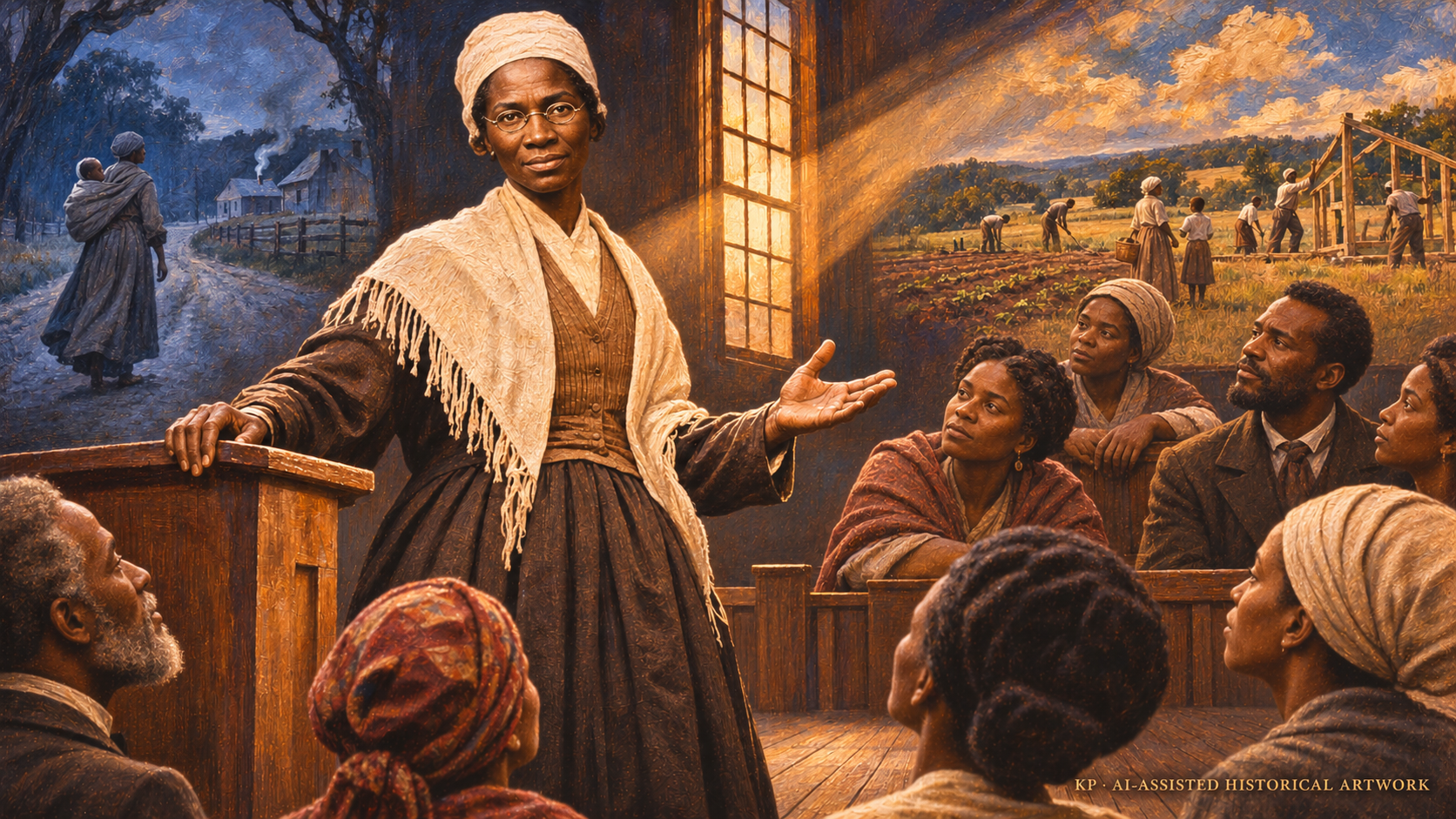
In 1826, Isabella Baumfree took her infant daughter Sophia and left the New York farm where she had been held in captivity. John Dumont had promised to release her ahead of the date set by state law, then withdrew his promise. Baumfree did not wait for him to change his mind. As she later recalled, “I did not run away, I walked away by daylight.” What Dumont could call a flight, she understood as a decision she had every right to make.
Seventeen years later, she took the name Sojourner Truth and began traveling as a preacher. Over the next four decades, she called for abolition, women’s suffrage, equal pay, and access to land for people newly freed from bondage. She is best remembered for the question “Ain’t I a Woman?” Yet the earliest substantial account of her 1851 address in Akron, Ohio, contains no such refrain. Her speech was no less pointed: drawing on years of farm labor and her knowledge of scripture, Truth challenged an audience accustomed to hearing men decide what women could do and what rights they deserved.
A childhood in New York bondage
Isabella Baumfree was born around 1797 in Swartekill, in the town of Esopus, Ulster County, New York. Her parents, James and Elizabeth Baumfree, were held in bondage by the Hardenbergh family. Elizabeth, also known as Mau-Mau Bet, taught her daughter to pray and to turn to God in trouble. Dutch was Isabella’s first language, as it was for many people in that part of the Hudson Valley. She learned English after she was separated from her family.
Isabella was about nine when, after Charles Hardenbergh’s death, she was sold at auction to John Neely. Her 1850 account remembers the sale alongside a flock of sheep for $100. In Neely’s household, where English was spoken, misunderstandings could bring beatings. She was sold again to a man named Schryver and then to John Dumont, on whose farm she spent much of her youth and early adulthood. There she married Thomas, a man also held in bondage by Dumont. Her account records five children, four of whom are known by name: Diana, Peter, Elizabeth, and Sophia.
New York’s gradual abolition laws did not free families together. The 1799 law declared children born after July 4 of that year to mothers in bondage legally free, but required them to work for the people who claimed their mothers’ labor until age 25 for girls and 28 for boys. A later law set July 4, 1827, as the date when people born before that cutoff would be freed. Isabella was in the latter group. When Dumont went back on his promise to release her early, she left with Sophia and found refuge with Isaac and Maria Van Wagenen. They paid Dumont $20 for his remaining claim on her labor, allowing her and Sophia to stay. Her other children could not leave with her.
Bringing Peter home
After leaving Dumont’s farm, Isabella learned that Peter had been sold and taken to Alabama in violation of New York law. Dumont had trafficked the boy to Eleazer Gedney, and Peter subsequently passed through the hands of Eleazer’s brother, Solomon Gedney, before being taken south. Isabella sought help, went to court, and gave a sworn statement under the name Isabella Van Wagenen. In 1828, the court ordered Peter released into his mother’s custody.
This was a significant case. The surviving papers—a writ requiring that Peter be brought before the court, Isabella’s sworn statement, Gedney’s response, and the court’s order—show what she accomplished. A Black mother who had only recently secured her own freedom used New York law to challenge the men who had arranged her son’s removal and bring him home. The gradual abolition laws had left members of the same family with different legal standings; Isabella insisted that the law protect Peter.
Mother and son moved to New York City in 1829. Years later, Peter joined the crew of the Nantucket whaling ship Zone. Truth received letters from him between 1840 and 1841, but he was not aboard when the ship returned in 1842. She never heard from him again.
Becoming Sojourner Truth
In New York City, Isabella Baumfree earned a living through domestic work and became involved in evangelical religious circles. She worked for Elijah Pierson and later joined the household of Robert Matthews, who called himself the Prophet Matthias. After Pierson died in 1834, Benjamin and Ann Folger tried to implicate Isabella in his death. She sued them for slander and won.
On June 1, 1843, Isabella took the name Sojourner Truth. For her, the name was a calling: she would travel from place to place and speak the truth as she understood it. The following year, she joined the Northampton Association of Education and Industry in Massachusetts, where she met abolitionists including Frederick Douglass, William Lloyd Garrison, and David Ruggles. Over the next four decades, her work brought her into contact with reformers including Amy Post, Parker Pillsbury, Wendell Phillips, Laura Haviland, Lucretia Mott, and Susan B. Anthony.
Whether she was addressing an abolitionist meeting or a women’s rights convention, Truth brought a preacher’s ear to the platform. In a deep, carrying voice, she could move from an argument to a biblical story or a song. English was her second language, and she never lost the Dutch accent she had spoken since childhood.
When Truth visited Harriet Beecher Stowe at her Massachusetts home in 1853, Stowe expected to keep the meeting short. A decade later, recalling the visit in The Atlantic, she wrote that Truth seemed “perfectly self-possessed and at her ease.” She remembered, too, “a solemn twinkle of humor” in the way Truth looked down at her. Stowe caught something of Truth’s composure and wit, but the Southern dialect she gave her on the page did not reflect the English Truth spoke.
The expanded edition of Truth’s Narrative preserves a story about that wit at work. A heckler told her he cared no more for her talk than he did for the bite of a flea. “Perhaps not,” she replied, “but, the Lord willing, I’ll keep you scratching.” She did not dispute the comparison. She took it as a promise to keep bothering him.
Truth did not read or write, but she found ways to reach people who would never hear her speak. She dictated her life story to Olive Gilbert, who shaped her recollections into the Narrative of Sojourner Truth, published in 1850. The book records what court papers could not: what her mother taught her, how she decided to leave Dumont, and what it took to bring Peter home. It also bears the imprint of Gilbert, who often recounts Truth’s experiences in the third person. That same year, Truth addressed the first National Woman’s Rights Convention in Worcester, Massachusetts. By the time she took the floor in Akron the following spring, she was already an experienced speaker with a published account of her life.
What she said at Akron
At the Ohio Women’s Rights Convention in May 1851, Truth began, according to the abolitionist editor Marius Robinson, with a striking declaration: “I am a woman’s rights.” She then made her own working life part of the argument: “I have plowed and reaped and husked and chopped and mowed, and can any man do more than that?” The list made the question concrete. A woman who had performed every one of those tasks did not need an audience to speculate about whether women could do hard physical labor.
Truth also challenged religious arguments for withholding women’s rights. If Eve had turned the world upside down, she reasoned, women ought to be given a chance to set it right. Then she asked how Jesus had come into the world: “Through God who created him and the woman who bore him. Man, where was your part?” She drew on the same scripture invoked to justify women’s exclusion and found in it grounds for their participation.
Robinson printed his account on June 21, 1851, within weeks of the convention. He acknowledged that a printed report could not reproduce the effect of Truth’s delivery. In 1863, Frances Dana Gage, who had presided at Akron, published a recollection that cast Truth’s speech in a Southern dialect and supplied the refrain now remembered as “Ain’t I a Woman?” Gage also had Truth say that she had borne thirteen children, a claim at odds with Truth’s own account. Neither text is a verbatim record, but Robinson’s is much closer to the event. The famous refrain belongs to Gage’s published rendering; it cannot be securely attributed to Truth. The speech does not need it. In Robinson’s account, Truth asks questions at least as searching, in arguments grounded in the life she had actually lived.
The shadow and the substance
By the Civil War years, Truth was circulating another kind of record: photographic portraits of herself. Truth is one of the few nineteenth-century Black women whose image survives, thanks to several photographic portraits she made of herself. On cards she sold to support her work, she printed the line “I sell the shadow to support the substance.” In an 1864 portrait preserved by the Library of Congress, she sits with knitting in her lap. The photograph is quiet, a contrast to the public platforms on which she made her reputation.
Based in Michigan by the time of the Civil War, Truth helped recruit Black men for the Union Army. Her grandson James Caldwell enlisted in the 54th Massachusetts Infantry. In 1864, she worked in Washington, D.C., with the National Freedmen’s Relief Association and met President Abraham Lincoln. She also challenged racial exclusion on the capital’s streetcars by boarding them and insisting on her right to ride. In Washington, the meaning of freedom could be tested in an ordinary act: whether a Black woman could get on a streetcar and be carried to her destination.
After emancipation, what would freedom require?
At the American Equal Rights Association’s 1867 meeting in New York City, Truth pressed reformers to say whose rights they meant. “There is a great stir about colored men getting their rights,” she told the gathering, “but not a word about the colored women.” She supported Black men’s suffrage and campaigned for it, even as some prominent women’s rights organizers opposed the Fifteenth Amendment. She refused, however, to treat Black women’s exclusion as a matter to be taken up later. Her argument went beyond voting: she wanted women to have a voice in court and equal pay for equal work. She recalled binding grain as fast as the men beside her, while they earned twice as much.
Truth brought the same attention to material conditions to her campaign for federal land grants. Beginning in 1870, she urged the government to make land in the West available to people who had come out of bondage. Land could give families a livelihood that did not depend on accepting the terms of landowners for whom they worked. She petitioned, lectured, and met with President Ulysses S. Grant, but Congress did not adopt her proposal. The campaign made clear why, for Truth, emancipation and economic independence could not be treated as the same achievement. Her work also extended to prison reform and opposition to capital punishment.
Sojourner Truth died at home in Battle Creek, Michigan, on November 26, 1883, and was buried in Oak Hill Cemetery. The words inscribed on her tombstone, “Is God Dead?” came from an 1852 encounter between Truth and another noted abolitionist, Frederick Douglass. They were both attending a meeting in Salem, Ohio, and Douglass had been speaking in a very despondent tone. A hush came over the audience as Sojourner rose and admonished Douglass, asking, “Frederick, is God gone?”
Sojourner Truth is best remembered for her work as an abolitionist and an advocate for women’s suffrage, but she also called for prison reform and spoke against capital punishment. In her lectures and campaigns, she brought questions of freedom down to the particulars of daily life: what women were paid for their work, whose testimony counted in court, and whether Black families could make a living on land of their own. She urged African Americans to build independent livelihoods and called on the federal government to make that independence possible. For Truth, emancipation was not the end of the struggle. It was the beginning of a different question: what would it take for people to live on their own terms?
Sources:
Enslaved Women in America, Daina Ramey Berry, Editor in chief
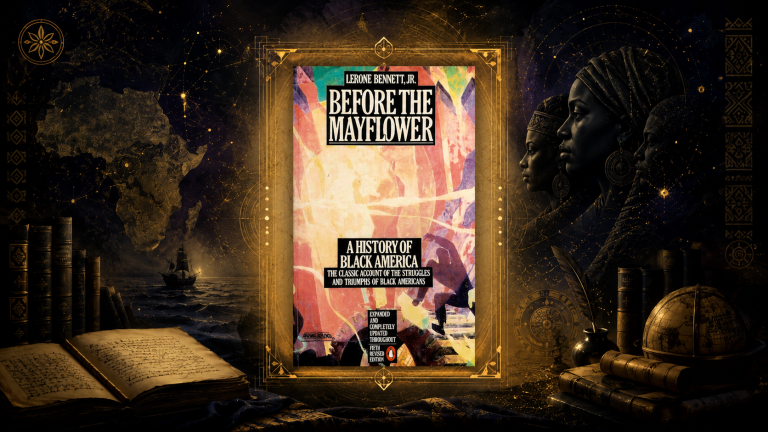
Before The Mayflower: A History of Black America, Lerone Bennett Jr.
http://www.biography.com/people/sojourner-truth-9511284#synopsis
http://www.history.com/topics/black-history/sojourner-truth
http://www.washingtonpost.com/wp-srv/style/longterm/books/chap1/sojournertruth.htm http://www.sojournertruth.org/Library/Archive/LegacyOfFaith.htm
https://docsouth.unc.edu/neh/truth50/truth50.html
https://www.nps.gov/people/sojourner-truth.htm
https://digitalcollections.archives.nysed.gov/index.php/Detail/objects/88246
https://www.nypl.org/blog/2022/09/29/court-records-sojourner-truth-legal-battle
https://teachingamericanhistory.org/document/remarks-at-the-womens-rights-convention
https://www.theatlantic.com/magazine/archive/2012/02/sojourner-truth-the-libyan-sibyl/308872
https://www.loc.gov/item/scsm000880
https://awpc.cattcenter.iastate.edu/communication/address-first-annual-meeting-american-equal-rights-association-may-9-1867
Read also Sojourner Truth in Life and Memory – Nell Irvin Painter