
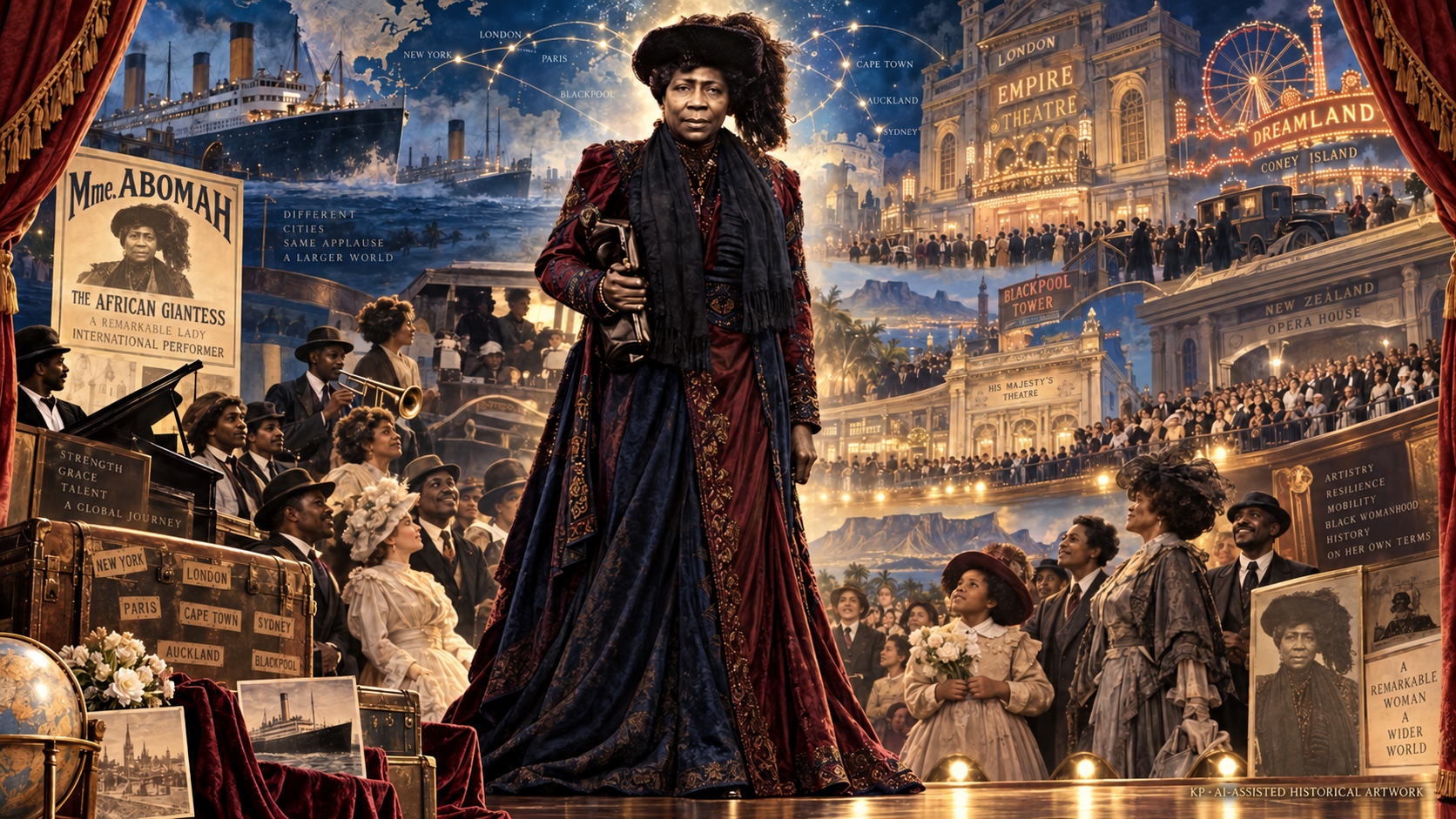
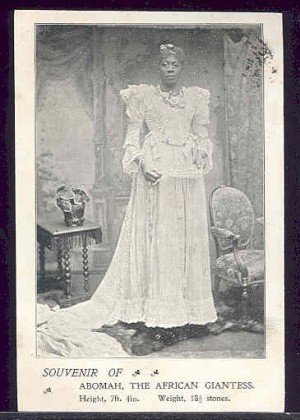
Mme. Abomah—also billed as the “Amazon Giantess” and the “African Giantess”—was an African American performer who became an international celebrity during the late nineteenth and early twentieth centuries. Promoters often advertised her as the world’s tallest woman. Her publicity gave her a height of 7 feet 6 inches, and at times even more, but photographs suggest that she was probably closer to 6 feet 10 inches or 6 feet 11 inches. Because no verified contemporary measurement has been located, her actual height should be treated as uncertain. What is beyond doubt is that she was exceptionally tall, and surviving photographs show her towering elegantly above those around her.
She was born Ella Grigsby near Cross Hill, Laurens County, South Carolina, in October 1865, only months after the formal abolition of slavery in the United States. As a teenager, she worked in Columbia, South Carolina, as a cook for Elihu and Harriet Williams, and she later became known as Ella Williams. In publicity and in many later accounts, she was known simply as Mme. Abomah.
In a 1915 statement attributed to her, Abomah recalled:
“I was born near Cross Hill in Laurens County. None of my sisters or brothers are unusually large. For years every time a showman saw me he would want me to sign a contract, but I never could make up my mind to leave Columbia. Finally, in the fall of 1896, while I was cooking for a prominent family in Columbia, Manager F. C. Bostock got me to sign up for a tour.”
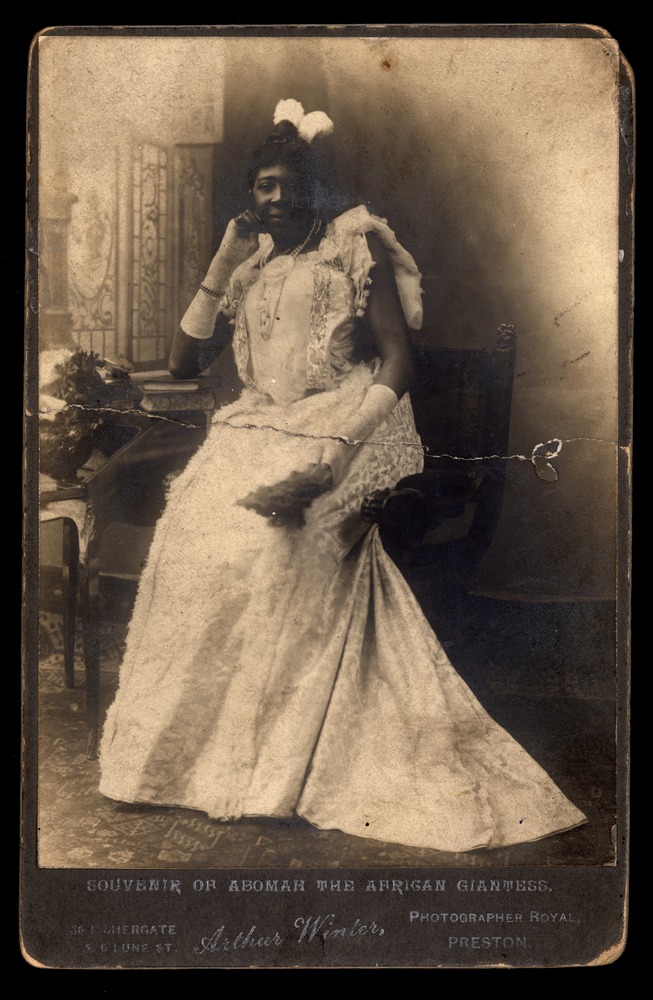
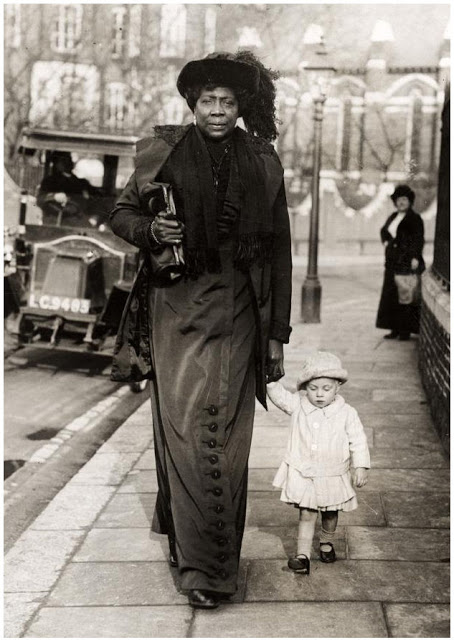
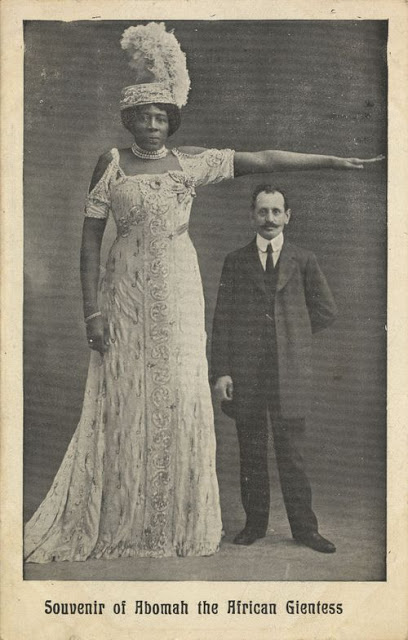

Frank C. Bostock, an English animal-show proprietor and impresario, engaged her for a tour of the British Isles in 1896. He fashioned a new stage identity for her: Mme. Abomah, probably a reference to Abomey, then the capital of the Kingdom of Dahomey, in what is now Benin. Bostock’s publicity presented her falsely as an African warrior princess and as one of the women soldiers of Dahomey—frequently and inaccurately called “Amazons” in European and American writing. Abomah was, in fact, an African American woman from South Carolina; the story was a colonial fantasy designed to sell an exhibition.
A British newspaper elaborated this invented history in 1900:
“She was formerly one of the attendants and body guard of the … King of Dahomey, whose Amazonian warriors have been famous alike for their prowess … Trained for her … calling from early childhood, she was inured to hardship and pain. Her stature increasing out of proportion to her years, she became a particular favorite of the monarch, and led his army. This extraordinary woman stands over eight feet in height, and can easily support the weight of a man on her outstretched hand. The dusky beauty, having recently evinced a strong desire to travel, and particularly to visit England, will no doubt soon pay a visit to some of our principal cities.”
— Tit-Bits, London, 7 September 1900
The article is important not as biography, but as evidence of the racialized promotional language that shaped Abomah’s public image. Her career offered her visibility and mobility across national boundaries, yet it also depended on an entertainment industry that commodified Black bodies and drew upon imperial myths of Africa.
Over roughly three decades, Abomah appeared in Britain, continental Europe, Australia, New Zealand, South America, Cuba, and the United States. A souvenir pamphlet sold during her engagements reportedly listed appearances with Reynold’s Waxworks and Exhibition in Liverpool in 1900; the Alhambra in Blackpool in 1901 and 1902; further engagements with Reynold’s in 1903; tours of Australia and New Zealand; a South American tour in 1909; European engagements in 1910 and 1911; English variety halls in 1914; Dreamland at Coney Island and Cuba in 1917; and Barnum & Bailey in 1918. Read these itineraries as promotional records, but newspaper coverage and surviving photographs confirm the broad international reach of her career.
In New Zealand, Abomah was presented with an elaborate wardrobe and an attendant, visual signals intended to reinforce the publicity image of royalty. Yet she was not merely displayed for her height. She also sang. The Otago Witness reported in 1904:
“On Saturday evening, at the Alhambra Theatre, Abomah, the Amazon giantess, made her first appearance before a Dunedin audience after a general tour of Otago and Southland. She stands 7ft 6in in height, is a full-blooded [Black woman], and was born in America. She is well-proportioned, and, needless to say, she completely dwarfs any average man or woman, and the expectations of the audience were more than realized, for the ‘tallest lady’ was everything that had been announced about her … Abomah, in addition to posing, contributed some songs, chief of which was ‘My Honolulu Bell,’ and she rendered this item in a pleasing voice and with good effect.”
— Otago Witness, 1904
The original article used language now recognized as racist; the bracketed wording above modernizes the description while preserving the report’s substance.
The outbreak of the First World War disrupted Abomah’s European engagements. Britain declared war on Germany in August 1914, and she appears to have returned to the United States in March 1915. She subsequently worked with Ringling Bros. and Barnum & Bailey and appeared at Coney Island venues including Dreamland. In 1920 and 1921, she was associated with the World’s Museum, and a 1921 notice announced a projected three-month engagement in Paris. Later evidence also places her at Coney Island in 1923 and at Pete Korte’s World’s Museum in Los Angeles in 1924.
The final years of Ella Williams’s life remain poorly documented. Her career did not end simply in the early 1920s, but the historical record becomes thin thereafter. That absence itself is revealing. Although Mme. Abomah traveled internationally, sang before audiences, and sustained a career across several decades, she has too often survived only through fragments: photographs, advertisements, brief newspaper notices, and the extravagant fictions constructed around her name.
Her story deserves to be remembered not as the tale of an exoticized “Dahomey Amazon,” but as that of Ella Grigsby Williams: a Black woman from South Carolina who navigated the racialized spectacle industry of her day and became a striking, widely traveled performer in her own right.
Source:
https://mashariazgitonga.blogspot.co.uk/2013/07/mme-abomah-african-giantess-tallest/
http://intothebeautifulnew.tumblr.com/post/
https://travsd.wordpress.com/2013-10-01/mme-abomah-the-african-giantess/
https://www.thetallestman.com/abomah/