

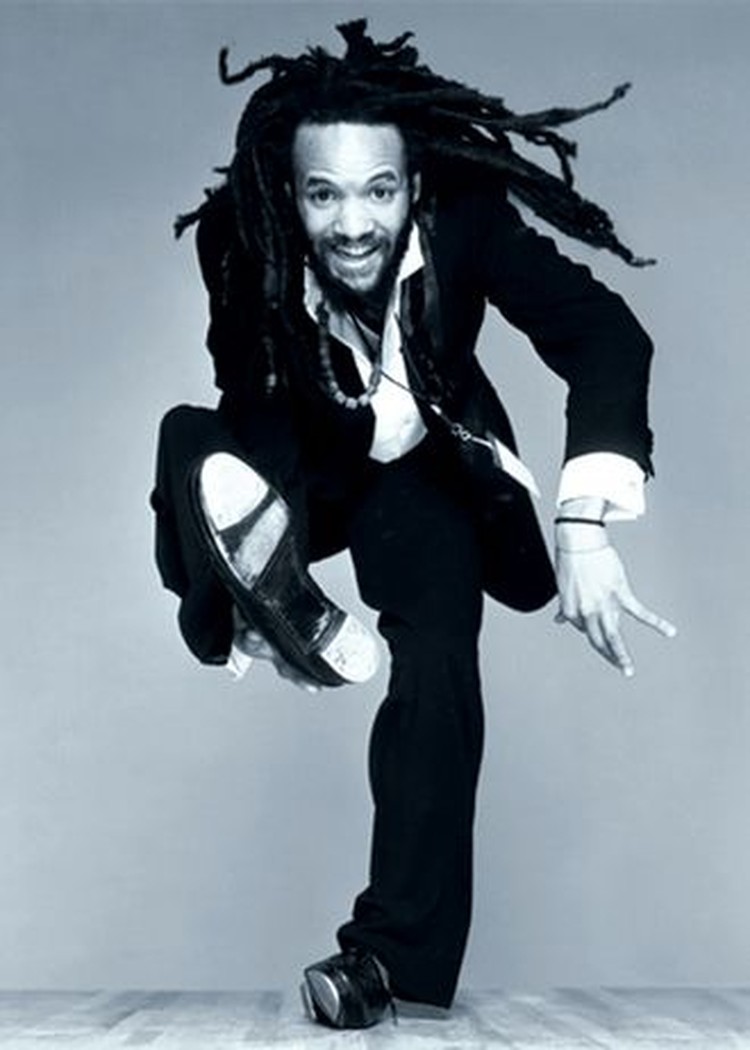
Savion Glover, born November 19, 1973, in Newark, New Jersey, is an American tap dancer, choreographer, and actor whose forceful, densely rhythmic style has helped redefine tap for modern audiences. Often described as “hitting,” his approach treats the floor as an instrument: the dancer’s feet generate not merely steps but intricate percussive phrases. Glover’s work has brought renewed public attention to tap, particularly among younger dancers, while insisting on the form’s Black cultural and musical lineage.
He grew up in a family shaped by music, performance, and athletic achievement. On his mother’s side, his great-grandfather Dick “King Richard” Lundy was a Negro League shortstop and manager. His grandfather Bill Lewis was a big-band pianist and vocalist. His maternal grandmother, Anna Mae Lundy-Lewis, was a gifted musician who served for many years as Minister of Music at New Point Baptist Church in Newark, where the Rev. S. L. Foote was pastor.
Anna Mae Lundy-Lewis was also central to the young Savion Glover’s early musical formation. In a 1995 profile, Glover’s mother, Yvette Glover, recalled that her mother first recognized her grandson’s unusual responsiveness to rhythm when he was an infant: as she hummed to soothe him, he smiled and hummed along. The same profile describes Anna Lundy-Lewis as having occasionally accompanied Whitney Houston in gospel performances.
Glover showed an affinity for rhythm from an early age. At four, he began drumming lessons, but advanced so quickly that they directed him to the Newark Community School of the Arts, where he became the youngest student in the school’s history to receive a full scholarship. At seven, he began tap lessons. Drawn especially to rhythm tap—the percussive tradition that uses the full foot to produce a range of sounds—he developed a lifelong commitment to dance’s music-making possibilities.

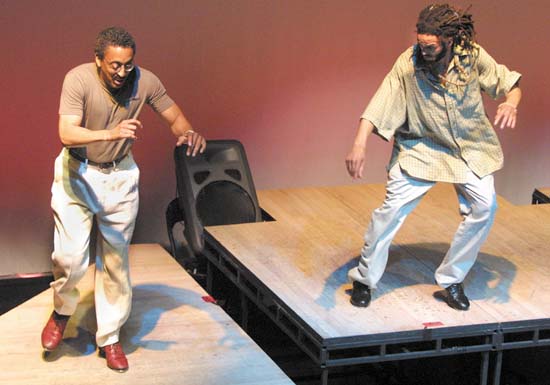
His Broadway career began at ten, in The Tap Dance Kid. He later appeared in Black and Blue from 1988 to 1989, earning a Tony Award nomination for Best Featured Actor in a Musical. In 1989, he made his film debut in Tap, alongside Gregory Hines. He also worked with and learned from major figures in tap, including Hines, Henry Le Tang, Jimmy Slyde, Honi Coles, Chuck Green, Buster Brown, Sammy Davis Jr., and Arthur Duncan.
Glover portrayed the young Jelly Roll Morton in George C. Wolfe’s Jelly’s Last Jam, which opened on Broadway in 1992. That same period established him as not only a performer but also a choreographer and teacher. In 1992, he became the youngest recipient of a National Endowment for the Arts grant. His most consequential theatrical work arrived with Bring in ’Da Noise, Bring in ’Da Funk. Conceived with director George C. Wolfe, the production used tap, song, spoken word, and theatrical tableaux to trace aspects of African American history. It opened Off-Broadway in 1995, transferred to Broadway, and won four Tony Awards in 1996, including Glover’s Tony Award for Best Choreography. The production demonstrated that tap could serve not simply as entertainment or virtuoso display, but as a language for history, memory, anger, celebration, and survival.
Glover also reached younger audiences through his regular appearances on Sesame Street between 1990 and 1995. In film, he played Manray/Mantan in Spike Lee’s Bamboozled (2000), appeared in the television film Bojangles (2001), and choreographed Mumble’s tap-dance movements in the animated films Happy Feet (2006) and Happy Feet Two (2011).
In 2005, Glover premiered Classical Savion, a work that placed his improvisatory tap in dialogue with classical music. He later opened the HooFeRzCLuB School for TaP in Newark in 2009, continuing his longstanding commitment to teaching and to the transmission of tap’s rhythmic vocabulary. His later work includes choreography for the 2016 Broadway production Shuffle Along; or, The Making of the Musical Sensation of 1921 and All That Followed, for which he received another Tony nomination.
Glover’s importance lies not only in his virtuosity but in the seriousness with which he has approached tap’s inheritance. His dancing hears the form as percussion, improvisation, and cultural memory. By connecting the art to jazz, hip-hop, African American social dance, and the work of earlier hoofers, he has helped make tap visible again as a living, evolving Black American art form.
Sources:
https://www.broadwaydancecenter.com/faculty/bios/glover_savion.shtml
http://www.britannica.com/biography/Savion-Glover
https://www.newyorker.com/magazine/1995/10/30/king-tap
https://www.thehistorymakers.org/biography/savion-glover
https://www.britannica.com/biography/Savion-Glover