
Paul Laurence Dunbar was a pioneering African American author who earned international recognition in the late nineteenth and early twentieth centuries. Renowned for his literary versatility, Dunbar produced a remarkable body of work distinguished by its formal mastery, wit, emotional depth, and profound exploration of Black inner life. His prolific output encompassed poetry, novels, and stage lyrics, including the first full-length musical written and performed by African Americans to be staged on Broadway. During his lifetime, Dunbar was celebrated for his dialect verse, but his enduring literary reputation also rests on his masterful poems in standard English. His influence reached far, inspiring and helping shape the literary inheritance of major figures such as Maya Angelou. Today, Dunbar’s legacy lives on in historic sites and educational institutions across the United States that proudly bear his name.
Paul Laurence Dunbar was born in Dayton, Ohio, on June 27, 1872. He came of age in the challenging aftermath of the Civil War, a time when emancipation had not brought true equality and racial discrimination continued to limit opportunities for African Americans in both the North and the South. Dunbar was the son of Joshua Dunbar and Matilda Murphy Dunbar, both originally from Kentucky. His father liberated himself from captivity through the Underground Railroad to Canada, then returned to fight for the Union in the 55th Massachusetts Infantry and the 5th Massachusetts Cavalry. His family’s history of bondage, liberation, military service, endurance, and ambition gave Dunbar a profound connection to African America’s recent past. These family stories became a foundation of his imagination, inspiring his creativity with themes of freedom, memory, and the resilience of ordinary Black people.
Dunbar’s parents separated when he was young, and his father, Joshua, died when Paul was just thirteen. Matilda Dunbar became the unwavering foundation of his life, learning to read so she could nurture his education. Under her devoted care, Dunbar’s talents emerged early: he wrote his first poem at six and reportedly gave his first public recitation at nine.
Dunbar attended Dayton Central High School as the only Black student in his class. Despite this isolation, he excelled academically and socially, becoming president of the literary society, editor-in-chief of the school newspaper, and class poet. Among his classmates was Orville Wright, with whom Dunbar developed a lasting friendship. Orville and his brother Wilbur later printed some of Dunbar’s early publications, giving a vital boost to the young writer’s ambitions. By his mid-teens, Dunbar had already published poems such as “Our Martyred Soldiers” and “On the River” in the Dayton Herald.
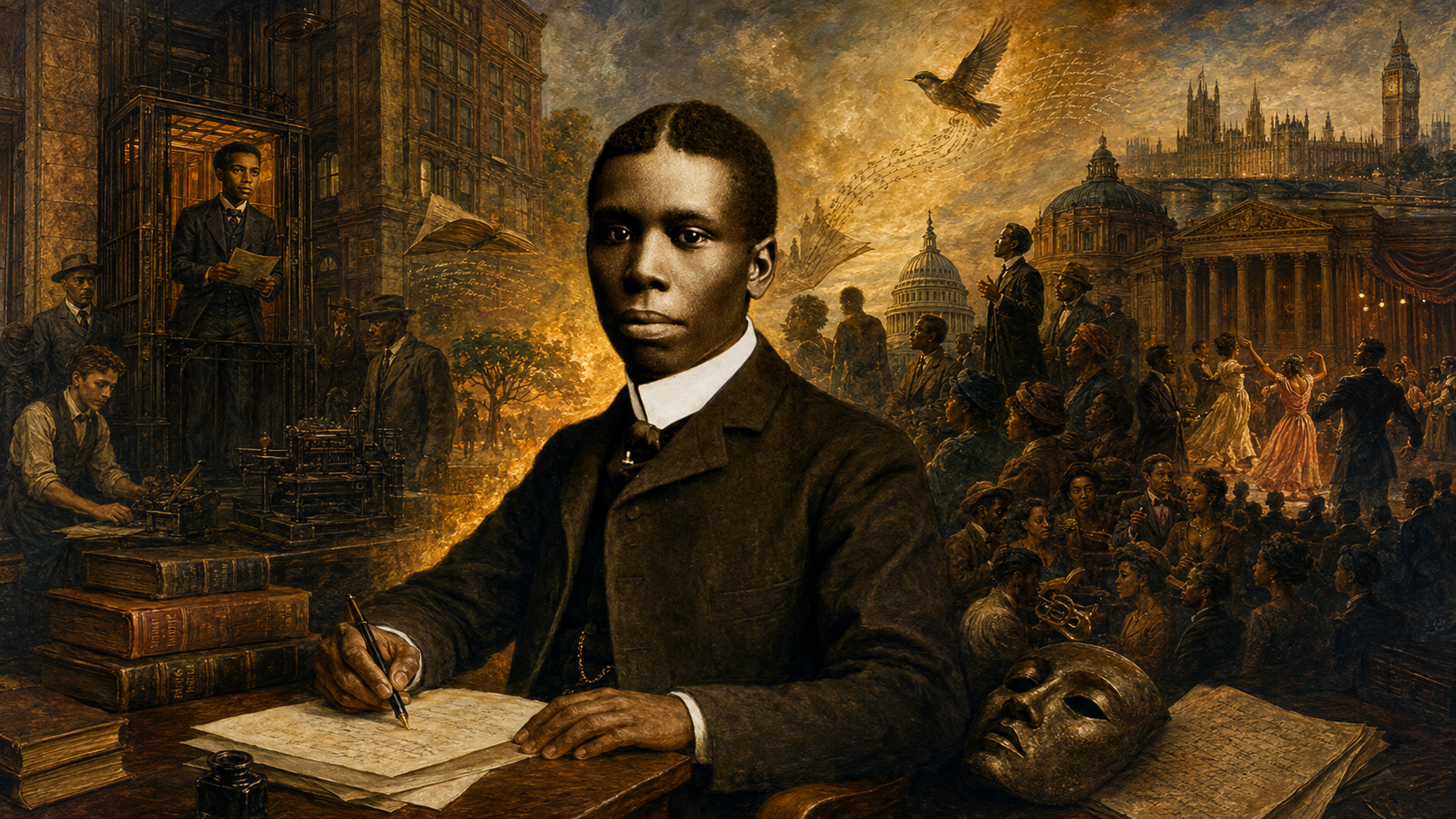
Despite his academic success, Dunbar could not escape the racial and economic barriers that shaped his adulthood. Although he aspired to study law, financial hardship and the restricted opportunities available to young Black men closed that door. Instead, he found work as an elevator operator in Dayton’s Callahan Building, earning just four dollars a week. The enduring image of Dunbar selling his books to passengers between elevator stops has become iconic, symbolizing both the injustices he faced and the extraordinary resolve with which he met them. He kept volumes of Keats, Shelley, and Shakespeare beneath his stool, seizing any spare moment to read and continuing to write amid the daily bustle of a segregated city.
In 1893, Dunbar self-published his first collection, Oak and Ivy, ingeniously selling copies for one dollar to passengers in his elevator and turning a constrained workplace into a platform for literary ambition. That same year, he traveled to the World’s Columbian Exposition in Chicago, where he met Frederick Douglass. The eminent abolitionist, recognizing Dunbar’s exceptional promise, called him “the most promising young colored man in America” and hired him as a clerk. Douglass’s encouragement connected Dunbar to the generation of Black leaders who had fought directly against enslavement, while Dunbar’s own achievements would come to define literary and cultural struggles in the post-emancipation era.
Dunbar’s national breakthrough came in 1896, when William Dean Howells, one of America’s most influential literary critics, praised Majors and Minors in Harper’s Weekly. Howells was particularly struck by Dunbar’s poems written in Black vernacular, then referred to as “Negro dialect.” This landmark review brought Dunbar national attention, and the publication of Lyrics of Lowly Life, with an introduction by Howells, cemented his status as a literary celebrity. In 1897, Dunbar embarked on a successful six-month reading tour of England, becoming an international representative of Black American literature.
Yet Dunbar’s acclaim came with a profound complication. He excelled in both vernacular verse and poetry in standard English—his “minors” and “majors,” as he called them. However, many readers, publishers, and critics within the dominant Euro-American literary establishment favored his dialect poems, especially those they believed depicted charming plantation scenes, Black humor, or sentimental folk characters. While Dunbar elevated vernacular poetry with music, dignity, emotional depth, and literary artistry, he resented being pigeonholed by a market that demanded he present only one version of Black life to predominantly Euro-American audiences. “I am tired, so tired of dialect,” he confided to a friend. This frustration foreshadowed a recurring dilemma in African American literary history: the tension between creative self-definition and the pressures of a marketplace intent on fixed racial types.
Dunbar’s literary reach extended far beyond poetry. In 1898, he married Alice Ruth Moore, a writer and teacher later renowned as Alice Dunbar-Nelson. The couple settled in Washington, D.C., where Dunbar accepted a clerkship at the Library of Congress. While the role granted him access to books and vital literary circles, the dusty environment worsened the tuberculosis that increasingly undermined his health. He eventually resigned to focus entirely on writing and lecturing. During these prolific years, Dunbar produced short stories, essays, novels, song lyrics, and poetry at a remarkable pace. His notable works from this period include the short-story collection Folks from Dixie and the novels The Uncalled, The Love of Landry, and The Fanatics. Some of these novels intentionally crossed the color line, reflecting Dunbar’s desire to be recognized as an American writer of broad imaginative range rather than as a Black writer, a category he felt was imposed on him.
Dunbar’s creative influence also extended to the stage. He wrote the lyrics for In Dahomey, which premiered in 1903 and became the first full-length musical written and performed by African Americans to be staged on Broadway. This groundbreaking production marked a major milestone in Black theatrical history, placing Black performers and creative talent at the center of one of America’s most prominent stages. It also underscored Dunbar’s role in a broader transatlantic cultural movement, one that connected Black musicians, actors, writers, and intellectuals as they worked to build vibrant institutions and audiences amid persistent racism.
The relentless pressures of work, illness, prejudice, and personal struggle took a devastating toll on Dunbar. By around 1900, he had developed tuberculosis, and his doctors, following the medical advice of the time, sometimes prescribed alcohol to ease his symptoms. This only deepened his dependency. His marriage to Alice Ruth Moore unraveled, and after a violent incident in 1902, the couple separated permanently, though they never formally divorced. This rupture marked a painful turning point in the lives of two exceptionally talented Black writers.
By 1904, Dunbar had returned to Dayton to live with his mother. Despite his declining health, he continued to write, publishing the 1905 collection Lyrics of Sunshine and Shadow. But tuberculosis, by then advanced beyond hope of recovery, ultimately claimed his life. Dunbar died at his mother’s home on February 9, 1906, at just thirty-three years old.
Although Dunbar’s life was tragically short, his achievements were extraordinary. He was among the first African Americans to sustain himself as a professional writer, moving between poetry, fiction, journalism, public readings, and the theater. He left behind twelve books of poetry, four novels, short fiction, essays, lyrics, and a legacy that helped make later Black literary movements imaginable. His career preceded the Harlem Renaissance, but it anticipated many of that movement’s central concerns: the dignity of ordinary Black life, the value of Black speech and folklore, the conflict between racial stereotype and self-representation, the psychological burden of racism, and the search for an artistic language adequate to Black experience.
Later writers did not all share Dunbar’s aesthetic choices, and some Harlem Renaissance critics worried that dialect poetry could perpetuate stereotypes. Yet they wrote in a literary landscape Dunbar had helped create. He showed that a Black writer could reach a national public, build a professional career, and command international attention. Dunbar’s legacy can be seen in the work and literary inheritances of writers as varied as Langston Hughes, Zora Neale Hurston, Margaret Walker, Nikki Giovanni, and Maya Angelou. Hughes and Hurston, each in distinct ways, would extend the literary use of Black vernacular language, folk tradition, humor, music, and oral culture.
Maya Angelou’s enduring connection to Paul Laurence Dunbar is powerfully reflected in her groundbreaking 1969 autobiography, I Know Why the Caged Bird Sings, a title drawn directly from Dunbar’s 1899 poem “Sympathy.” In Dunbar’s poem, the image of the caged bird, with its bruised wings and bleeding heart, becomes an unforgettable symbol of confinement and yearning for freedom. Angelou reimagined this symbol in the context of the civil rights era, infusing it with renewed relevance as she confronted racism, gendered violence, childhood trauma, and the struggle for voice and survival. Angelou recognized Dunbar as part of the African American literary lineage that shaped her own ambitions. The artistic bridge between these two writers demonstrates how a nineteenth-century poet’s vision of captivity became an enduring language of resistance and hope for generations to come.
If “Sympathy” gave Angelou the enduring image of the caged bird, “We Wear the Mask” stands as one of Dunbar’s most celebrated poems for its profound meditation on the psychological cost of racism. First published in his 1895 collection Majors and Minors, the poem opens with “We wear the mask that grins and lies,” immediately introducing the mask as both protection and indictment. Dunbar’s speakers conceal their anguish, presenting cheerful façades to a world unwilling to acknowledge their pain. The poem’s refrain, “We Wear the Mask,” is at once communal, disciplined, and laced with bitter wisdom. In language that anticipates and parallels W. E. B. Du Bois’s later formulation of double consciousness, Dunbar gave voice to the inner conflict of seeing oneself inwardly while performing for a prejudiced society.
While “We Wear the Mask” addresses the harsh racial realities of late nineteenth-century America—marked by lynching, segregation, disenfranchisement, and dehumanizing caricature—it also transcends its era, capturing a wider human experience. Dunbar’s poem resonates with those who have endured hidden suffering, adopted social masks, or grappled with the divide between outward appearance and private pain. Its concision, formal control, and emotional force explain why it has become one of his most enduring and frequently anthologized works.
Paul Laurence Dunbar’s legacy continues to resonate powerfully. His poetry has inspired composers from his own era to the present, while schools, libraries, and public institutions across the United States bear his name. His Dayton home, Ohio’s first state memorial dedicated to an African American, is now preserved as part of Dayton Aviation Heritage National Historical Park, and his inclusion among the 100 Greatest African Americans in 2002 reflects his enduring cultural stature. More than a celebrated poet of his own era, Dunbar was a foundational artist of Black American letters: a writer who gave language to the pressures of racial performance, the ache of constrained freedom, and the persistent determination to create. His work helped create the literary conditions for future generations to speak in their own voices.
Sources:
https://en.wikipedia.org/wiki/Paul_Laurence_Dunbar
https://poets.org/poet/paul-laurence-dunbar
https://www.poetryfoundation.org/poets/paul-laurence-dunbar
https://beltmag.com/compensation-paul-laurence-dunbar
https://theconversation.com/the-brief-but-shining-life-of-paul-laurence-dunbar-a-poet-who-gave-dignity-to-the-black-experience-191553
https://eduj.uowasit.edu.iq/index.php/eduj/en/article/view/469/424
https://woodlandcemetery.org/wp-content/uploads/bsk-pdf-manager/2025/09/A-Woodland-Minute-08102025-Dunbars-Willow.pdf