
“Anastacia, holy Anastasia,
You who were borne by Yemanjá, our mother,
Give us the strength to struggle each day
So we may never become [captives],
So that, like you, we may be rebellious creatures
May it be so. Amen”
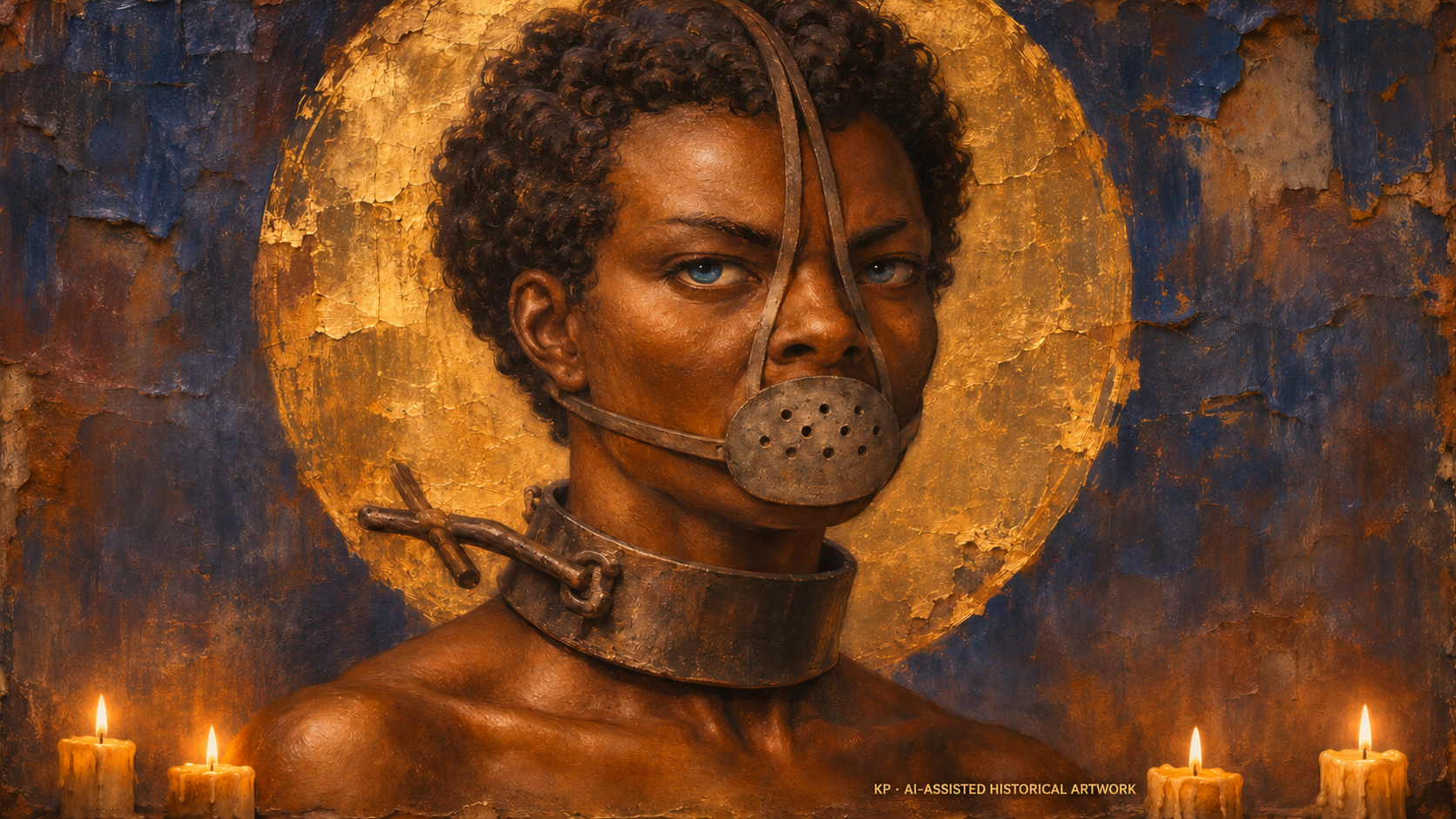
In Rio de Janeiro’s Museu do Negro, a nineteenth-century print acquired a name its maker had never given it: Anastácia. The print shows a Black person wearing an iron collar and a metal device covering the mouth. In later devotional images, the figure became a Black woman with piercing blue eyes. People brought prayers and petitions to her image, asking for healing, protection, and the strength to resist injustice. The Catholic Church has never canonized Anastácia, but for many devotees she is a saint.
The surviving record does not establish that a woman named Anastácia lived the life told in her legends. It does, however, allow two histories to be traced: the history of an illustration made during the Maafa in Brazil, and the history of the communities that transformed it into an image of faith and resistance.
From a nineteenth-century print to a popular saint
The image most closely associated with Anastácia comes from a drawing made by the French traveler Jacques Étienne Victor Arago during his visit to Brazil between 1817 and 1820. It later appeared as a lithograph in his travel memoir. In their study of the image, Jerome S. Handler and Kelly E. Hayes concluded that Arago had depicted an unidentified African man held in bondage, not a woman named Anastácia. The print was monochrome; the vivid blue eyes that distinguish many later portraits belong to the devotional image, not to the original. What the print does record is the use of an iron face covering as an instrument of punishment.
A turning point came in 1968, when a reproduction went on display in Rio during commemorations marking 80 years since Brazil’s legal abolition of human bondage. The print became associated with the Museu do Negro, housed in the same complex as the Church of Our Lady of the Rosary and Saint Benedict of Black Men and linked to a historic Black Catholic brotherhood. It was in this setting that the figure in the print came to be known as Anastácia. What had been published as an illustration of punishment became the focus of prayers, offerings, and stories about a woman who had refused to submit.
No single account fully explains how the figure in the print became the woman of the legends. What is clear is that the brotherhood’s museum gave the image a setting in which Black Brazilians could interpret it for themselves. Arago’s print showed what had been done to the person it depicted. The stories of Anastácia asked a different question: what had she done that those who held her captive were so determined to stop?
The lives told in her name
The stories give Anastácia different birthplaces, families, and lifetimes. In some, she was born in Brazil to an African woman who had been taken across the Atlantic. One version names her mother as Delminda, a woman of royal lineage who was subjected to sexual violence before Anastácia’s birth. Other accounts make Anastácia herself a woman of royal birth who was taken from Africa to Brazil. These are distinct traditions, not episodes that can be joined into a single documented life.
In one widely circulated account, a man from the household that held Anastácia captive pursues her and punishes her for refusing him. Some tellings say that he rapes her and forces her to wear the iron mask. In others, the mask is punishment for helping people escape or for defying those who claim the right to control her. The stories also remember her as a healer who helps others even as her own health fails. Where the mask brings about her death, it does not end her ability to act: in devotional tradition, people continue to turn to her for aid.
The differences between these accounts are part of their meaning. One version centers a Black woman’s right to refuse sexual coercion. Another remembers resistance as an obligation to those still in captivity. The healing stories give Anastácia a power that does not depend on the household that holds her. Across these accounts, the mask marks an effort to silence her, yet her story has been told and retold across generations.
The name Anastácia comes from the Greek word for “resurrection.” It is a fitting name for a figure whose story has survived so many retellings. Her legend can be read as an act of collective remembrance, honoring Black women who endured captivity in Brazil and who resisted coercion, cared for others, and helped people find freedom. Anastácia gives that memory a name without turning those many lives into a single, settled biography.
A saint beyond the altar
Devotion to Anastácia spread through prayer cards, statues, shrines, and offerings left in gratitude for help that devotees attributed to her. Her likeness also appeared outside places of worship, on clothing and in Black beauty salons. The same face could be a sacred presence to someone praying for protection and a declaration of Black dignity to someone who did not pray to her at all.
Her place in Brazilian religious life has never depended on a single institution. Some Afro-Catholic devotees appeal to her as an intercessor, asking her to act on their behalf. Practitioners of Umbanda, an Afro-Brazilian religion, also turn to her for protection and strength. These practices do not require identical beliefs about who Anastácia was. Nor did opposition from Catholic authorities end her veneration. In the late 1980s, church critics publicly challenged her historicity and the identification of Arago’s figure as Anastácia. Devotion continued in neighborhood shrines and other spaces beyond official Catholic worship.
The dispute over her status makes an important distinction visible. Canonization is a formal act of the Catholic Church. Popular sainthood is sustained by people who pray, tell stories, make offerings, and pass images from one household to another. Whatever the historical record can establish about Anastácia, the communities that have kept her memory alive are not in doubt.
Anastácia without the mask
In 2019, the Rio de Janeiro artist Yhuri Cruz created Anastácia Livre—Free Anastácia—as part of his Monument to the Voice of Anastácia. Cruz had first encountered her image through his mother, a devotee. In his version, he removed the device that covered Anastácia’s mouth and gave her a smile. He also produced prayer cards that visitors could take with them, carrying the new image into circulation in the same form that had helped spread devotion to the old one.
Cruz’s work does not ask viewers to forget what the iron mask recorded. It asks why an instrument of torture should remain the most recognizable feature of the woman who wore it. The earlier image bears witness to what was done to people held in bondage. Anastácia Livre makes room for something the original print could not show: how Anastácia might look when the people who tried to silence her no longer determine how she is seen.
Sources:
http://www.mattbranson.co.uk/page4/
http://usslave.blogspot.co.uk/2012/03-story-of-legendary-icon-anastacia.html
http://en.wikipedia.org/wiki/Escrava_Anastacia
http://www.nytimes.com/2000/05/21/arts-dance-both-a-slave-and-a-saint-she-lives-on.html
http://kathmanduk2.wordpress.com/2009/02/07-black-history-month-black-heroines-part-2-anastasia-patron-saint-of-brazils-blacks/