

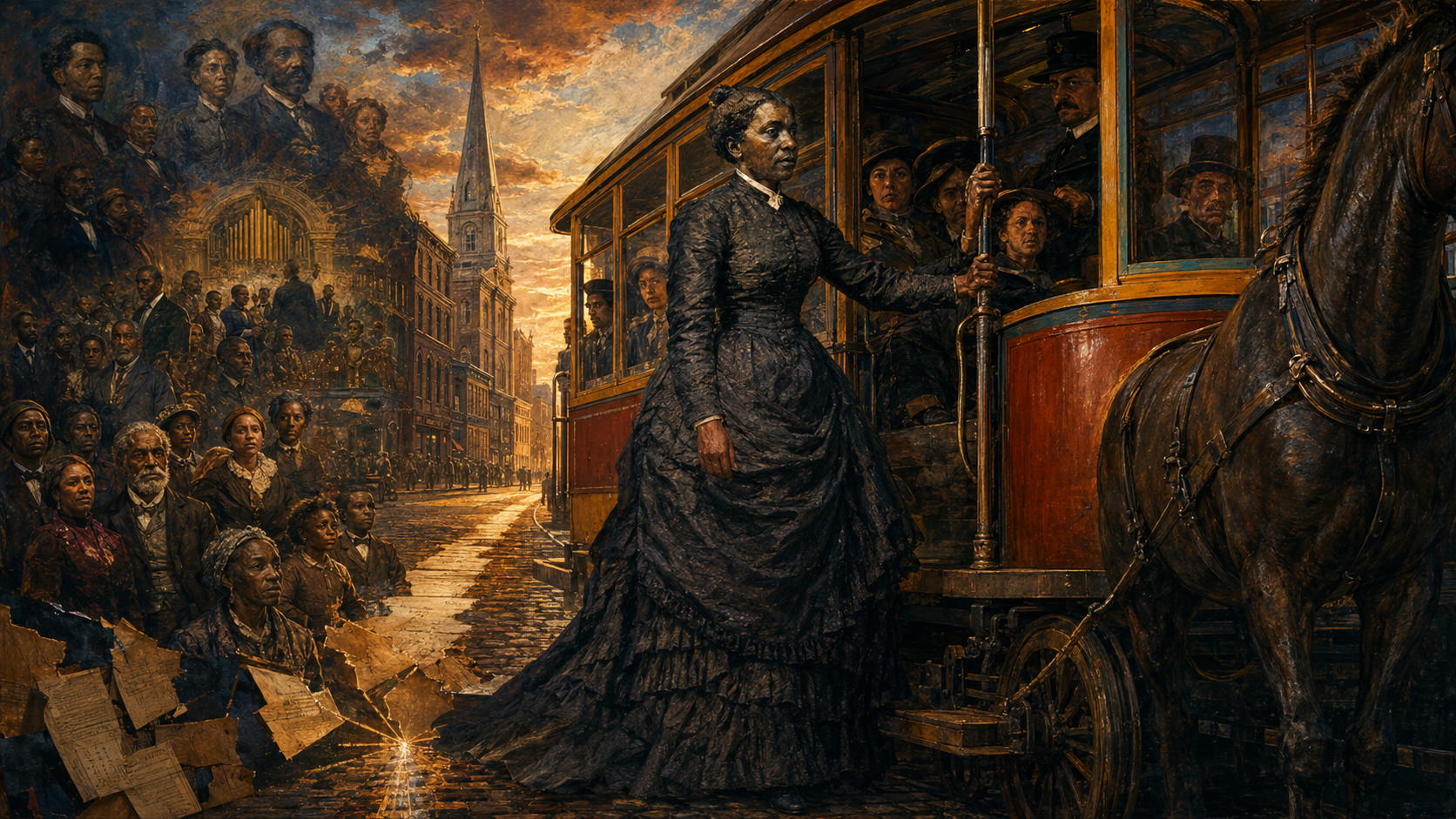
Elizabeth Jennings Graham (born Elizabeth Jennings, c. late 1820s–June 5, 1901) was a Black schoolteacher, church organist, and civil-rights pioneer in New York City. More than a century before Rosa Parks’s 1955 protest in Montgomery, Alabama, Jennings challenged racial exclusion on public transportation. After she was violently removed from a Third Avenue Railroad Company streetcar in 1854, she sued the company and won a landmark verdict in 1855. Her case helped propel the struggle that ended segregation on New York City’s street railways.
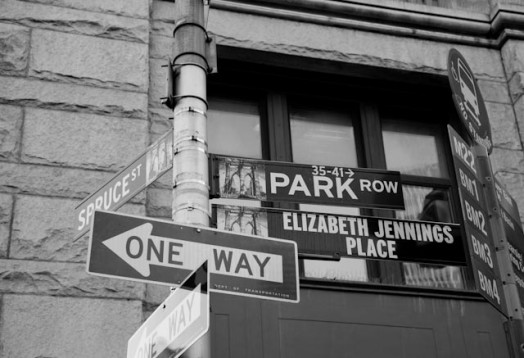

Elizabeth Jennings was born free in New York City to Thomas L. Jennings and Elizabeth Jennings. Sources differ on the year of her birth, and the precise date remains uncertain. Her parents belonged to New York’s small but influential Black middle class. Her father was an inventor, entrepreneur, abolitionist, and civic leader; in 1821, he became the first African American known to receive a United States patent, for a process known as “dry scouring,” a precursor to modern dry cleaning. He also supported and served as a trustee of the Abyssinian Baptist Church.
Like her father, Elizabeth was active in religious and civic life. She was an organist at the First Colored American Congregational Church. On Sunday, July 16, 1854, she and her friend Sarah Adams were travelling to church when they hailed a Third Avenue Railroad Company horse-drawn streetcar.
At the time, New York’s streetcar companies commonly practised racial exclusion. Some cars carried placards reading “Colored Persons Allowed,” but they ran infrequently. Black passengers were sometimes admitted to other cars at the discretion of drivers and conductors, often only if white passengers did not object.
The car Jennings and Adams attempted to board bore no such placard. The conductor initially told Jennings that she could enter but warned, “if the passengers raise any objections you shall go out.” Jennings later recalled answering that she was “a respectable person, born and raised in New York” and that the conductor was “a good for nothing impudent fellow for insulting decent persons while on their way to church.”
The conductor attempted to remove her. Jennings resisted, reportedly clinging first to a window frame and then to the conductor’s coat. When a police officer came to the conductor’s aid, the two men forcibly expelled her from the car. In her account of the assault, Jennings recalled being left on the pavement with her bonnet crushed and her dress soiled.
The attack provoked outrage in New York’s Black community. Jennings’s account was read at church the following day and reprinted in the New-York Daily Tribune and Frederick Douglass’ Paper. With community support, she retained the law firm of Culver, Parker and Arthur. The case was assigned to the firm’s junior partner, Chester A. Arthur, who would later become the twenty-first president of the United States.
At trial in Brooklyn in February 1855, Arthur argued that New York’s common-carrier law required the company to carry all sober, well-behaved passengers who were free from contagious disease. Judge William Rockwell instructed the jury that Black passengers possessed the same right to ride the streetcars as other passengers and could not be excluded by company rules, force, or violence. The all-white, all-male jury found for Jennings and awarded her $225 in damages and $22.50 in costs.
The Third Avenue Railroad Company agreed to desegregate its streetcar service immediately. Other companies continued discriminatory practices, however, and Thomas Jennings went on to found the Legal Rights Association to challenge segregation in public transportation. Through litigation, public advocacy, and organised protest, Black New Yorkers continued the campaign until the city’s transit system was desegregated by 1861.
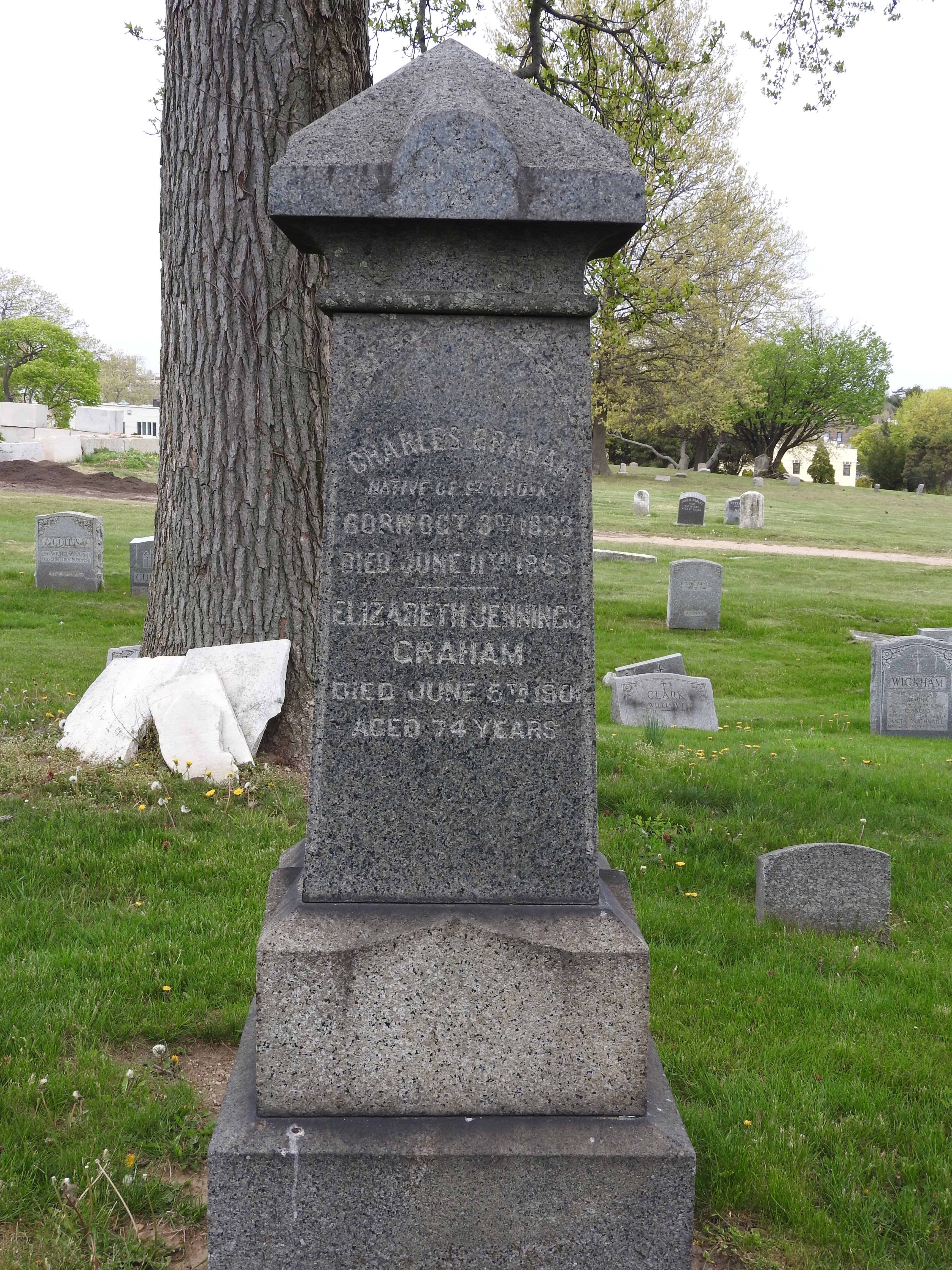
In 1860, Elizabeth Jennings married Charles Graham and thereafter became known as Elizabeth Jennings Graham. The couple had a son, Thomas, in 1862; he died in infancy. Charles Graham died later in the decade.
In her later years, Graham operated a kindergarten for Black children from her home. She continued this work until her death on June 5, 1901. She was buried in Cypress Hills Cemetery in Brooklyn, alongside members of her family.
Sources:
http://www.blackpast.org/aah/graham-elizabeth-jennings-1905
https://www.biography.com/people/elizabeth-jennings-graham-091415
http://www.nytimes.com/2005/11/13/nyregion/thecity/the-schoolteacher-on-the-streetcar.html?_r=0
https://history.nycourts.gov/case/jennings-third-ave/


One Response
Loved it!